AI Moves From Digital Discovery To Clinical Development in Biotechnology

16 NOV, 2026
By Alexander Roll from Global X ETFs Europe


Marketing Communication. Capital at risk. For Professional Investors Only.
Biotechnology has spent years promising faster research and more precise treatment. In 2026, that promise began to take shape in laboratories, late-stage trials and corporate investment. AI is helping scientists develop designs they can test in the lab, while genetic information is being used to monitor cancer and develop personalised treatments.1,2
The evidence now extends further along the development path. AI-designed proteins have bound their intended targets in laboratory tests.3 An AI-enabled drug candidate for a lung disease has entered Phase 3, and Merck and Moderna have reported positive topline Phase 3 results for a personalised cancer treatment.4,5
Companies are changing how research is organised. Anthropic has built a biology laboratory where scientists test ideas generated with Claude. Roche says it has begun building autonomous AI laboratories.6,7 AI is moving closer to the experiments that determine which ideas merit further study.8
These developments give the biotechnology theme a wider base. This paper updates our earlier analysis, The Platform Shift: AI, Genomics and the Patent Cliff Transforming Biotech M&A, in light of recent laboratory results, clinical developments and investment activity.
Key takeaways
- AI enters the experimental loop – Models are now designing proteins, generating hypotheses and informing experimental decisions. Laboratory results and an AI-designed drug entering Phase 3 provide more demanding tests of whether faster discovery can produce effective treatments.9,10
- Genomics is broadening its role in oncology – Sequencing is moving beyond treatment selection to shape personalised medicines, monitor patients after treatment and support the infrastructure needed for potential delivery at scale.11,12
- The patent cliff sustains demand for external innovation – As major drugs approach patent expiry, large pharmaceutical companies need external innovation to replenish their pipelines, supporting continued demand for approved treatments, late-stage programmes and differentiated technology platforms.13
AI enters the experimental loop
AI is beginning to move ideas from a computer into the laboratory. OpenAI introduced GPT Rosalind in April to help scientists search research, develop hypotheses and plan experiments.14 By September, the model was available globally to eligible organisations, with OpenAI working alongside Amgen, Moderna, Thermo Fisher Scientific and the Allen Institute.15,16
In August, Claude models designed proteins intended to bind to a range of targets.17 Adaptyv Bio and Twist Bioscience produced and tested the designs, confirming binders for 14 of the 15 targets that could be evaluated.18 Further studies would be needed to assess their therapeutic potential.
The next challenge is making that process routine. Reuters reported in September that Anthropic had built a biology laboratory in the San Francisco Bay Area, where scientists can test ideas generated by Claude and explore AI-directed robotic equipment under human oversight.19
Adoption is widening among established drugmakers. Novo Nordisk and Anthropic announced a collaboration in September covering medicine discovery and software development.20 Roche went further and said it had begun building autonomous AI laboratories and reported that 40 percent of pipeline decisions from the fourth quarter of 2025 through the second quarter of 2026 had a tracked AI or computational contribution.21,22 It expects its Target Nexus tool to contribute to 80 percent of research portfolio decisions by the end of 2026.23 These figures show how quickly AI is entering research decisions. Its effect on clinical outcomes remains to be established.
Pharmaceutical companies are also committing capital to faster research. Eli Lilly agreed to pay Insilico Medicine $115 million upfront to search for treatments across several disease areas, with the agreement potentially reaching about $2.75 billion if development and sales milestones are met.24
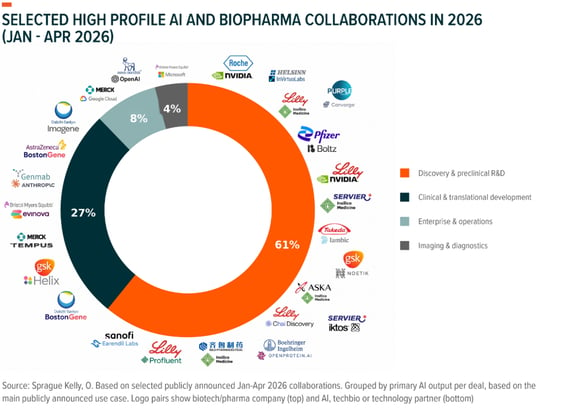
McKinsey found that selected AI-enabled programmes reached first-in-human or equivalent preclinical milestones 15 to 80 percent faster than relevant large-pharma benchmarks.25 Yet most AI-native clinical assets remain in Phase 1 or Phase 2, so their effect on later clinical success is still unclear.26
Insilico’s lead drug, rentosertib, offers a more advanced test.27 The AI-enabled candidate is being developed for idiopathic pulmonary fibrosis (IPF), a disease that scars the lungs. The first patient in its Phase 3 trial received a dose on 10 September.28 In a 12-week Phase 2a study of 71 patients, the highest-dose group improved by an average of 98.4 mL on a lung-function test, compared with a 20.3 mL decline in the placebo group.29 The Phase 3 trial is expected to enrol 320 patients in China and will track lung function over 52 weeks, testing whether that early signal persists in a larger and longer study.30
Genomics is broadening its role in oncology
The clearest recent genomics milestone came from Moderna and Merck. Their Phase 3 study tested intismeran, a personalised treatment designed from the genetic sequence of each patient’s tumour, in combination with Keytruda.31 The study involved 1,137 people whose high-risk melanoma had been removed by surgery.32 Adding intismeran to Keytruda extended the time patients remained free from recurrence or spread compared with Keytruda alone.33 The medicine teaches the immune system what to attack, while Keytruda then helps the immune system act on that information by releasing a brake that cancer can exploit. Producing individualised medicines for hundreds of participants could indicate that personalised manufacturing can operate at meaningful clinical-trial scale.34
Delivering such a treatment also requires diagnostic infrastructure. In October, Tempus expanded its collaboration with Moderna and Merck to manage the collection and transfer of tumour and blood samples. Subject to regulatory approvals, Tempus will also provide genetic sequencing to support the design and manufacture of intismeran as the companies prepare for possible commercial use.35 Important evidence is still missing. The Phase 3 result is promising, but the companies have yet to publish the detailed data. Whether patients live longer remains under study, and commercial use still requires regulatory approval.
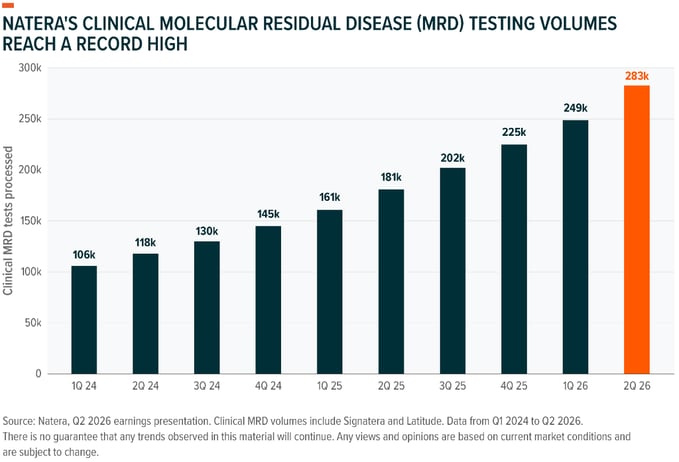
The commercial opportunity also extends to monitoring patients after treatment. Natera processed approximately 57% more oncology tests in the second quarter of 2026 than a year earlier.36 These blood tests detect fragments of tumour DNA that may remain after surgery or treatment, potentially warning doctors earlier that cancer is returning.37 Total revenue rose 37.7 percent to $752.8 million, and the company raised the midpoint of its annual revenue guidance by $100 million.38
The patent cliff sustains demand for external innovation
The business pressure behind biotechnology deals remains straightforward. When a successful medicine loses patent protection, lower-priced competitors can enter and sales can fall quickly. Several major products face this point by 2030.39 Internal research rarely produces enough replacements on the required timetable, so large drug companies continue to buy or license medicines developed elsewhere.40 Smaller biotechnology companies still face costly financing, making a well-capitalised buyer especially important.41
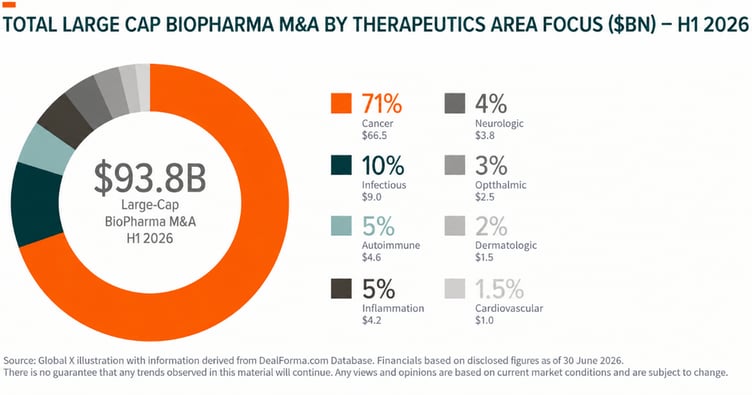
Oncology attracted a particularly large share of this capital. Cancer-focused transactions represented $66.5 billion, or 71%, of the $93.8 billion in disclosed large-cap biopharma M&A during the first half of 2026.42
BioWorld recorded an overall $186.69 billion of biopharma deal value in the first seven months of 2026, 13% more than a year earlier, while completed transactions fell to 674 from 718.43 Buyers appear willing to spend on fewer programmes with clearer evidence or a strong fit with existing expertise.
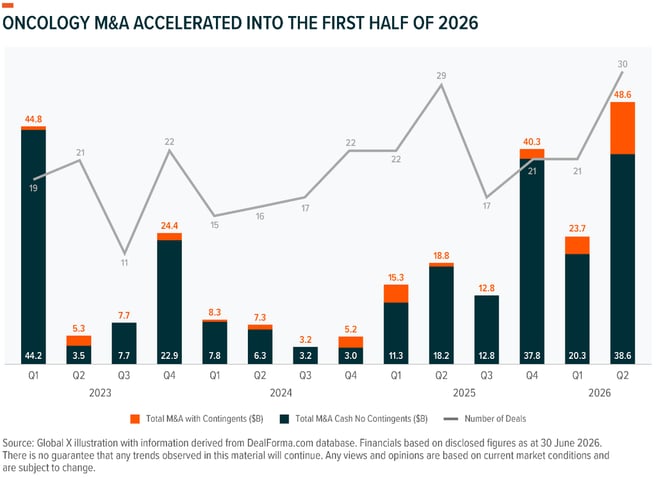
Recent transactions show how buyers are managing that risk. Vertex agreed to pay about $10 billion for Crinetics, gaining an approved rare-disease medicine and a second treatment in late-stage development.44 AstraZeneca chose a partnership, agreeing to invest $2 billion in Summit Therapeutics and test Summit’s cancer drug alongside its own medicines.45 BioMarin made an earlier-stage bet on Alesta, paying $275 million upfront and up to $215 million more if agreed development and regulatory milestones are met.46 These acquisition, equity and licensing structures give buyers different ways to stage their exposure to external science.
Conclusion
Laboratory results, clinical trials and new deals give investors more evidence with which to assess biotechnology’s progress. The next clinical results will show which approaches benefit patients. Their commercial value will also depend on regulatory approval and the ability to manufacture and deliver treatments at a viable cost.
Footnotes
1. OpenAI. Introducing GPT-Rosalind for Life Sciences Research. 21 April 2026.
2. Natera. Natera Reports Second Quarter 2026 Financial Results. 6 August 2026.
3. Anthropic. How Claude is accelerating protein design and analytical chemistry. 18 August 2026.
4. Insilico Medicine. Insilico Initiates Phase III Clinical Trial of Rentosertib for Idiopathic Pulmonary Fibrosis. 7 July 2026
5. Merck and Moderna. Merck and Moderna Announce Phase 3 INTerpath-001 Trial of Intismeran Autogene Plus KEYTRUDA Met Endpoints of Recurrence-Free Survival and Distant Metastasis-Free Survival in Patients With Completely Resected Stage IIB–IV Melanoma. 19 August 2026.
6. Reuters. Anthropic sets up Bay Area biology laboratory for AI drug research. 18 September 2026.
7. Roche. Revolutionizing drug R&D with Lab in a Loop. Pharma Day 2026 presentation. 28 September 2026.
8. Ibid.
9. Anthropic. How Claude Is Accelerating Protein Design and Analytical Chemistry. 18 August 2026.
10. Insilico Medicine. Insilico Medicine Doses First Patient in GENESIS-IPF-3, the World’s First Phase III Trial of a Generative AI-Driven Innovative Drug. 10 September 2026.
11. Merck and Moderna. Merck and Moderna Announce Phase 3 INTerpath-001 Trial of Intismeran Autogene Plus KEYTRUDA Met Endpoints of Recurrence-Free Survival and Distant Metastasis-Free Survival in Patients With Completely Resected Stage IIB–IV Melanoma. 19 August 2026.
12. Natera. Natera Reports Second Quarter 2026 Financial Results. 6 August 2026.
13. Bank of America Institute. Pharma Patent Cliff Fuels Biotech M&A and Acquisition Demand. 13 July 2026
14. OpenAI. Introducing GPT-Rosalind for Life Sciences Research. 21 April 2026
15. Ibid.
16. OpenAI. Introducing GPT-Rosalind for Life Sciences Research. Updated 11 September 2026.
17. Anthropic. How Claude is accelerating protein design and analytical chemistry. 18 August 2026.
18. Ibid.
19. Reuters. Anthropic sets up Bay Area biology laboratory for AI drug research. 18 September 2026.
20. Novo Nordisk. Novo and Anthropic will collaborate to advance drug discovery with Claude. 16 September 2026.
21. Roche. Revolutionizing drug R&D with Lab in a Loop. Pharma Day 2026 presentation. 28 September 2026; Reuters. Roche outlines plans to move towards autonomous AI labs. 28 September 2026.
22. Roche. Revolutionizing drug R&D with Lab in a Loop. Pharma Day 2026 presentation. 28 September 2026
23. Ibid.
24. Insilico Medicine. Insilico Medicine Announces Global R&D Collaboration with Lilly. 29 March 2026.
25. McKinsey & Company. AI drug discovery: Focusing on what matters most. 21 September 2026.
26. Ibid.
27. Insilico Medicine. Insilico Medicine Doses First Patient in GENESIS-IPF-3, the World’s First Phase III Trial of a Generative AI-Driven Innovative Drug. 10 September 2026.
28. Ibid.
29. Ibid.
30. Ibid.
31. Merck and Moderna. Merck and Moderna Announce Phase 3 INTerpath-001 Trial of Intismeran Autogene Plus KEYTRUDA Met Endpoints of Recurrence-Free Survival and Distant Metastasis-Free Survival in Patients With Completely Resected Stage IIB–IV Melanoma. 19 August 2026.
32. Ibid.
33. Ibid.
34. Ibid.
35. Tempus. Tempus Announces Multi-Year Collaboration with Moderna and Merck. 7 October 2026.
36. Natera. Natera Reports Second Quarter 2026 Financial Results. 6 August 2026.
37. Natera. Signatera. Circulating Tumor DNA Blood Test. Accessed 8 October 2026.
38. Natera. Natera Reports Second Quarter 2026 Financial Results. 6 August 2026.
39. Bank of America Institute. Pharma Patent Cliff Fuels Biotech M&A and Acquisition Demand. 13 July 2026.
40. Ibid.
41. Ibid.
42. Harutyunyan, A. DealForma. Large-Cap BioPharma M&A – H1 2026 Review. 9 September 2026.
43. BioWorld. July Defies Summer Slowdown as Biopharma M&A Hits Year’s Highest Month. 1 September 2026.
44. Vertex Pharmaceuticals and Crinetics Pharmaceuticals. Vertex to Acquire Crinetics Pharmaceuticals. 6 July 2026.
45. AstraZeneca. AstraZeneca Announces Strategic Equity Investment and Clinical Collaboration With Summit Therapeutics to Advance Leading ADC Combination Strategy in Cancer. 28 September 2026.
46. BioMarin. BioMarin to Acquire Alesta Therapeutics to Gain ALE1, a Potential First Oral Therapy for Hypophosphatasia, Adding an Important Clinical Program to BioMarin’s Pipeline. 18 August 2026.
Important information
This communication is for Professional Investors only and should not be used with, nor relied upon by, retail clients. It is for use only by the recipient and should not be forwarded to a third party.
The Global X UCITS ETFs are regulated by the Central Bank of Ireland.
This is a marketing communication.
Please refer to the relevant prospectus, supplement, and the Key Information Document (“KID”) of the relevant UCITS ETFs before making any final investment decisions.
Investors should also refer to the section entitled “Risk Factors” in the relevant prospectus of the UCITS ETFs in advance of any investment decision for information on the risks associated with an investment in the UCITS ETFs, and for details on portfolio transparency. The relevant prospectus and KID for the UCITS ETFs are available in English at www.globalxetfs.eu/funds.
Investment in the UCITS ETFs concern the purchase of shares in the UCITS ETFs and not in a given underlying asset such as a building or shares of a company, as these are only the underlying assets that may be owned by the UCITS ETFs.
A UCITS ETF’s shares purchased on the secondary market cannot usually be sold directly back to a UCITS ETF. Investors must buy and sell shares on a secondary market with the assistance of an intermediary (e.g. a stockbroker) and may incur fees for doing so. In addition, investors may pay more than the current net asset value when buying shares and may receive less than the current net asset value when selling them. Changes in exchange rates may have an adverse effect on the value price or income of the UCITS ETF.
Past performance of a UCITS ETF does not predict future returns. Future performance is subject to taxation which depends on the personal situation of each investor, and which may change in the future. Neither past experience nor the current situation are necessarily accurate guides to the future growth in value or rate of return of a UCITS ETF.
Investment may be subject to sudden and large falls in value, and, if it is the case, the investor could lose the total value of the initial investment. Income may fluctuate in accordance with market conditions and taxation arrangements. The difference at any one time between the sale and repurchase price of a share in the UCITS ETF means that the investment should be viewed as medium term to long term.
Any investment in a UCITS ETF may lead to a financial loss. The value of an investment can reduce as well as increase and, therefore, the return on the investment will be variable.
Global X ETFs ICAV is an open-ended Irish collective asset management vehicle issuing under the terms of its prospectus and relevant supplements as approved by the Central Bank of Ireland and is the issuer of certain of the ETFs where stated.
Global X ETFs ICAV II is an open-ended Irish collective asset management vehicle issuing under the terms of its prospectus and relevant supplements as approved by the Central Bank of Ireland and is the issuer of certain of the ETFs where stated.
Communications issued in the European Union relating to Global X UCITS ETFs are issued by Global X Management Company (Europe) Limited (“GXM Europe”) acting in its capacity as management company of Global X ETFs ICAV. GXM Europe is authorised and regulated by the Central Bank of Ireland. GXM Europe is registered in Ireland with registration number 711633.
Communications issued in the United Kingdom and Switzerland relating to Global X UCITS ETFs are issued by Global X Management Company (UK) Limited (“GXM UK”), which is authorised and regulated by the Financial Conduct Authority. The registered office of GXM UK is 77 Coleman St, London, EC2R 5BJ, UK. Information about GXM UK can be found on the Financial Services Register (Firm Reference Number 965081).
GXM Europe may terminate marketing arrangements.
Information for Investors in the United Kingdom
Please refer to the relevant prospectus, supplement, and the Key Investor Information Document (“KIID”) of the relevant UCITS ETFs before making any final investment decisions. These are available in English at www.globalxetfs.eu
The Financial Ombudsman Service is unlikely to consider complaints relating to the ETF and any claims for losses relating to the manager and the Depositary of the ETF are unlikely to be covered under the Financial Services Compensation Scheme.
Information for Investors in Switzerland
This is an advertising document. The state of the origin of the fund is Ireland. In Switzerland, the representative is 1741 Fund Solutions AG, Burggraben 16, CH-9000 St.Gallen. The paying agent is Tellco Bank AG, Bahnhofstrasse 4, 6430 Schwyz.
The prospectus, the key information documents, the articles of association as well as the annual and semi-annual reports may be obtained free of charge from the representative.
Past performance is no indication of current or future performance. The performance data do not take account of the commissions and costs incurred on the issue and redemption of units.