How does the Allianz Global Artificial Intelligence Fund Invest?

20 MAY, 2024
By Andrea Sepúlveda from LatamSelf


The Allianz Global Artificial Intelligence fund is a thematic equity fund - mainly from North America - domiciled in Luxembourg, which was launched in mid-2018 and is classified as article 8 according to the SFDR. Therefore, although its main objective is not sustainability, it still includes a minimum quota of such instruments.
In this analysis we see all its characteristics and the opportunities it offers to investors.
Characteristics of the Allianz Global Artificial Intelligence fund
This fund is actively managed and has a benchmark that combines global equity and a thematic index to give a specific inclination to the fund.
Regarding the management company, Allianz manages assets for over 530 billion euros for institutional and private investors around the world. Among its strategies are equity, fixed income, private markets and multi-asset. It is noteworthy that they do not have a headquarters, as they declare that their center of gravity are the customers. They therefore have more than 600 professionals in 20 offices distributed between Europe, North America and Asia Pacific.
- Investment strategy: As the name suggests, the fund's strategy is to invest in companies related to artificial intelligence, with at least 70% of its assets invested in shares of companies operating in this sector. Among these companies there may be software developers, chip manufacturers and automation companies. The fund's thesis is that this sector is constantly evolving and offers a potential for high profitability in the long term, which is why investors are recommended to keep the fund for no less than 5 years.
- Benchmark index: Its benchmark is: 50% MSCI AC World (ACWI) NR + 50% MSCI World Information Technology NR. The team declares to use this benchmark only for comparison purposes, even if, despite there being considerable differences in terms of subsectors, countries or relative weights of the instruments, they believe that their underlying assets are still included in the benchmark.
- Investment Team: The fund's team is led by Sebastian Thomas, with over 22 years of experience, who also leads the technology and telecommunications analysis team in the United States, and is responsible for covering large and medium capitalization internet software and technology companies. Before joining Allianz in 2003, he worked at Roger Engemann & Associates, a Phoenix Investment Partners company, Fidelity, Morgan Stanley and the Board of Governors of the Federal Reserve.
- Assets: as of the end of March 2024, the strategy had nearly 7.4 billion euros in assets under management.
Evolution of the Allianz Global Artificial Intelligence Fund

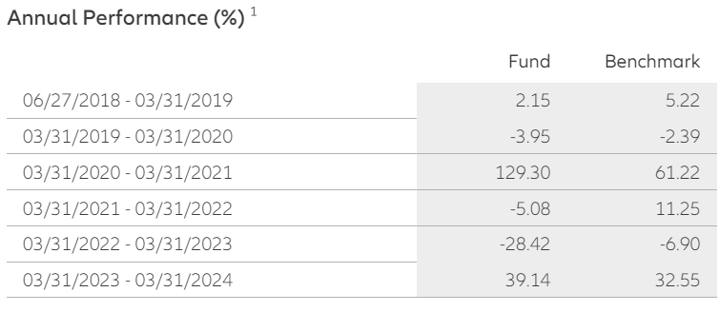
Given the launch date of the specific fund, we know we can have a sufficient history to evaluate the fund's performance results up to 5 years, which can be useful for assessing the consistency of the fund.
We also know that the fund's team recommends keeping the instrument long term to best exploit the potential of company selection. However, looking at the evolution of the fund, it can be seen that it has struggled to maintain consistency in its results over different time horizons. It is important to mention that one of the variables that institutional investors appreciate most is precisely consistency. It doesn't matter if a fund is second or third, but it is important that it stays in that position. Basically, having some certainty about what to expect from the fund.
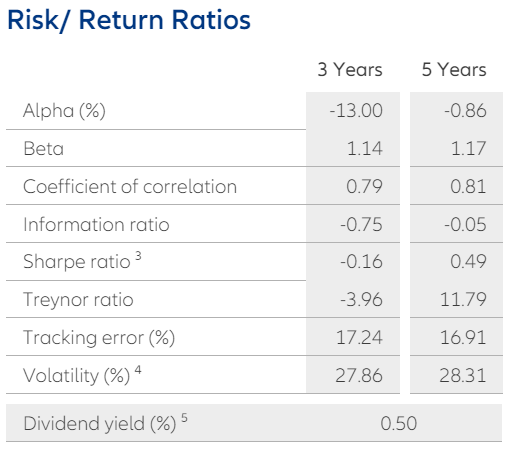
As for risk metrics, the management company presents them in the fund's monthly fact sheet. Again, we will examine the 5-year data compared to its benchmark.
The first thing that stands out is the alpha, which corresponds to what was previously observed in the performance results. Therefore, the investment team has not managed to outperform the performance of its benchmark in two important time horizons for an institutional assessment.
As for the market Beta, this is higher than 1 in the periods of 3 and 5 years, showing consistency. The team consistently takes more risk than its reference market, although, considering other ratios such as Sharpe or Information Ratio, it can be seen that this has not necessarily led to better results.
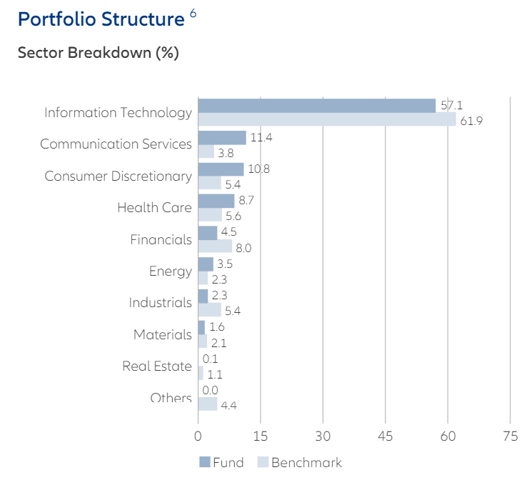
Here you can see that the fund's theme in Artificial Intelligence does not necessarily mean that it will have a greater investment in sectors such as Information Tech, but it has diversified into other sectors to include more investments in companies from sectors such as Health Care and Consumption.
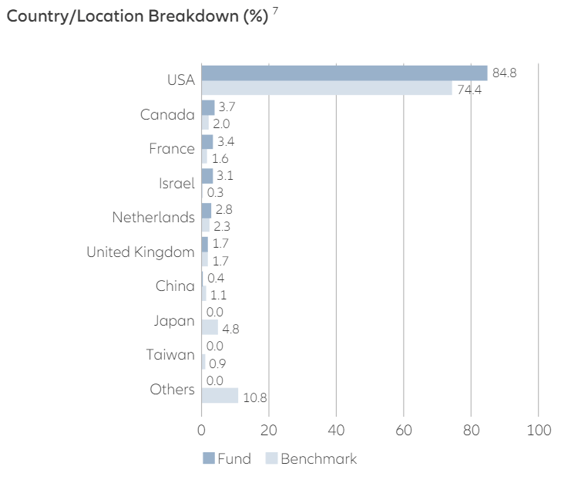
On the other hand, as far as regional positioning is concerned, although the fund is global - like its benchmark - it was mentioned at the beginning of the analysis that the fund is mainly focused on North America, most likely because the team sees better opportunities in this market and due to the experience and knowledge of this market by the fund manager.
Conclusions
Advantages
- Management company recognized globally for its active management
- Institutional size and more than 5 years of history
- Theme declared by many as the current growth trend.
Disadvantages
- The fund finds it difficult to maintain consistency in its results, which affects its risk and return ratios.