Analysis of the Fidelity Funds – Global Industrials Fund

19 JUL, 2024
By Andrea Sepúlveda from LatamSelf



The fund Fidelity Funds - Global Industrials is a global industrial sector fund domiciled in Luxembourg, launched in the year 2000, which has achieved good results compared to its peers and its category and which, for this reason, has received awards and ratings assigned by important financial information platforms worldwide.
Below we see its characteristics and the opportunities it offers to investors.
Characteristics of the Fidelity Funds - Global Industrials fund
The main features of this strategy are:
- Investment strategies: although it is a sectoral thematic fund, the strategy involves investments in various sub-sectors within the industrials, such as: Industrial and Chemical, Metallurgical and Mining, and Energy. Within these sub-sectors, the investment team makes a bottom-up selection of quality companies - which present a reasonable value while offering sustainable or strengthened competitive advantages, i.e. companies that may be subject to changes in their business or industrial structure.
- Benchmark index: Given the approach of the strategy, its benchmark is the MSCI AC World Industrials + Materials + Energy Index as it thus considers the various sub-sectors in which the fund invests. However, it is important to mention that such benchmark is used to review the investable universe, for risk monitoring and performance comparison. The team adopts an active selection for its portfolio.
- Investment team: the fund's team is led by Ashish Bhardwaj, who joined Fidelity in 2009 as part of the equity investment teams and then became the portfolio manager of this strategy in 2015. Furthermore, since mid-2019 Ashish is co-PM for the America and American Special Situations funds. Fidelity, for its part, has global resources and access to in-depth research that supports the investment team's decision-making process.
- Assets: As of the end of May 2024, this specific strategy had just over 600 million EUR in assets under management.
- Investment company: As for Fidelity in particular, it is a management company with over 50 years of history, which has more than 25 offices globally and with assets under management exceeding 800 billion USD.
Evolution of the Fidelity Funds - Global Industrials fund
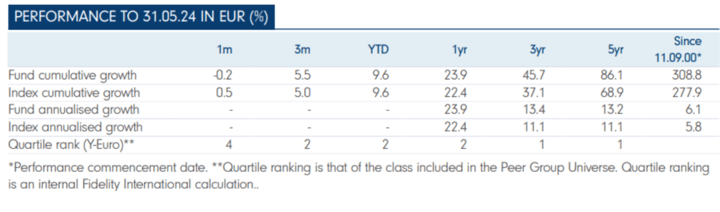
Note: Past performance does not predict future performance. The fund's returns may increase or decrease due to exchange rate fluctuations.
The fund was launched in 2000 and the change of the portfolio manager occurred in 2009, so there is enough time to examine the 1, 3 and 5 year performance results at least. As always, the strategy is sought to be able not only to outperform the benchmark, but also to do so consistently. Here you can also add consistency with its peers, observing the quartiles in which the fund has positioned itself in different time horizons.
Examining the table above, it can be seen that the fund has been able to outperform the benchmark (MSCI AC World Industrials + Materials + Energy Index) at 1, 3 and 5 years, so the fund team has made a good selection of companies to include in the portfolio.
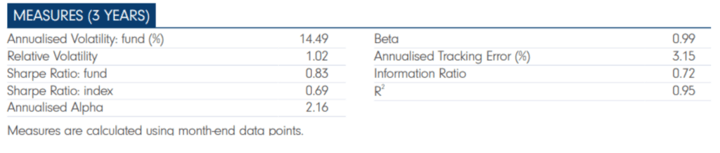
The strategy's fact sheet also provides specific risk data for its 3-year measurement. Here you can reinforce what has already been seen in the performance results. Good 3-year alpha value, so the team has achieved better results with a market risk level similar to its benchmark (Beta almost 1).

As for the portfolio composition in terms of regions and subsectors, you can see that, although global, the fund's largest allocation is in developed countries, with particular emphasis on the North American region. In terms of subsectors, the largest investment is in industrials, although Energy and Materials have a good presence, as illustrated by the investment team in the fund presentation.
The diversification of its underlying assets in different subsectors allows the fund to offer consistent returns in different phases of the economic cycle, enhanced by the fund team's bottom-up company selection ability.
Conclusions
Advantages
- Institutional size and good track record.
- Good defensive exposure in global equity.
- Manager with history and prestige and global presence.
Disadvantages
- The specific niche theme may be too restrictive for an investor with a more core portfolio.