Analysis of the Ruffer Total Return International Fund

26 JUL, 2024
By Andrea Sepúlveda from LatamSelf



The Ruffer Total Return International fund is a global multi-asset strategy launched in 2011, domiciled in Luxembourg, whose aim is essentially to achieve consistent positive returns, regardless of the performance of the financial markets. The fund manager indicates that they aim not to lose money in any 12-month period and aim to increase the value of our investors' assets in the long term.
In this article, we analyze this investment strategy.
Characteristics of the Ruffer Total Return International fund
The investment objective of this strategy is to achieve positive returns through an actively managed portfolio, although a benchmark index is used for profitability measurement purposes.
- Investment strategy: The fund team follows the philosophy and fundamental strategy of Ruffer manager, which dates back to the company's beginnings in 1994: flexibility and diversification, where the essential is capital preservation and, subsequently, achieving attractive returns for their investors. It usually focuses on international investments, investing in a variety of markets and assets. In addition, they use strategies to protect themselves from market falls, which is an integral part of their investment approach.
- Benchmark index: This index is the FTSE All-Share Index Total Return, Bloomberg Global - Aggregate Total Return and HFRI Fund of Funds Composite.
- Investment team: The fund is managed by the investment director Alex Lennard, who has managed the fund since its launch in 2011, and by the investment manager Fiona Ker, who became co-manager in 2023.
- Assets: At the end of June 2024, this strategy at the total level had just over 5 billion euros in managed assets.
- Investment company: Ruffer LLP is an investment manager based in London, United Kingdom, founded in 1994 and known for its conservative approach and its ability to manage assets in various market conditions. The company is an independent manager, it only deals with asset management, so it is not tied to a large banking parent company, which allows it to maintain a more flexible and customer-oriented approach in investment management. In numbers, Ruffer has almost 30 years of experience, at the end of May it managed almost 26 billion euros in AUM, with almost 70% of its clients being institutional, over 300 employees and offices in London, Paris, Edinburgh and Guernsey.
Evolution of the Ruffer Total Return International fund
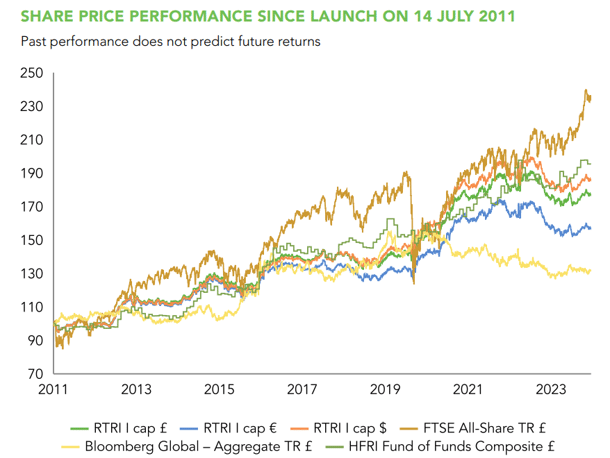
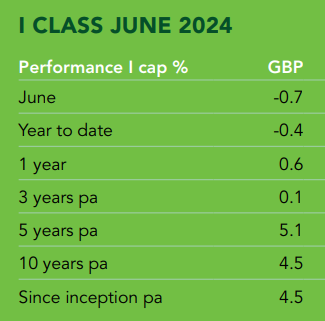
In the previous graph, it can be observed that since its launch, the institutional class in pounds manages to surpass one of the 3 benchmarks, the Bloomberg Global Aggregate, however, it does not do so with respect to the others.
Regarding performance, the fund aims to provide capital protection; and since its launch it has provided a 4.5% nominal in pounds after fees. This can adapt to a conservative risk profile.
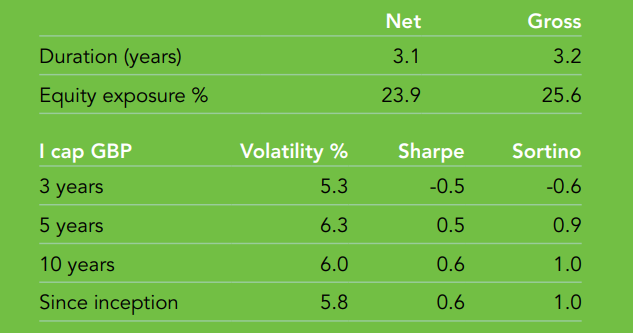
In relation to risk parameters, we can see that at 5 years, it has a positive Sharpe of 0.5, which means it efficiently manages the risk assumed in the portfolio.
The Sortino Ratio, which we often do not mention much in these analyses, is a parameter that takes on relevance especially for investors more averse to falls, as it considers the volatility of downward returns. It means that it calculates a portfolio efficiency, like the Sharpe, but using only the volatility of downward returns. In this case it has good Sortino measures, which confirms what was said at the beginning, it is a fund for investors who want to protect their capital, less inclined to take risks.
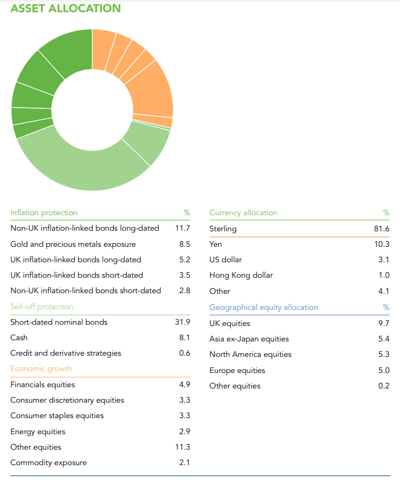
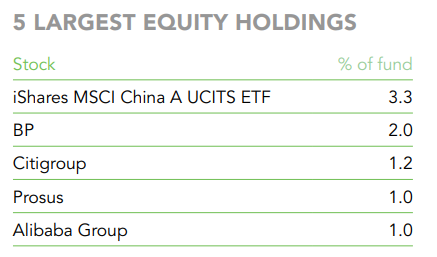
The Ruffer Total Return International fund has a investment policy that allows for broad geographical and sectoral diversification. This means that it can invest in a variety of asset classes, such as stocks, bonds, commodities and possibly even alternatives such as real estate investments or unlisted assets.
As can be seen in its positioning, the strategy has about 25% of its portfolio in equity-like instruments, among which stands out as one of the most invested positions an ETF of China A outside of the specific positions that the fund may have in that region. It could be part of the fund's strategy, but this position does not fail to attract attention.
Conclusions
Advantages
- Institutional size and track record.
- Total return fund, diversified with a bias towards fixed income - inflation protection.
- Flexible fund adaptable to market conditions.
Disadvantages
- Fund with conservative results for a Latam institutional that, moreover, evaluates equity and bond funds generally separately.