Analysis of the Schroder International Selection Fund – Frontier Markets Equity

13 SEPT, 2024
By Andrea Sepúlveda from LatamSelf



The Schroder Frontier Markets Equity fund by Schroders invests in frontier market companies. It is domiciled in Luxembourg and was launched at the end of 2010, which allows it to have a sufficient track record to be analyzed by a long-term investor. Moreover, it is important to mention that, thanks to its good results, the strategy has received recognition and ratings from major financial information platforms worldwide.
Characteristics of the Schroder International Selection Fund – Frontier Markets Equity
Let's see what are the most important features of this fund:
- Investment strategy: The strategy uses the MSCI Frontier Emerging Markets (FEM) Index (Net TR) with Emerging Markets limited to 10% as a benchmark, but mainly uses it as a reference for frontier markets and to compare results. The strategy is very active and the investment team has the flexibility to choose the companies and/or sectors in which to invest. More specifically, the fund can invest up to a third of its assets directly or indirectly in other types of assets and/or countries, sectors or currencies, for example. On the other hand, it is important to underline that, for the markets in which it invests, having a high conviction selection is fundamental. The fund generally holds between 50 and 70 companies, which shows how active the strategy is compared to its benchmark, which has more than 230 components.
- Investment team: the fund's investment team is composed of Rami Sidani, with over 20 years of experience, leader of Frontier Markets Investments at Schroders, who joined the company in 2008 and is based in London. Along with him, there is Tom Wilson, also with over 20 years of experience, leader of emerging market equities, also based in London.
- Assets: At the end of July 2024, the frontier markets strategy had over 630 million dollars in AUM.
- Management Company: Schroders is a leading entity in active asset management, consulting and wealth management. It is also recognized as a leader in sustainability. Its investment tool offerings include both public and private markets. The company manages more than 970 billion dollars in assets (AUM), is present in 38 different countries/jurisdictions, has a 98% employee retention rate and an MSCI ESG rating of AAA.
Evolution of the Schroder International Selection Fund – Frontier Markets Equity
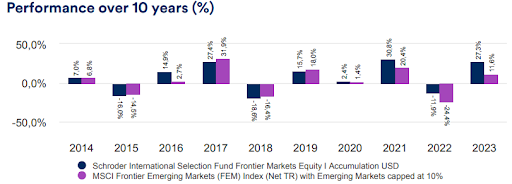

Note: Past performance does not predict future returns. The fund's returns may increase or decrease due to exchange rate fluctuations.
One of the advantages of analyzing a fund with more than 10 years of history is that, in addition to comparing it with its benchmark over longer periods of time, the fund's consistency and long-term results can be examined. The management company emphasizes the importance of the fund's investors focusing more on maximizing long-term returns rather than minimizing short-term losses.
Examining the chart and table above, it can be seen that the fund has been able to outperform the benchmark (MSCI Frontier Emerging Markets (FEM) Index (Net TR) with Emerging Markets limited to 10%) over three, five and 10 years, demonstrating that the fund's team has made a good selection of companies in frontier markets.
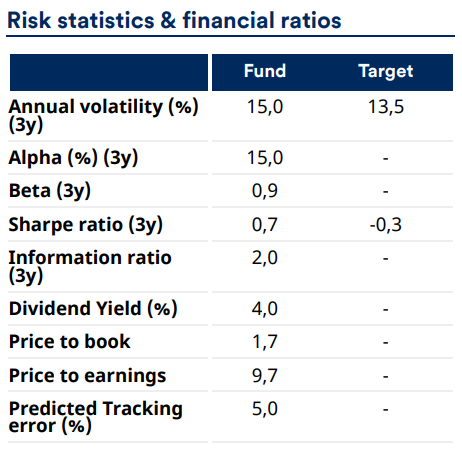
The strategy fact sheet also includes the risk analysis of the strategy over a three-year period.
Here we can confirm what has already been observed in the performance results: good three-year alpha results, showing that the team has managed to achieve better results with a lower level of risk compared to the reference market (beta < 1).
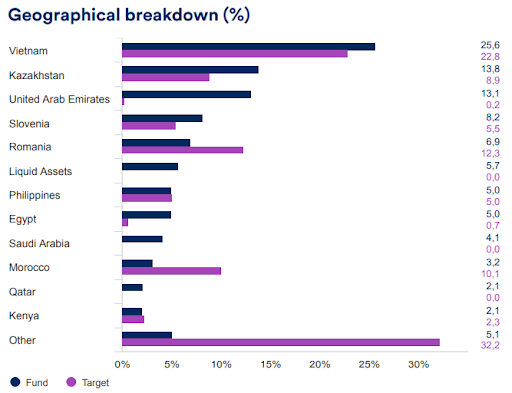
Finally, this chart on the fund's position at the end of July compared to countries in frontier markets is added, as it clearly shows how active the fund is in its selection, not only maintaining a fifth of the companies compared to the benchmark, but also reflecting its geographical diversification.
Conclusions
Advantages:
- Institutional size and good track record.
- Proven alpha in a sustainable strategy.
- Support from a company like Schroders.
Disadvantages:
- This type of strategy is generally adopted by institutional investors when they already have sufficient exposure to emerging markets and have the ability to add this type of markets to their portfolio.