Analysis of the Wellington Global High Yield Bond Fund

15 JAN, 2025
By Andrea Sepúlveda from LatamSelf



The Wellington Global High Yield Bond is a global fixed income fund that invests in high yield bonds. The strategy, domiciled in Ireland, was launched in mid-2012 and, although it does not have a sustainable investment objective, it is classified as Article 8 under the European SFDR regulation. In addition, due to its results and process, it has received distinctions and ratings awarded by important financial information platforms worldwide.
Next, we analyze in detail the characteristics, composition and performance of this investment fund managed by Wellington Management to better understand its risk-return profile and evaluate its suitability within a diversified portfolio.
Characteristics of the Wellington Global High Yield Bond fund
- Investment strategy: the investment team carries out active management with respect to the benchmark index (ICE BofA Global High Yield Constrained Index). Its investment process is based on a combination of bottom up and top down analysis. Thus, the team conducts an analysis of the credit profile of individual high yield issuers and then considers the macroeconomic and microeconomic environment of high yield bonds globally. Thus, the main source of the fund's results comes from its fundamental bottom up analysis and as a secondary source the analysis of the economic cycle, sectors and credit quality is considered, to obtain a well-diversified portfolio with proper risk management.
- Benchmark: its benchmark index is the ICE BofA Global High Yield Constrained Index.
- Manager: at the helm of this product is the manager Wellington Management. The manager emphasizes that its greatest advantage over its competitors is the team specialized in high yield analysis, composed of 40 members and has the support of Wellington's global analysis platform; which allows it to develop a multidimensional vision with solid perspectives in the 78 countries of the Global High Yield index.
- Investment team: it is led by Konstantin Leidman, CFA, who has over 22 years of experience in the sector and has been linked to the manager for 5 years. Konstantin is responsible for the development and management of the Global High Yield strategy.
- Assets: the Wellington Global High Yield Bond strategy has over 560 million dollars in assets under management, as of October 31, 2024.
Evolution of the Wellington Global High Yield Bond Fund
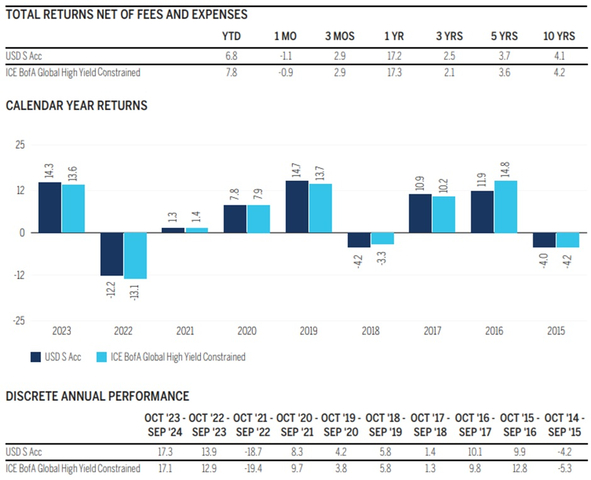
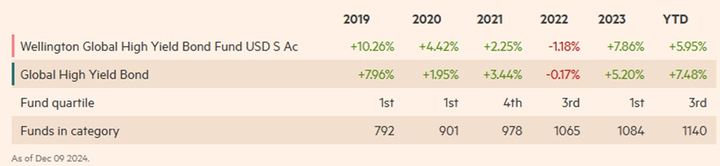
Considering what the manager delivers in its fact sheet, the Wellington Global High Yield Bond fund has not had an outstanding performance compared to its benchmark index over different periods of time. If another information source is consulted, the view may change. When compared to its “Global High Yield” category and competing funds, this strategy defends itself much better although it would be ideal to see more consistency in its quartile positioning as can be seen in the following table.
In relation to its risk parameters, and also using an external source to the manager to review it, the following is appreciated:
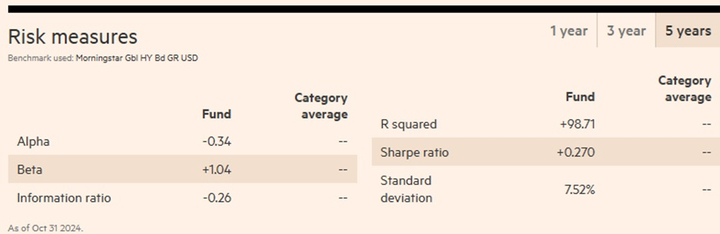
First of all, it is worth mentioning that this source is using a benchmark for the fund's category, not specifically the fund's index. Having said that, the 5-year risk results were sought, since the strategy's objective speaks of a long-term focus.
The five-year alpha level is negative and the beta tells us that the team took more risk in its selection than the general market in which it invests, although without better results. It is also worth mentioning that the 3-year alpha is positive; but, again, an institutional investor seeks consistency in results even when the investment fund is not always number one.
Regarding the diversification of the credit portfolio, we can take a look at the following image.
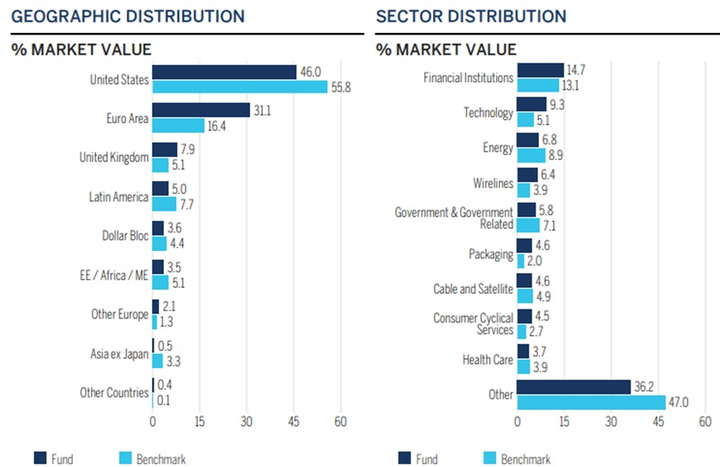
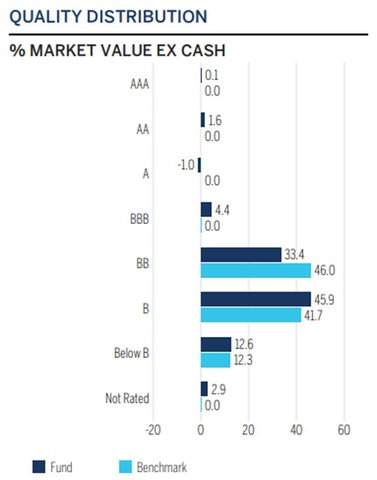
As indicated by Wellington Management, the team seeks to build a well-diversified portfolio by sectors and geographies, but also takes advantage of secular or cyclical trends that may occur in different market cycles. Here you can see that the fund's positioning does have instruments that differ from its benchmark, in geographies, overweighting the euro zone to lower its investment in the US, having some differences in sector weighting as well, but especially in the credit quality of its instruments, as despite having a general credit quality of B+, like its benchmark, the specific positioning considers more BBB and B than BB, as does the ICE BofA Global High Yield Constrained.
Conclusion
Advantages:
- Backed by a manager like Wellington Management
- Fund size and track record
- Experienced team in the asset type
Disadvantages:
- Discreet results in terms of performance, lack of consistency over time.