European banking strengthens its resilience and consolidates its investment appeal in a favourable credit environment

20 OCT, 2026
By Raphaël Thuin from Tikehau Capital



A banking sector supported by solid fundamentals
The European banking sector continues to demonstrate resilience, supported by positive operating trends that reflect a commitment to decoupling from interest-rate cycles and a focus on operational efficiency and capital productivity. Bank profitability has reached its highest level since the 2008 financial crisis, driven by a favourable interest-rate environment, continued revenue diversification, disciplined cost management and low provisioning needs. In fact, the credit environment remains favourable, with low non-performing loan (NPL) ratios on bank balance sheets. Finally, solid capital levels provide additional buffers against any potential macroeconomic deterioration, further strengthening the sector's stability.
The brisk mergers and acquisitions (M&A) activity within the European banking sector confirms its renewed strength. Driven by excess capital and solid valuations, with some price-to-book ratios close to or above 2x, banks are going on the offensive to drive market consolidation and optimise operational efficiency. However, organic growth generally remains the preferred route, as acquisitions are subject to highly selective criteria, although Italy remains an M&A market to watch.
Growth continues to progress as expected, albeit with marked geographical disparities. In particular, several regions of Central and Eastern Europe stand out for more favourable dynamics in terms of economic activity, volume growth and margins, while in France political and fiscal uncertainty continues to weigh on the outlook.
The new frontier: operational efficiency and the strategic use of AI
The sector's profitability model is undergoing a shift: revenue diversification, optimisation of costs and risk-weighted assets, and the rise of scalable operating platforms. The challenge is clear: maintaining high levels of profitability by leveraging cross-selling, expanding client ecosystems and generating fees with an efficient use of capital.
The banking sector is adopting AI cautiously, prioritising productivity and risk management over replacing workers. Although this technology is essential, the investment required and governance constraints could limit its immediate impact on margins. Its success will depend on security, user trust and the regulatory framework.
Identifying value in equities: restored profitability, strategic discipline and rising dividends
European banks currently offer a particularly attractive investment profile. Their profitability, as mentioned, at its highest level since the 2008 crisis, exceeds that of their US peers. The sector is reducing its sensitivity to interest-rate cycles by prioritising operational efficiency and capital optimisation, which ensures greater resilience in a favourable credit environment.
Their strategies now favour internal investment and shareholder returns over external growth through acquisitions. Solid capital structures and higher profitability are freeing up a significant surplus of equity capital to boost dividends, share buybacks or special distributions. Since the start of the year, the European banking index has risen 16.64%, compared with 0.81% for its US counterpart (according to Bloomberg data, as of 10 July 2026).
Finally, in terms of valuation, the sector remains very attractive: European banks are currently trading at 11.5x earnings, compared with 16.8x for the Stoxx 600 index (according to Bloomberg data, as of 10 July 2026). This persistent discount offers an attractive entry point into a sector characterised by healthy balance sheets and solid growth profiles, according to our analysis.
Banks benefit in the long term from a higher interest-rate environment
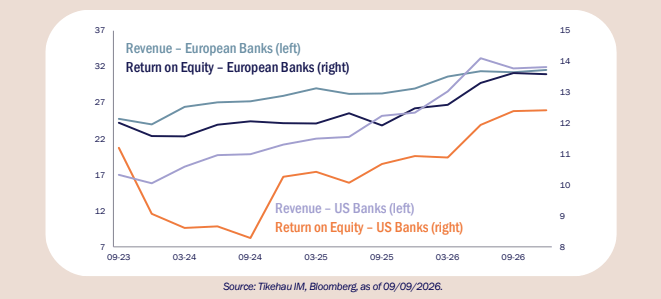
Higher interest rates have boosted bank margins and profitability on both sides of the Atlantic. Despite their recent rerating, banks remain significantly undervalued relative to the market.