Global Bond Markets Navigate Uncertainty

14 NOV, 2023
By Johanna Zidani from RankiaPro Europe


In the ever-evolving landscape of global financial markets, the dynamics of bond yields, particularly in the euro area (EA) and the United States, have witnessed notable shifts during October. As investors grapple with uncertainties surrounding economic slowdowns and central bank policies, a nuanced analysis of recent trends provides valuable insights into potential market trajectories.
International Yield Curve Dynamics
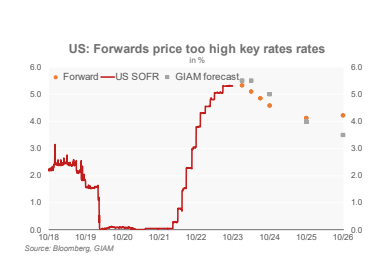
While long-dated euro area core yields remained relatively stable last month, their U.S. counterparts experienced a discernible upward trend. The steepening of international yield curves, despite a more benign environment for bonds, raises questions about the factors influencing these movements. Notably, real yields and medium-term key rate expectations are viewed as potentially too high in anticipation of an economic slowdown.
EA Non-Core Bond Spreads and Market Volatility
October witnessed a moderate tightening of EA non-core government bond spreads, signaling a shift from the long-term highs observed in preceding months. Attention is now focused on the upcoming Moody's rating decision on Italy in November, with potential implications for the region's bond markets. Increased volatility in international government bond markets during October reflects heightened uncertainty about future developments.
The divergence between U.S. and EA core yields, which trended sideways despite weakened equity markets and rising spreads in corporate and emerging market bonds, challenges traditional expectations. Surprisingly, there has been no flight to quality, with U.S. Treasuries failing to build a premium despite geopolitical tensions in the Middle East. This stands in contrast to the notable rise in the gold price relative to copper.
The rise in long-dated U.S. yields is attributed to an increase in the term premium, fueled by concerns about a continued uptick in Treasury supply. Despite some upside potential for the U.S. term premium over the next 12 months, other factors are expected to influence market dynamics.
While the markets project a higher key rate than the Federal Reserve and GIAM expectations, the sustainability of these projections is questioned. As a response, the recommendation is to overweight short-dated U.S. Treasuries, emphasizing the importance of aligning portfolios with potential market mispricings.