RankiaPro Funds Meeting in Geneva: Insights from Fund Managers

30 OCT, 2026



The latest edition of the RankiaPro Funds Meetings took place on Thursday, October 15th, at the prestigious Ritz-Carlton - Hotel de la Paix. The event brought together top investment professionals to discuss market trends, investment strategies, and economic outlooks for the coming months.
During the session, attendees had the opportunity to engage with distinguished speakers, including:
- Michael Sun, Client Portfolio Manager - Quantitative Strategies from Eastspring Investments
- Petter Langenskiöld, Portfolio Manager from EVLI
- Anastasia Bloom, Senior Advisor from Marsham Investment Management
- Laurent Dobler, Fund Manager from Quaero Capital
The morning began with a networking breakfast, allowing fund selectors and buyers to exchange insights on key market challenges and opportunities. Each speaker then presented their firm's investment approach, fund strategies, and market perspectives, providing attendees with valuable takeaways on portfolio positioning and asset allocation in the current economic climate.
Michael Sun, Client Portfolio Manager - Quantitative Strategies from Eastspring Investments
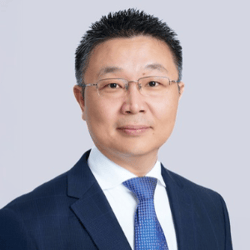
Eastspring Investments presented its Asian Low Volatility Equity Strategy, a quantitative investment approach designed to navigate the volatility of Asia Pacific equity markets while seeking attractive long-term returns.
Asia remains an important source of global economic growth, supported by domestic consumption, innovation and structural economic trends. However, the region's equity markets can experience sharp fluctuations, driven by geopolitical tensions, policy uncertainty and concentrated market leadership. Eastspring's approach aims to address these challenges by constructing a diversified portfolio designed to reduce overall volatility without simply selecting the least volatile stocks.
The investment process combines quantitative analysis, multiple investment factors and portfolio optimisation. Starting with a broad universe of approximately 4,700 stocks across Asia Pacific excluding Japan, the team applies filters based on liquidity, valuation, quality, sentiment, momentum and other signals to identify investment opportunities. The resulting portfolio is then optimised to manage risk and correlations while maintaining diversification across countries, sectors and individual holdings.
A key differentiator is that low volatility is achieved at the portfolio level rather than by relying exclusively on low-volatility individual stocks. The strategy also considers dividend income, trading costs and liquidity when constructing the portfolio.
Eastspring's central message was that a low-volatility approach does not necessarily mean sacrificing long-term growth. By seeking to limit downside exposure and manage drawdowns, the strategy aims to help investors remain invested through changing market conditions.
Petter Langenskiöld, Portfolio Manager from EVLI

EVLI presented Evli Hannibal, a European equity strategy built around a distinctive contrarian investment philosophy. Rather than following popular market trends or focusing on companies with strong current profitability, the fund seeks opportunities among businesses trading at exceptionally low valuations, particularly when their share prices have fallen significantly below historical levels.
The strategy is based on the belief that markets can become excessively pessimistic about companies facing temporary difficulties. By analysing historical earnings capacity and comparing current valuations with long-term averages, the investment team seeks to identify companies with significant mean-reversion potential. Its disciplined approach also extends to portfolio management: positions are reduced or sold as valuations recover, while investments that have yet to rebound may be retained or increased.
This approach differentiates Evli Hannibal from conventional value strategies, which often place greater emphasis on current profitability and traditional valuation multiples. Instead, the fund focuses on identifying substantial valuation dislocations and maintaining a consistent contrarian investment style across market cycles.
The presentation highlighted the importance of distinguishing between a company's current challenges and its longer-term earnings potential, offering investors an alternative perspective on European equity allocation.
Anastasia Bloom, Senior Advisor from Marsham Investment Management

Marsham Investment Management LLP introduced its Transitional Issuers fixed-income strategy, which combines fundamental credit research, active portfolio management and artificial intelligence to identify attractive opportunities in developed-market corporate bonds.
The strategy focuses on companies undertaking a credible and executable transition towards more sustainable business models. These businesses may not yet be recognised as sustainability leaders, but their plans to improve operations and reduce environmental impacts can create opportunities that the market has not fully appreciated.
Marsham applies an equity-like analytical approach to fixed income, examining companies' business models, financial positions, operational drivers and potential risks. Its research process also incorporates AI-powered tools, which the firm has used since 2017 to improve the collection and analysis of information. This is complemented by a proprietary Transitional Issuer Scorecard intended to help assess companies' transition potential.
Portfolio construction is benchmark-agnostic and actively managed, allowing the team to adjust exposures across sectors, credit curves and investment-grade and high-yield bonds according to market conditions and its macroeconomic outlook. Portfolios are typically concentrated in around 30–40 holdings, reflecting the team's high-conviction approach, with risk management playing a central role in position sizing.
For investors seeking differentiated fixed-income exposure, Marsham's approach aims to identify undervalued credit opportunities by combining company-level fundamental analysis with the potential for operational improvements associated with the sustainability transition.
Laurent Dobler, Fund Manager from Quaero Capital

Quaero Capital presented the Alséa Quality Growth Europe Equity strategy, managed by Alséa Partners, which focuses on European companies capable of delivering sustainable growth and attractive returns on capital over the long term.
The strategy is built around the principle of quality growth: identifying businesses with durable competitive advantages, strong management teams, consistent organic revenue growth and the ability to reinvest capital at attractive rates of return. Rather than focusing solely on short-term earnings momentum, the investment team seeks companies whose business models can support long-term earnings compounding.
The investment process combines quantitative screening with detailed fundamental research. Starting from a selected universe of approximately 400 European companies, quantitative filters narrow the field to around 200 candidates. The team then assesses competitive advantages, barriers to entry, pricing power, management quality, capital allocation and the sustainability of future growth. This process results in a concentrated portfolio of approximately 25 stocks, with position sizes determined by conviction, expected returns, valuation and company-specific risks.
The presentation also addressed the changing environment for quality-growth companies. Artificial intelligence, the energy transition and geopolitical developments are reshaping competitive advantages across European industries. The team believes investors must distinguish between businesses with genuinely sustainable growth prospects and those whose previous advantages may be under pressure.
The strategy's investment philosophy ultimately centres on the power of long-term compounding: identifying high-quality companies that can continue creating value through durable growth, disciplined capital allocation and strong returns on capital.