Strong inflows into European investment funds in early 2025, with equity and multi-asset leading

1 SEPT, 2025
By Joanna Piwko from RankiaPro Europe



The European fund industry recorded another quarter of solid inflows in the first quarter of 2025, despite a slight decline in overall net assets, latest EFAMA Quarterly Statistical Release confirms.
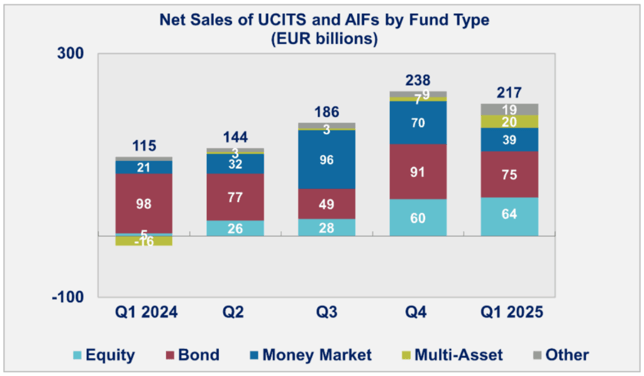
Net assets of UCITS and AIFs declined by 1.1% in Q1 2025, reaching EUR 23.2 trillion. UCITS and AIFs attracted EUR 217 billion in net inflows, down slightly from EUR 238 billion in Q4 2024. However, while there’s a bit of negative news for Europe, the positives outweigh it.
Investor appetite shifted toward equity and multi-asset strategies
Long-term funds recorded strong net inflows of EUR 179 billion. All LT fund categories experienced net inflows. Equity funds absorbed €64 billion in net inflows, up from €60 billion in the previous quarter, signaling continued confidence in stock markets.
Multi-asset funds continued to gain momentum, with inflows tripling to €20 billion from just €7 billion in the previous quarter. Despite lingering caution, worries about potential US tariff hikes did not prevent investors from taking on more risk.
Bond funds, traditionally the backbone of European portfolios, still led in absolute terms but eased slightly, with €75 billion in inflows versus €91 billion in the prior quarter.
After a strong run at the end of 2024, demand for short-term liquidity weakened. Money market funds took in €39 billion, nearly halving from the €70 billion seen in Q4.
The largest net inflows unquestionably belong to the leaders: Ireland (€98.2 billion) and Luxembourg (€59.9 billion). On the other hand, the biggest outflows were recorded in the Netherlands (–€8.1 billion) and France (–€4.9 billion).
ETF boom continues
Exchange-traded funds (ETFs) once again stood out. UCITS ETFs posted €100 billion in net sales, extending their growth trend and underscoring their role as a low-cost, flexible investment option for both institutional and retail investors.
Article 8 up, article 9 down
The sustainable fund segment showed a stark divergence. SFDR Article 8 funds (¨light green¨– funds promoting environmental or social characteristics) attracted €42.6 billion in new money, while the stricter Article 9 funds (“dark green” funds specifically have sustainable investment as their core objective) continued to face withdrawals, suffering €7.9 billion in outflows – their sixth consecutive quarter of net redemptions.
Households drive demand
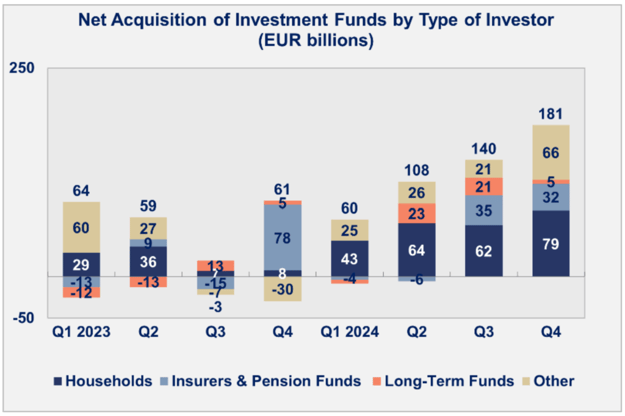
Retail investors played a decisive role. Households across Europe, particularly in Germany, Spain, and Italy, accounted for much of the inflow momentum, purchasing €79 billion in funds in late 2024, the second-highest level since mid-2021. Banks and financial intermediaries added another €66 billion, confirming broad-based demand.
General outlook
The first quarter of 2025 highlighted a resilient European fund market that is adjusting to new dynamics: investors were rotating toward equities and multi-asset strategies, ETFs were consolidating their dominance, and sustainable finance was seeing selective support. With households and banks continuing to fuel inflows, the industry finished the H1 with cautious optimism.