The Case for Responsible Gold Miners

5 NOV, 2026



Gold has historically been regarded as a store of value, with its scarcity and global recognition supporting its role in long-term wealth preservation and portfolio diversification.1 Gold miners may provide leveraged exposure to gold, with operational improvements creating potential for stronger cash flows.2 A context-sensitive responsible-mining framework may support the assessment of how effectively gold miners manage material risks, strengthen business resilience and contribute to sustainable development.3
The Global X Responsible Gold Miners UCITS ETF (GLDX LN) seeks to invest in companies that provide exposure to the gold mining industry by applying a responsible mining framework that incorporates sustainability screens, environmental impact metrics and selected social and governance indicators.
Below, are highlighted some key characteristics of the gold market and the gold mining sector, as well as the sector's responsible approach.
Gold Has Preserved Wealth Through Market Cycles and Central Banks' Buying Reinforces its Strategic Role
Gold occupies a distinctive position in global financial markets as a real asset, reserve asset and potential safe haven.4 During periods of economic or geopolitical uncertainty, it has historically attracted demand for its potential diversification benefits and resilience when confidence in fiat currencies weakens.5
For centuries, gold has been regarded as a store of value, helping preserve wealth through market cycles thanks to its physical qualities of durability and scarcity.6 Gold is highly durable and corrosion-resistant; as a result, unlike many other commodities, gold produced over time remains in existence today held as jewellery, coins, bars, and central bank reserves, or used in other applications.7 Yet gold is scarce, and the 'gold cube' helps illustrate this scarcity: if every ounce of the world's gold mined throughout history were placed side by side, the resulting cube of pure gold would only measure approximately 22.5 meters on each side.8
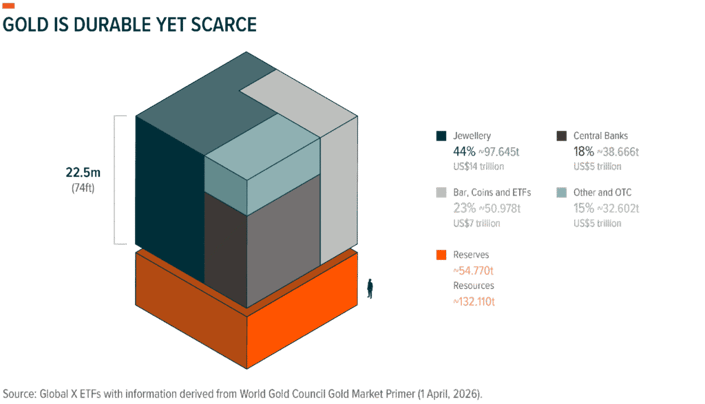
Gold demand spans jewellery, investment, technology and official-sector holdings, while supply is drawn from geographically dispersed mine production and recycled metal.9 This diversity may support market stability by reducing the market’s dependence on any one consumer group, region or source of supply.10
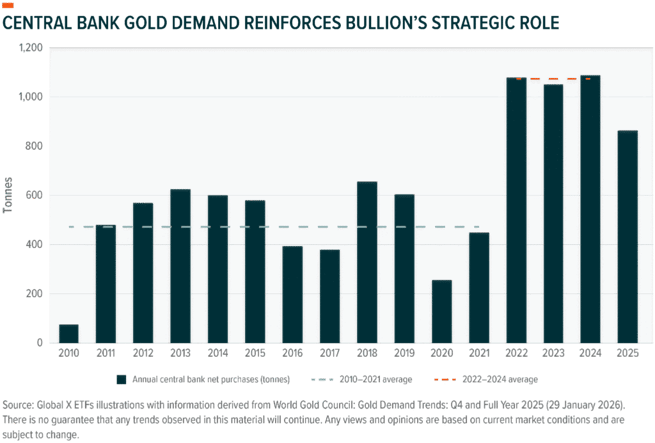
Central banks have become an increasingly important source of gold demand.11 Official-sector purchases remained elevated in 2025, after having exceeded 1,000 tonnes annually between 2022 and 2024 compared with an average of 500 tonnes per year over the preceding decade.12
A June central banks survey found that 89% of respondents expected global central-bank gold reserves to increase over the following 12 months, while a record 45% expected their own institution’s holdings to rise.13 Central banks cite crisis performance, long-term value preservation, diversification, and geopolitical risk mitigation among the reasons for holding or increasing gold reserves.14
The increase in official-sector gold holdings appears to form part of a broader reassessment of reserve composition amid geopolitical uncertainty and concerns about exposure to traditional reserve currencies.15 Looking forward, sustained central bank demand may reinforce gold’s long-term structural outlook and therefore may create a favourable backdrop for gold mining companies, notwithstanding near-term interest-rate risks.16
Miners May Translate Higher Gold Prices into Stronger Margins and Cash Flow
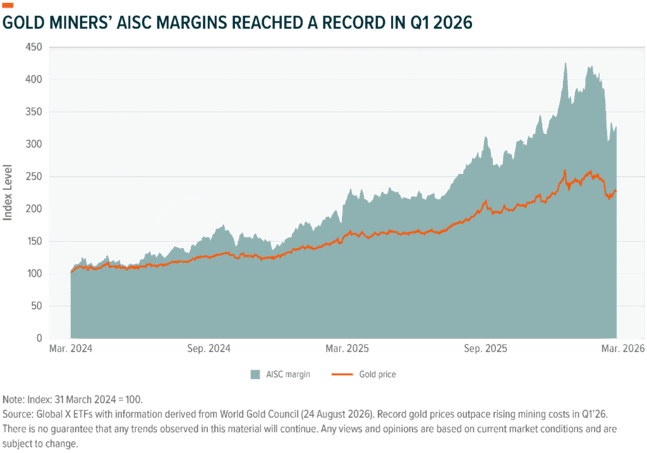
Gold miners can offer a differentiated way to gain exposure to gold. Unlike bullion, they are operating businesses that may generate earnings and cash flow. Because a significant proportion of mining costs may adjust more slowly than the gold price, sustained strength in gold may lead to greater increases in margins and profitability17. This operational leverage means miners may outperform the underlying metal during favourable gold cycles, although it may also magnify losses when prices decline.18
The long-term foundations of the opportunity may remain supportive.19 For miners, gold’s structural sources of demand may be complemented by company-specific opportunities to create value through productivity improvements, exploration, reserve development and disciplined capital allocation.20 Stronger cash flows may be used to reduce debt, fund growth, pay dividends or repurchase shares.21
Q1 2026 provides an example of this dynamic: global average all-in sustaining cost (AISC) margins—the difference between gold prices and AISC—reached a record US$3,076 per ounce, increasing 134% year-on-year despite continued cost inflation.22 Average AISC rose 16% year-on-year to US$1,785 per ounce, while the average gold price increased 70%.23
During that period, producers maintained relatively disciplined spending and cost management compared with previous gold-price booms, with many holding net cash positions and returning cash to shareholders.24 The durability of these benefits depends on gold prices, production costs, investment requirements and operational execution.25
Responsible Mining Practices May Strengthen Long-Term Business Resilience
How investors assess the sector remains relevant as gold miners face operational disruption, cost inflation, commodity price volatility, and political or jurisdictional risk.26 A responsible approach to gold mining may help identify companies with stronger governance, environmental stewardship, safety standards and community relationships.27 These qualities can help maintain a licence to operate and protect the value of long-lived mining assets, making responsible practices a relevant consideration in risk management and business resilience.28
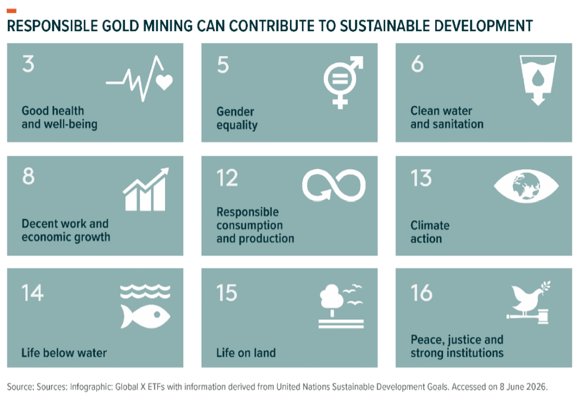
Responsible mining may contribute to the Sustainable Development Goals (SDGs) through employment, infrastructure development and community investment.29 These potential benefits should be assessed alongside mining’s environmental and social impacts.30 In gold mining, this requires attention to environmental stewardship, human rights, affected communities, sound governance, and the equitable distribution of benefits to host countries.31 Applying an SDG lens could provide a systematic and transparent framework for assessing and weighting companies against defined sustainability indicators.32
Responsible mining may be assessed by how effectively policies and commitments are implemented and overseen in practice.33 Independent assurance, where available and appropriately scoped, may provide an additional input into this assessment.34 Appropriate practices are likely to vary according to the jurisdiction, operating context and stage of the mine lifecycle.35 Relevant factors may include water management, tailings safety, effects on communities, activities in conflict-affected or high-risk areas, and engagement with artisanal and small-scale miners.36
Responsible mining may therefore be viewed as an ongoing process of identifying, preventing or mitigating, monitoring and communicating impacts, rather than as a fixed designation.37

1. International Monetary Fund. (2026, March 3). Gold’s lasting luster. Finance & Development, 63(1).
2. Reuters. (2026, January 26). Gold miner shares jump as bullion prices hit $5,100/oz record high.
3. World Gold Council. (2019, September 12). Responsible Gold Mining Principles (RGMPs).
4. International Monetary Fund. (2026, July 9). Gold in Central Bank Reserves: Strategic Considerations, Market Risks, and Practical Guidance.
5. Ibid.
6. International Monetary Fund. (2026, March 3). Gold’s lasting luster. Finance & Development, 63(1).
7. U.S. Geological Survey. (2026, February 10). How much gold has been found in the world?
8. World Gold Council. (2026, April 1). Gold Market Primer: Market size and structure.
9. U.S. Geological Survey. (2026). Mineral Commodity Summaries 2026: Gold.
10. Reuters. (2026, January 12). How investors buy gold and what fuels the market.
11. European Central Bank. (2026, June 11). The International Role of the Euro, June 2026.
12. Ibid.
13. Reuters. (2026, June 16). More central banks signal plans to increase gold holdings, WGC survey shows.
14. Ibid.
15. European Central Bank. (2026, June 11). The International Role of the Euro, June 2026.
16. J.P. Morgan Global Research. (2026, June 9). Will gold prices hit all-time highs again in 2026?
17. PwC. (2026, June). Mine 2026: Ambition to Action.
18. Reuters. (2026, January 26). Gold miner shares jump as bullion prices hit $5,100/oz record high.
19. Reuters. (2026, February 25). JP Morgan raises long-term gold price forecast to $4,500.
20. PwC. (2026, June). Mine 2026: Ambition to Action.
21. Ibid.
22. World Gold Council / Metals Focus. (2026, August 24). Record gold prices outpace rising mining costs in Q1’26.
23. Ibid.
24. Ibid.
25. World Gold Council / Metals Focus. (2026, August 24). Record gold prices outpace rising mining costs in Q1’26; PwC. (2026, June). Mine 2026: Ambition to Action; S&P Global Market Intelligence. (2026, August 12). H1 2026 Mining Analysis: Cost Inflation, Geopolitical Risk, and Commodity Divergence.
26. S&P Global Market Intelligence. (2026, August 12). H1 2026 Mining Analysis: Cost Inflation, Geopolitical Risk, and Commodity Divergence.
27. World Gold Council. (2019, September 12). Responsible Gold Mining Principles (RGMPs).
28. ERM. (2025, April 15). Sustainability that pays: Defining a credible business case for investing in sustainability in mining and metals.
29. World Gold Council. (2020, September 22). Gold Mining’s Contribution to the UN Sustainable Development Goals.
30. World Gold Council. (2019, September 12). Responsible Gold Mining Principles (RGMPs).
31. Ibid.
32. United Nations Development Programme. (2021, July). SDG Impact Standards for Enterprises: Version 1.0.
33. World Gold Council. (2019, September 12). Responsible Gold Mining Principles (RGMPs).
34. Ibid.
35. Ibid.
36. Ibid.
37. Ibid.
This communication is for Professional Investors only and should not be used with, nor relied upon by, retail clients. It is for use only by the recipient and should not be forwarded to a third party.
The Global X UCITS ETFs are regulated by the Central Bank of Ireland.
This is a marketing communication.
Please refer to the relevant prospectus, supplement, and the Key Information Document (“KID”) of the relevant UCITS ETFs before making any final investment decisions.
Investors should also refer to the section entitled “Risk Factors” in the relevant prospectus of the UCITS ETFs in advance of any investment decision for information on the risks associated with an investment in the UCITS ETFs, and for details on portfolio transparency. The relevant prospectus and KID for the UCITS ETFs are available in English at www.globalxetfs.eu/funds.
Investment in the UCITS ETFs concern the purchase of shares in the UCITS ETFs and not in a given underlying asset such as a building or shares of a company, as these are only the underlying assets that may be owned by the UCITS ETFs.
A UCITS ETF’s shares purchased on the secondary market cannot usually be sold directly back to a UCITS ETF. Investors must buy and sell shares on a secondary market with the assistance of an intermediary (e.g. a stockbroker) and may incur fees for doing so. In addition, investors may pay more than the current net asset value when buying shares and may receive less than the current net asset value when selling them. Changes in exchange rates may have an adverse effect on the value price or income of the UCITS ETF.
Past performance of a UCITS ETF does not predict future returns. Future performance is subject to taxation which depends on the personal situation of each investor, and which may change in the future. Neither past experience nor the current situation are necessarily accurate guides to the future growth in value or rate of return of a UCITS ETF.
Investment may be subject to sudden and large falls in value, and, if it is the case, the investor could lose the total value of the initial investment. Income may fluctuate in accordance with market conditions and taxation arrangements. The difference at any one time between the sale and repurchase price of a share in the UCITS ETF means that the investment should be viewed as medium term to long term.
Any investment in a UCITS ETF may lead to a financial loss. The value of an investment can reduce as well as increase and, therefore, the return on the investment will be variable.
Global X ETFs ICAV is an open-ended Irish collective asset management vehicle issuing under the terms of its prospectus and relevant supplements as approved by the Central Bank of Ireland and is the issuer of certain of the ETFs where stated.
Global X ETFs ICAV II is an open-ended Irish collective asset management vehicle issuing under the terms of its prospectus and relevant supplements as approved by the Central Bank of Ireland and is the issuer of certain of the ETFs where stated.
Communications issued in the European Union relating to Global X UCITS ETFs are issued by Global X Management Company (Europe) Limited (“GXM Europe”) acting in its capacity as management company of Global X ETFs ICAV. GXM Europe is authorised and regulated by the Central Bank of Ireland. GXM Europe is registered in Ireland with registration number 711633.
Communications issued in the United Kingdom and Switzerland relating to Global X UCITS ETFs are issued by Global X Management Company (UK) Limited (“GXM UK”), which is authorised and regulated by the Financial Conduct Authority. The registered office of GXM UK is 77 Coleman St, London, EC2R 5BJ, UK. Information about GXM UK can be found on the Financial Services Register (Firm Reference Number 965081).
GXM Europe may terminate marketing arrangements.
Information for Investors in the United Kingdom
Please refer to the relevant prospectus, supplement, and the Key Investor Information Document (“KIID”) of the relevant UCITS ETFs before making any final investment decisions. These are available in English at www.globalxetfs.eu
The Financial Ombudsman Service is unlikely to consider complaints relating to the ETF and any claims for losses relating to the manager and the Depositary of the ETF are unlikely to be covered under the Financial Services Compensation Scheme.
Information for Investors in Switzerland
This is an advertising document. The state of the origin of the fund is Ireland. In Switzerland, the representative is 1741 Fund Solutions AG, Burggraben 16, CH-9000 St.Gallen. The paying agent is Tellco Bank AG, Bahnhofstrasse 4, 6430 Schwyz.
The prospectus, the key information documents, the articles of association as well as the annual and semi-annual reports may be obtained free of charge from the representative.
Past performance is no indication of current or future performance. The performance data do not take account of the commissions and costs incurred on the issue and redemption of units.