

Jonathan Woolley from Amati Global Investors is our Sales Manager of the Month

9 JUL, 2025
By Jose Luis Palmer from RankiaPro Europe


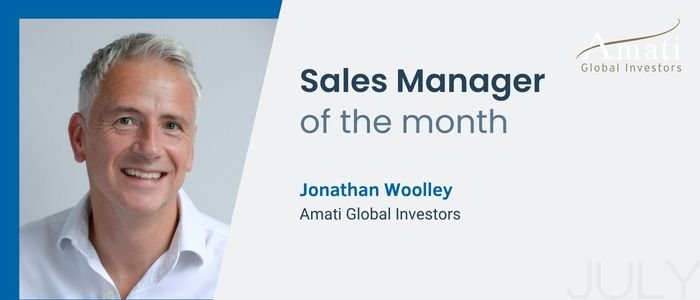
Jon is one of the Sales Directors at Amati, covering London, the South West of England and Wales. He spent 12 years with JO Hambro Capital Management as Sales Director, covering the South West, Midlands and Ireland – and prior to that held roles at Old Mutual and UBS, developing relationships with discretionary and advisory accounts.
Jon holds the CISI Private Client Investment Advice & Management (PCIAM), IMC and a degree in Economics.
What made you decide to go into the financial sector? Did you have any other vocations? How were your first steps in the sector?
As a topic I always enjoyed Economics, and it’s what I went on to study at university. My teacher loved the subject, which always helps, and one of our class activities was a share competition, and an introduction to the Financial Times. That kind of sparked my interest.
I’ve worked in various financial roles, from a high street bank to a Money Market Dealer in a Treasury department, and then into Asset Management and distribution. I once considered becoming a dive instructor! Finance I can say has never ceased to be interesting; I got my first proper introduction to investing joining a firm just a month before Black Monday in 1987!
What does a typical workday look like for you? What do you enjoy the most about your job?
Working for a boutique fund management company, there is rarely a typical day; it’s pretty varied, and that’s what makes the job interesting and a challenge. You might be providing input into strategic plans, followed by marketing ideas, and then of course the most important and enjoyable part of the role – meeting clients. It’s the variety and challenges the role brings as well as meeting clients face to face, discussing markets, their needs – and all the stuff outside of work too!
In your opinion, what are the key drivers for successful fund distribution? How do you approach building and maintaining relationships with clients?
I think it’s about being in touch with the marketplace and being relevant in your offering to clients. That can only come from speaking to clients, understanding their needs and challenges, and remembering that it’s a two-way process to be a success. So of course, we share views and opinions on our various funds and strategies, and communication is very important, but equally it’s about listening too.
Could you highlight any topic on which investors should focus for the long term?
I may be somewhat biased here, but from an investment perspective, I’d highlight the smaller companies effect! Smaller companies may well be more volatile in the short term, but over the long term they outperform larger companies. We have definitely been through one of those tougher periods for smaller companies, none more so than in UK Smaller Companies, so perhaps it’s time to focus on small caps again and their longer term superior returns.
How do you stay informed about market trends and changes in the asset management industry?
Nothing unusual – the usual trade press and many useful webinars, and of course speaking with our fund managers, who cover a range of topics from UK equities to gold, commodities, global equities and innovation!
What is your advice to investors, how should they position their portfolios with the curren environment?
Well, it’s not my role to give advice and I’d be very wary of doing that! There are many experienced wealth managers and investment managers charged with the considerable responsibility of advising their clients. However, our view is that even though we have seen a rebound in the US markets from the Trump tariff sell off, that it’s caused some thought around the seemingly constant move towards global benchmarks and passive too. It feels as though UK equities could be a beneficiary of that thought process, particularly given the value on offer – and we see that in UK Small Caps and the AIM. Of course, investors aren’t going to abandon the US market, but we believe there are some really exciting ideas beyond the obvious and Magnificent Seven which could attract more attention – a good environment for active managers to sit alongside passive I feel.
What is the most exciting thing you have seen in the markets since you started working in the financial sector? And the biggest challenge you had to face?
Well, the run up to the dot-com bubble was a pretty exciting time, or at least it felt that way until it peaked in March 2000! I remember the excitement at that time around the tech theme, working at a firm that launched a tech orientated fund. It’s always a challenge post bubbles like that, and it’s a reminder that factors like profitability, cashflow and valuation do matter.
What do you see as the biggest challenges and opportunities in the asset management industry today, and how would you address them as a Sales Manager?
Someone’s challenge is another’s opportunity, and passive investing has certainly been a beneficiary at the expense of active management. That creates a challenge for active management in terms of proving it’s worth, but also in terms of cost, which is a huge focus nowadays. Those challenges are particularly acute in smaller boutique firms where you also have the added challenge of consolidation in the wealth management market. I don’t believe it’s a case of passive or active, I think there is a place for both through the cycle for investors. I think we could see a profitable period for active fund management. That said, I believe you need to be truly active, differentiated from passive and then the challenge is getting the message across; there is space for both.
When you have free time, what do you like to do?
Family is the focus, and we love to travel, having had some real adventures over the years. Ski-ing and scuba diving sit high on my favourite holiday pastimes, and I really enjoy running, preferring a trail run to a road run. My wife is a big fan of ‘Parkrun’, which takes you to places in the UK you perhaps wouldn’t have visited – and abroad too!


