

Monaco’s FATF grey list lesson: why paper compliance no longer works

24 JUL, 2026



Paris, third week of June. A room with bad coffee and expensive lawyers. The Financial Action Task Force is holding one of its three yearly plenaries. Nobody outside notices.
Monaco’s file comes up. The news is good. Fourth progress report accepted. Action plan substantially completed. Inspectors will come for the final visit.
And Monaco stays on the grey list.
Not because anyone in that room thinks the Principality is a laundromat. Look at the scorecard. There are forty international recommendations. Monaco now rates compliant, or largely compliant, on thirty-nine.
Thirty-nine out of forty. If this were a university exam it’s a first, and nobody asks to see your notes.
It wasn’t enough. It hasn’t been enough since June 2024.
Here’s why.
There are two scorecards
Everybody quotes the first one. Almost nobody has looked at the second.
The first grades the rules. Are the laws written, are the obligations in force, do the powers exist on paper. That’s the 39 out of 40.
The second grades results. It asks whether eleven specific things actually happen in the real world. Investigations. Prosecutions. Supervision that supervises. Criminals losing property.
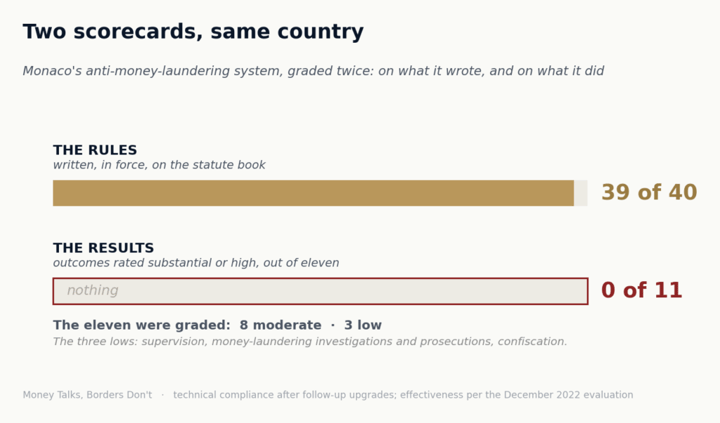
Of those eleven, the 2022 evaluation rated exactly none as substantial or high. Eight came back moderate. Three came back low.
Look at which three. Supervision. Money-laundering investigations and prosecutions. Confiscation of the proceeds of crime.
The report noted a very low number of convictions. An even lower number of confiscation orders. And of those, not one reached property of equivalent value, or property held by somebody else’s name.
That last detail is the whole thing in miniature. The power to confiscate existed. It was written down, correctly, in a proper law. It just wasn’t reaching anything.
Why one number moved and the other didn’t
Now the part that explains the two years.
You can fix the first scorecard with a pen. Monaco did. Nine laws in one evaluation round, and the technical score climbed to thirty-nine.
You cannot fix the second one with a pen. There’s no statute you can pass that produces a conviction. No amendment that seizes an asset. The only way to move that number is to actually do it, for long enough that someone believes you.
So the action plan never asked for better laws. It asked for outcomes. And outcomes take time, which is exactly what two years on a list looks like from the inside.
The word the evaluators used for the system’s effectiveness was “uneven.”
Not absent. Not corrupt. Uneven.
That adjective cost two years and a national reform programme.
Because a perfect rulebook proves one thing only: somebody wrote it.
Now look at your own file
Here’s why this matters to you, and it has nothing to do with money laundering.
Tax authorities made the same move. Years ago, quietly.
They stopped asking whether your holding company was properly incorporated. They started asking where it’s actually run. Who decides. From which room.
Nobody banned the letterbox company. That’s not what happened.
What happened is worse. “Correct on paper” stopped being an answer. The documents didn’t get harder to produce. They got ignored.
Same shift, different building. Regulators everywhere worked out the same thing at roughly the same time: paperwork is cheap to buy and tells you nothing about what anyone actually does on a Tuesday.
It reached countries first. It’s reaching structures now, one file at a time, much more quietly.
Three examples of what that costs.
One: the holding company
Somewhere sensible in Europe. Two million euros of profit through it every year.
The paperwork is beautiful. Articles by a good firm. Share capital correct. Registered office at a corporate services provider. A local director who is entirely real and holds two hundred other mandates. Board decisions signed by circular resolution, wherever people happen to be that week.
Cost to run: fifteen thousand a year, plus about a hundred thousand in local tax. Call it a hundred and fifteen.
Now the other version. Same company, run for real.
An office that exists. A director who lives there, gets paid properly, and sometimes decides against the family. Board meetings held where the company says it lives. Minutes recording real decisions taken in that actual room.
Extra cost: around eighty thousand a year.
Almost everyone picks the first one. Obviously. It looks identical from outside and saves sixty-five thousand every year.
For five years it works perfectly. Because nobody looks.
Year six, somebody looks.
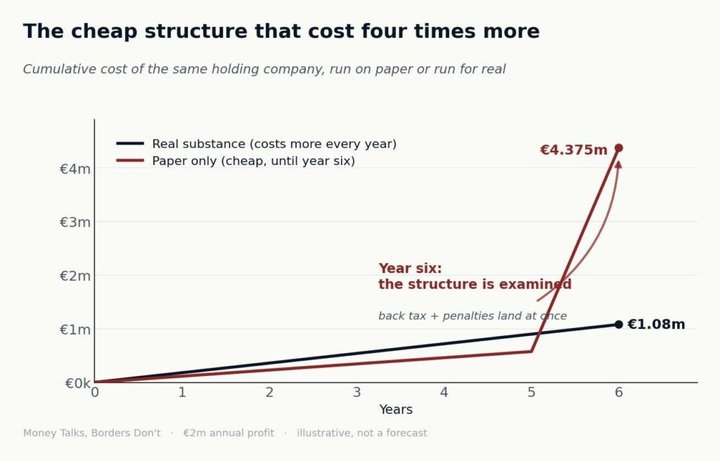
The company gets taxed where it’s really run, not where the letterhead says. Five years of profit come home. Roughly 2.4 million in back tax, less credit for what was paid abroad. Call it 1.9 million. Penalties land on top, in the same ballpark.
It all arrives at once. For years you’d closed and forgotten.
Six years of the cheap version: 4.4 million.
Six years of the real one: just over 1 million.
The structure that saved sixty-five thousand a year cost four times more.
And notice what failed. Not the paperwork. The paperwork was flawless right to the last day.
What failed is that nothing behind it was true.
Two: the SCI that never met
Smaller, more common, and I see this one constantly.
An SCI holds a French property. The statuts are perfect, drafted properly, filed properly. Two associés, a gérant, everything in order.
And in eight years, not one assemblée générale. No minutes. Ever.
The compte courant d’associé has money going in and out with no written convention behind it. The gérant signs everything alone because he’s the father and who’s going to argue.
For eight years this is completely fine. It’s fine right up until someone dies, or divorces, or a tax inspector picks the file.
Then the questions start, and none of them are about the statuts. They’re about whether this company ever made a decision as a company. Whether the current account is a loan or just a family member moving his own money through a shell. Whether the SCI is a company at all, or a costume.
The prevention was one meeting a year and a piece of paper recording it. Two or three thousand a year, mostly of attention.
The failure costs the entire benefit of the structure, backwards, all of it, in the worst possible week.
Same disease as the holding. Different size, different country, identical autopsy.
Three: what it’s costing you right now
A practical note, since plenty of you bank here.
While a country sits on that list, banks elsewhere apply enhanced due diligence to anything touching it. That’s not an accusation. It’s a risk input, and it’s automatic.
But watch what the questions have become.
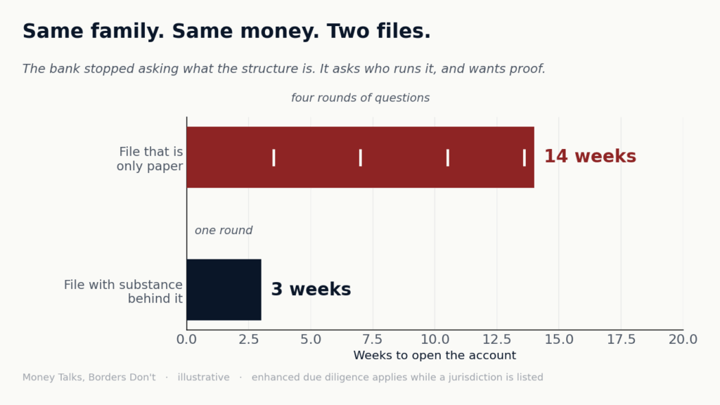
Ten years ago, opening an account meant producing documents. Certificates, articles, passports. The bank checked they existed and matched.
Now the bank wants to know who actually decides. Where. On what basis. And it wants that evidenced, not asserted.
A file that has substance behind it answers in one round. Three weeks and you’re open.
A file that’s only paper answers each question with another certificate, which produces another question. Four rounds. Fourteen weeks. Sometimes the bank just stops replying, which is its own kind of answer.
Nobody is calling you a criminal. They’re applying the same test the examiners applied to Monaco, at your scale. Not “is it correct.” Does it correspond to anything.
The good news is that this part is nearly over. The work is substantially done and the inspectors are coming. The Principality did the unglamorous half, which was proving the machine runs rather than merely exists.
And the local regulator has been proving it out loud. Breaches of Monaco’s AML law draw fines up to two hundred thousand euros, criminal exposure if they persist. Since late 2025 the sanctions decisions get published. First a real-estate agent, then a high-value-asset broker.
Publishing them is the whole point. An enforcement power nobody has ever seen used may as well not exist.
Three questions, one afternoon
We keep circling the same instinct here. Too many banks: give each one a role. Currency bleeding out of every trade: manage it once, on purpose. Assets you own but might not reach: spread the custody.
This is that instinct aimed at your own file.
The test stopped being whether an arrangement is correct. Correct is table stakes. Correct is thirty-nine out of forty, and Monaco can tell you precisely what that buys when the examiner is asking the other question.
The test is whether it’s real. Three questions get you most of the way.
Does anyone genuinely decide anything where the structure says decisions get made?
Is there a record of that deciding, written at the time, not reconstructed later by someone helpful?
Could you show the whole thing to a well-informed stranger tomorrow morning, without explaining what it’s for?
If any of those makes you pause, you don’t have a compliance problem yet. You have a paperwork asset with nothing behind it.
That prices itself later. All at once. In a year you weren’t expecting.
Monaco spent two years learning that a perfect rulebook proves nothing except that someone wrote it. Expensive lesson. Public. And now free, for anyone who wants it.
For analysis, not advice. The worked examples are illustrative and simplified: residence, substance and penalty rules vary sharply by jurisdiction and by facts. Every situation should be assessed with your own advisors.
Sources & notes
MONEYVAL’s fifth-round mutual evaluation of Monaco was adopted in December 2022 and published on 23 January 2023, based on an on-site visit from 21 February to 4 March 2022. It rated a moderate level of effectiveness for risk understanding, international cooperation, preventive measures applied by the private sector, use of financial intelligence, and implementation of UN targeted financial sanctions on terrorist and proliferation financing; found that major improvements were required on transparency of legal persons and terrorist-financing investigations and prosecutions; and found that fundamental improvements were needed on supervision, money-laundering investigations and prosecutions, and confiscation. The report raised concerns about a very low number of convictions and an even lower number of confiscation measures, none covering property of equivalent value or property held by third parties.
On the second scorecard: MONEYVAL assesses effectiveness across eleven immediate outcomes, rated High, Substantial, Moderate (achieved to some extent, major improvements required) or Low (fundamental improvements required). Mapping the published findings onto that scale gives eight at moderate and three at low, with none at substantial or high. That mapping is derived here from the Council of Europe’s published summary and the rating scale, not from a separate tally.
One point of precision that matters for the argument. Technical compliance can be upgraded through the follow-up process between evaluation rounds, which is how Monaco reached compliant or largely compliant on 39 of the 40 Recommendations after passing nine AML-related laws during the round. Effectiveness ratings are not re-scored that way; they are re-tested at the next full evaluation, which is why an on-site visit is the final gate.
The FATF placed Monaco under increased monitoring on 28 June 2024. At the June 2026 plenary in Paris, 15 to 19 June, it adopted Monaco’s fourth progress report and made an initial determination that Monaco has substantially completed its action plan and warrants an on-site assessment, which verifies that implementation has begun and is being sustained. As of the 19 June 2026 statement Monaco remained listed, alongside 21 other jurisdictions.
On enforcement in Monaco: breaches of Law 1.362, including beneficial-ownership identification and record-keeping, can draw administrative fines up to €200,000 and criminal penalties where they persist. The AMSF Sanctions Commission began publishing decisions, with November 2025 sanctions involving a real-estate agent and a high-value-asset broker.
The holding-company, SCI and onboarding examples are illustrative, built to show orders of magnitude. The figures are the author’s own and describe no actual case.
References: MONEYVAL Fifth Round Mutual Evaluation Report on Monaco (December 2022); Council of Europe; eucrim; FATF (June 2026 plenary statement, Jurisdictions under Increased Monitoring, Mutual Evaluation of Monaco); Monaco Life; NEWS.MC.