Active vs Passive ETFs – Insights from European Investors

17 FEB, 2025


Previous data from Research in Finance’s European Fund Selector Study (EuroFSS) revealed that investors in some European markets are now allocating more to passive ETFs than traditional index-tracking mutual funds when investing in passive strategies. In a new European ETF study (EuroETF) conducted by Research in Finance, they surveyed 450 retail fund buyers and distributors who use ETFs to explore the perceived pros and cons. The study also looked at which European countries are adopting active vs passive, and which companies they are using.
45% of retail intermediary clients invest in passive ETFs, but newer active ETFs are quickly gaining ground
Although passive ETFs have been around for longer, first launching in 1993, it now seems the lesser-known Active ETFs are certainly beginning to make their mark.
Passive ETFs remain the clear European favourite for now, with 92% of intermediaries who use ETFs offering them. Of those that offer passive ETFs, 45% of their clients have an allocation.
Active ETFs, however, are clearly growing at a substantial rate. EuroETF has revealed that out of existing ETF users, 49% of intermediaries are now recommending and allocating active ETFs. Of these, around 26% of their clients have an allocation. Smart/strategic beta ETFs in contrast, have shown fairly limited adoption levels, with lower usage.
Over 80% of those surveyed say that ETFs will be preferred to or complement mutual funds in the future
According to a previous wave of EuroFSS, Swiss fund buyers showed the strongest confidence in ETFs, with 56% of their passive allocations going to ETFs, rather than index-tracking mutual funds.
When asked to think about their business in five years’ time, 84% of EuroETF respondents suggested that ETFs will be either preferred or complementary to mutual funds. Investors in France and Switzerland were most likely to suggest that ETFs would be the preferred option in time. In Spain and the UK investors predominantly view ETFs as complementary to mutual funds.
7% of those surveyed suggested that ETFs will completely replace mutual funds in the future.
BlackRock / iShares is dominating the ETF market according to financial intermediaries
BlackRock / iShares is considered the market leader by far when it comes to passive ETFs, with 84% of survey respondents mentioning the brand as one of their top two perceived leaders. Second came Vanguard, mentioned by 49% of fund buyers, then Amundi with 19%. In total, 22 asset managers were mentioned by those surveyed when asked who they thought the market leader was.
When it comes to active ETFs, J.P. Morgan is considered the market leader, mentioned by 35%. This is followed closely by BlackRock / iShares at 34%, which belies the fact that the firm is at an earlier stage of active ETF development in Europe. This suggests that many intermediaries less familiar with active ETFs assume it is a leader in this space. Interestingly, compared to the 22 brands mentioned for passive, nearly twice as many brands are mentioned for active, 43 asset managers. This suggests there is a lesser concentration of active ETF providers in the minds of fund buyers, with a wider competitive field.
The biggest pros and cons of ETFs according to the intermediaries buying them
While costs will always be a predominant factor when selecting investments, buyers have expressed other tangible pros and cons when choosing the correct ETFs.
One wealth manager from France said:
ETFs are very popular, because they allow you to meet an investment need with a lower layer of costs. I use ETFs because they’re relevant and because they’re cheaper.
EuroFSS Qualitative Interview Q4 2024

After fees, the biggest pro for allocating or recommending passive ETFs is low tracking errors, mentioned by 39% of survey respondents. Low trading costs and liquidity were also mentioned by 34% of respondents.
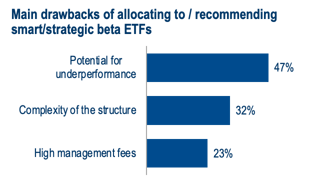
The biggest pro, voted for by 41%, for active ETFs is the potential for outperformance compared to passive. Potential for outperformance was also ranked top for smart/strategic beta ETFs.
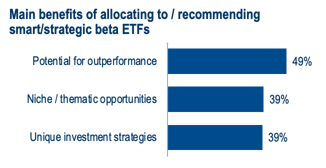
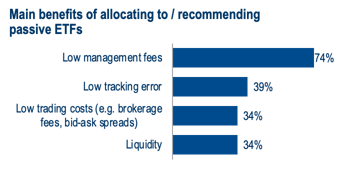
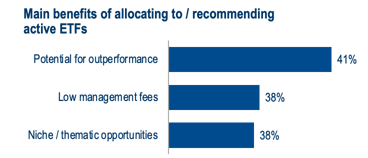
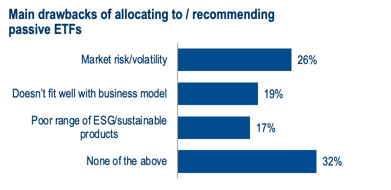
The cons for passive ETFs were led by market risk and volatility. This potentially reflects concerns of concentrated weightings to large-cap tech stocks in products tracking popular global and US indices. It also explains why the second response in the findings was that they don’t fit well with business models, and are considered less agile than active ETFs. Furthermore, they could also be more difficult to integrate into distribution models that are currently more reliant on commission payments.
A German financial advisor added:
With the increasing spread of ETFs and, of course, the increasing knowledge of customers, there are more and more discussions about the best investment plans. For unit-linked life insurance policies and retirement provision contracts, I now almost exclusively offer customers ETFs to reduce costs. For general wealth building, we still have a large proportion in active funds.
EuroFSS Qualitative Interview Q4 2024
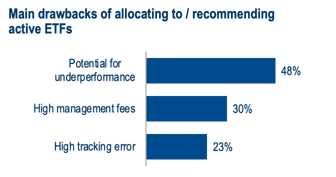
For active ETFs it’s the potential for underperformance that investors think is the biggest drawback, with 48% mentioning this. A separate question on expected tracking errors highlighted disparate views among intermediaries of how much tracking error, or active risk, they would tolerate in an active ETF. High tracking error was voted the third main drawback of active ETFs by 23%.