AI and the Productivity Frontier in Investment Management
17 NOV, 2025
By ARK Invest




Rahul Bhushan, Global Head of Investment Products, ARK Invest Europe
Much of today’s debate on artificial intelligence focuses on disruption—automation, job loss, and regulatory uncertainty. Yet a different story is unfolding across financial services. AI is emerging not as a threat to human capital, but as a powerful driver of productivity, scale, and value creation.
AI as an Engine of Operational Efficiency
In investment management, productivity is often the single greatest determinant of competitiveness. Firms that deploy AI across research, operations, and client servicing are already seeing measurable results. AI-assisted analysis can process vast datasets, generate summaries of earnings calls or filings, and highlight emerging trends in minutes, not days. This allows analysts to move faster from data to decision, while maintaining quality and oversight.
Across middle and back-office functions, AI’s impact is equally profound. Natural-language tools now automate compliance documentation, risk monitoring, and client reporting. Early evidence from industry pilots shows time savings of 30–50 per cent for recurring tasks, freeing up resources for product innovation and client engagement. Rather than replacing people, AI amplifies their ability to handle complexity.
From Automation to Augmentation
Our research suggests that AI could propel global software productivity gains worth more than $14 trillion by 2030, driven by the diffusion of AI-powered tools across sectors. These gains are not limited to technology firms—they extend to every data-intensive industry, including asset management and banking.
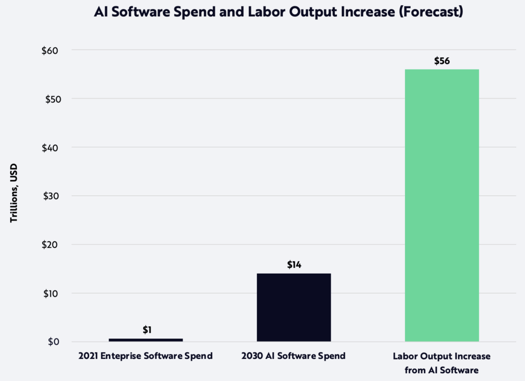
In the investment domain, the shift is toward augmentation. Portfolio teams can generate faster scenario analysis, automate macro screening, and synthesise qualitative inputs such as management tone or policy signals. Client-facing teams can use generative systems to draft tailored communications and portfolio commentaries, all subject to human review. The result is higher throughput, faster iteration, and more informed client conversations.
A New Productivity Cycle for Global Finance
If the industrial revolution multiplied muscle power, the AI era is multiplying mental power. As the financial system becomes increasingly digital, the marginal cost of intelligence is falling—creating conditions for new levels of output and efficiency. That dynamic can lift growth potential, support corporate margins, and reshape how capital is deployed globally.
For investors, this represents an under-appreciated theme. Companies that harness AI effectively may enjoy widening productivity spreads versus peers, a factor that can compound over time. The winners will be those who embed AI not just in tools, but in culture, governance, and decision-making.
At ARK, we see AI not as a short-term efficiency play but as a long-term productivity revolution—one capable of expanding the world’s capacity for innovation, financial inclusion, and economic growth.