Bigger. And Bigger. And Faster.

23 NOV, 2026


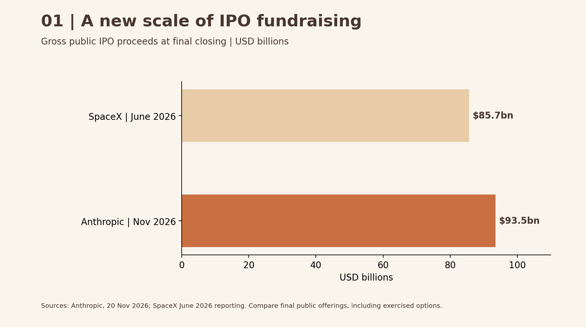
Five months after SpaceX's record offering, Anthropic came to market with an even larger one. On 18 November it priced 980 million shares at $83, raising $81.34 billion before the underwriters' option. By Friday, the final amount was larger again. It is tempting to focus on the records. As an investor, I am more interested in what the company will have to deliver to justify this extraordinary amount of capital.
From an indicative range to a record offering
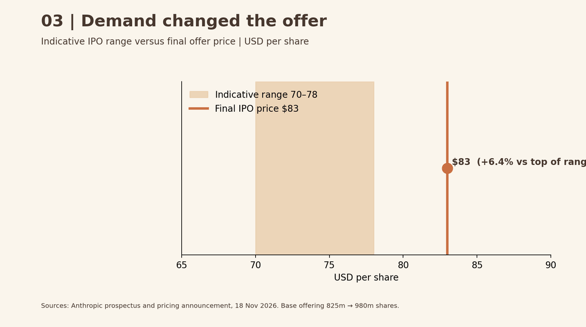
Anthropic's initial $70–$78 indicative price range gave way to a final price of $83, 6.4% above the upper end. The base offering expanded from 825 million to 980 million shares. Demand was clearly there. That is worth noting, but demand at the offering price tells us little about the return someone will earn buying shares once trading begins.
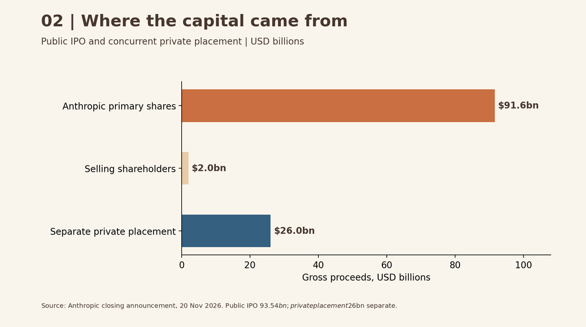
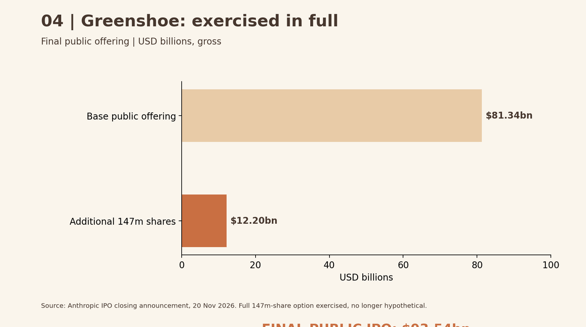
One important development since the original article: the underwriters exercised their option to purchase the full additional 147 million shares. Anthropic announced on 20 November that the completed public offering comprised 1.127 billion shares, generating approximately $93.5 billion in aggregate gross proceeds. Of that amount, approximately $91.6 billion related to shares sold by Anthropic; the remainder related to shares sold by existing holders. This replaces the earlier assumption that the greenshoe remained merely potential.
Separately, Anthropic closed a roughly $26.0 billion private placement of Class N shares to strategic technology investors. The public offering and concurrent private placement therefore amounted to approximately $119.5 billion in combined gross transaction proceeds. These categories must remain distinct: the $93.5 billion public IPO includes secondary shares, while the $26 billion private placement is not part of the public IPO. Gross proceeds are not the same as net cash available after fees and expenses.
Two trading sessions, two very different entry points
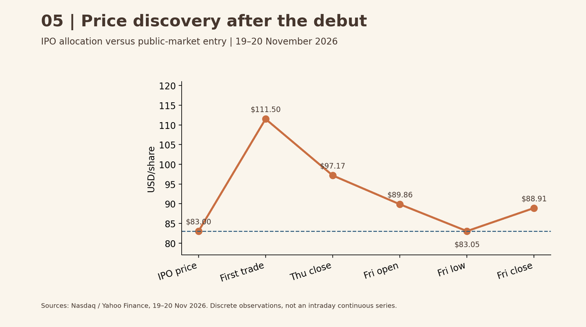
Anthropic began trading on Nasdaq under ANT on Thursday, 19 November. Shares opened at $111.50, a 34.3% premium to the $83 offering price, and finished the session at $97.17, still 17.1% above the IPO price but 12.9% below the first trade. On Friday, 20 November, the shares opened at $89.86, traded as low as $83.05 and closed at $88.91, down 8.5% on the day.
By Friday's close, the stock remained 7.1% above the price paid by investors allocated shares in the offering. But investors buying at the first public trade of $111.50 faced a mark-to-market decline of 20.3%. The company had not changed in those two days. The price paid for it had. For me, that is the most useful lesson from the debut. A strong investment thesis can still produce a poor result if the entry price leaves no room for disappointment.
I would also be careful about reading too much into two days of trading. AI-linked shares were under pressure more broadly, with investors again asking what the sector's enormous capital spending will eventually earn. Anthropic was trading in that market, not in isolation.
A greenshoe exercised early: funding certainty versus aftermarket flexibility
The full exercise of the underwriters' option is significant for more than the headline fundraising total. It secured an additional approximately $12.2 billion in gross primary proceeds for Anthropic. It also raises a legitimate market-structure question: how should issuers and underwriters balance maximising proceeds against maintaining flexibility to support orderly secondary-market trading? The timing has attracted scrutiny, but the share-price decline alone cannot establish improper allocation practices or deliberate selling by insiders. Those claims require transaction-level evidence.
After the IPO, the difficult questions remain
For portfolio managers, the real work starts after the opening bell. AI revenues are growing at exceptional speed, yet the business model requires equally exceptional access to compute, electricity, data centres and financing. A revenue run rate is not the same as audited annual revenue; contracted future capacity is not the same as cash already spent. Growth, margins, free cash flow and shareholder returns must be analysed separately.
The competitive map is broader than the model developer itself. Value may accrue to chipmakers and compute providers, cloud and data-centre operators, or application businesses that own distribution and customer workflows. Each layer has a different risk profile: supplier concentration and capital intensity in infrastructure; pricing pressure and model differentiation at the frontier; switching costs, retention and monetisation at the application layer. We may be right about the technology and still be wrong about where the investment returns end up.
What investors should watch next
I would resist drawing a firm conclusion from the next few trading sessions alone. I would watch whether a stable trading range emerges around or above the $83 offer price; how liquidity, turnover and institutional demand evolve after the opening frenzy; and whether future operating disclosures demonstrate that revenue growth is translating into improving unit economics and cash generation.
For long-term investors, I keep coming back to three questions. First, can revenue per unit of compute keep improving as competition intensifies? Second, how much additional capital must be committed before durable free cash flow emerges? Third, does governance preserve flexibility as technology, regulation and customer preferences evolve? These questions matter more than any single share-price move.
My investment takeaway
Anthropic has shown just how much capital investors are willing to put behind the next stage of AI. The first two trading days showed something else: raising capital successfully and buying an investment well are not the same thing. I remain fascinated by the opportunity. But I would rather ask difficult questions about cash generation, governance and price today than explain away disappointing returns tomorrow. The biggest IPO makes the headline. What that money earns will make the story.
Sources and methodological notes
- Anthropic, "Anthropic prices initial public offering", 18 Nov 2026
- Anthropic, "Anthropic announces closing of initial public offering", 20 Nov 2026
- Reuters, "Anthropic's post-debut stumble delivers reality check for AI trade", 20 Nov 2026
- Reuters, "Anthropic's blockbuster debut tests Wall Street's faith in AI boom", 19 Nov 2026
- Yahoo Finance, ANT historical price information, 19–20 Nov 2026
All prices in USD. IPO proceeds are gross before underwriting discounts and expenses. Return percentages are price-only, exclude transaction costs, and compare different entry points. Market data cutoff: Friday, 20 November 2026 regular-session close. As of the morning of 23 November, the next regular session had not yet closed.