Copper demand – the impact of Data Centers and AI

31 JAN, 2025



Author: Alice Fox, strategist at Macquarie
Data centres are once again in the headlines. It started in early January, with Microsoft announcing it would spend $80Bn on AI data centres this year, followed last week by President Trump and the Stargate Project announcing a $500Bn investment over the next four years to build AI infrastructure in the USA for Open AI. Not to be outdone, Meta subsequently announced an investment of $60-65Bn in 2025, with a large portion to be spent on a 2GW data centre. And then came Deepseek, which has upended the market this week by calling into question current assumptions on chip usage, electricity consumption, and required capital investment for AI.
We first looked at copper demand from data centres in May 2024, after the market whipped itself into a frenzy with reported estimates ranging from 500ktpa to over 2Mtpa copper demand by 2030. At the time, we concluded that the impact would be considerably lower than this, with our analysis quantifying the increase in copper demand at ~200kt by 2030.
Given recent developments, we have updated our estimates for both the copper required for the energy infrastructure to power the data centre and the copper in the data centre itself. At this time, we have not made any adjustments for the potential implications of newcomers like DeepSeek.
Power Infrastructure
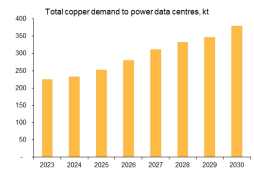
As before, the required power infrastructure is based on work by our Equity Research colleagues, who have quantified the power demand based on a bottom-up analysis of GPU/Accelerator and server-shipment forecasts. The required power capacity increases from 77GW in 2023 to 334GW in 2030, ~30% higher than previously estimated but still only ~5% of forecast global power additions. We assume that all power is generated from renewable sources, primarily solar, and apply an intensity-of-use to calculate copper demand will increase by ~155kt by 2030.
Generating renewable energy will require an additional ~155kt copper in 2030
Copper Usage Inside Data Centres
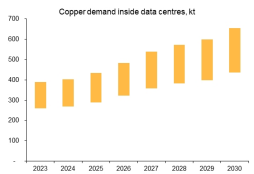
Reliable data is elusive. We previously noted that the amount of copper used in a data centre for data transfer has significantly decreased as computing power has gone beyond copper cable's technical limit. Data speeds are increasingly moving towards transmission rates of up to 800Gb/s, meaning fibre optics are now the preferred choice to connect servers, switches, and racks with ranges of a few to hundreds of meters. Copper is still used for connecting equipment intra-rack and in-between racks, depending on the bandwidth requirements. Given this uncertainty, we have quantified the increase in copper usage at 175-265ktpa copper by 2030.
Cooper usage inside the data centre
Total Copper Demand Increase
In total, we now estimate the increase in copper demand for data centres will be 330-420kt in 2030, with a mid-point of 375kt.