The dollar peering into the abyss

9 JUL, 2025
By Philippe Waechter
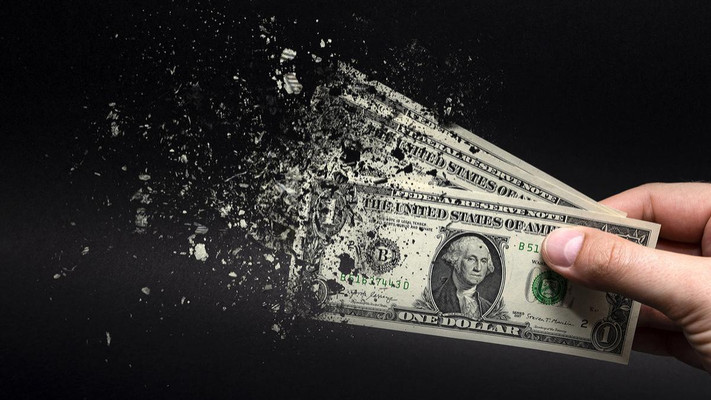


The Financial Times noted that the first half of the year had been the dollar’s worst since the first six months of 1973. At that time, the value of the greenback, measured against the six most important currencies, had fallen by 15%. In 2025, the drop in the first six months has been more than 10%.
The two periods are very different.
The events of the first half of 1973 marked the end of the Bretton Woods exchange rate system. The formal framework that had held the International Monetary System (IMS) together was no longer viable and had become too restrictive. Its sudden loosening prompted large-scale adjustments, especially for the greenback.
Today, the story is not the same, as the prevailing framework was that of a flexible market. It is the recent rupture that raises questions. Taking a specific dimension, the euro-dollar parity had regularly tracked short-term interest rate differentials (two-year rates one year ahead). Since Donald Trump's arrival, the two curves have diverged. The parity stands at 1.17, while the interest rate differential would suggest a parity closer to 1.07. It is the dollar that has the problem.
The fall of the greenback reflects the confusion surrounding economic policy across the Atlantic.
Uncertainty is causing a kind of hesitation among investors, who no longer follow interest rate arbitrage mechanically. The unpredictability of decisions from the White House and the lack of long-term clarity in economic policy are deterring investors.
The question now is what will happen next.
Will the US government allow the dollar to depreciate, as Stephen Miran desires? Miran believes the dollar is a public good and that its strength has enabled the development of the rest of the world and financial markets, to the detriment of the United States. Although this theory is debatable, its implementation would raise serious questions about the stability of the IMS.
Another possibility is the emergence of alternative currencies. Christine Lagarde speaks of a global euro and the conditions that must be met to achieve it. Pan Gongsheng, head of the Chinese central bank, no longer wants the dollar as a reference currency. He supports a multipolar IMS with strong competition between regional benchmark currencies. The yuan would not replace the dollar. Reportedly, he advocates for greater use of IMF-issued Special Drawing Rights as last-resort lenders. The story does not end here. Stablecoins, which resemble national currencies but are not, will increase monetary confusion. Central bank-backed digital currencies are also contributing to the confusion.
There is a risk of entering a monetary transition period that could lead to instability. From this perspective, the United States would bear significant responsibility for any potential chaos.