The Fed holds rates: Warsh begins his term with a hawkish message

18 JUN, 2026
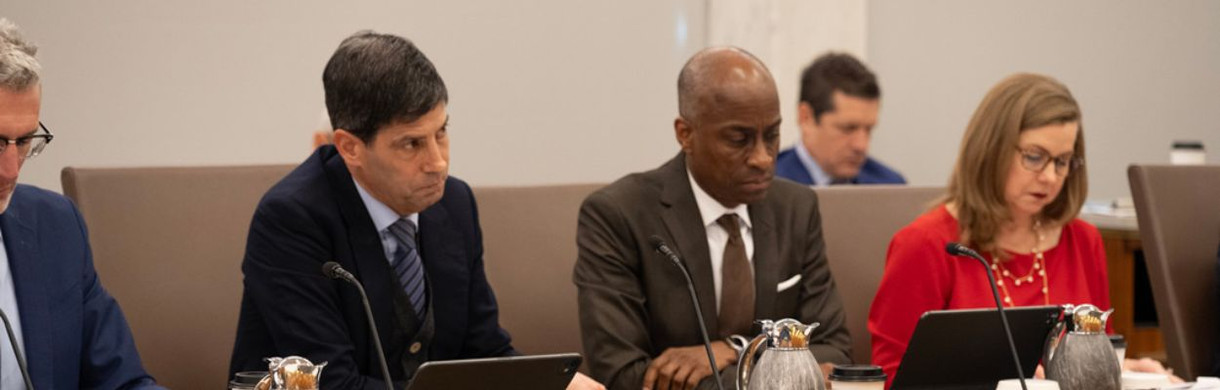


The US Federal Reserve held its fourth consecutive meeting without changes in interest rates, which remain in the range of 3.5%-3.75%. But the relevant thing was not the decision itself, completely discounted by the markets, but the debut of Kevin Warsh as president and the unequivocally restrictive tone he printed on his first meeting at the head of the central bank.
The revised dot plot, the most succinct statement in years and the refusal to offer guides about the future configure a regime change in the Fed that asset managers are already discounting in their portfolios.
What has changed with Warsh at the head of the Fed?
The most immediate change is in form, but it has profound implications. David Macià, Director of Investments and Market Strategy at Creand AM, points out that Warsh "does not believe in forward guidance", something that was evident from the first moment: the statement was the briefest in a long time and the new president avoided answering questions about hypothetical scenarios in the subsequent press conference.
This communicative austerity is not cosmetic. Warsh also refrained from including his point in the dot plot (dot diagram) and announced the creation of several working groups to review areas such as communication, balance or the measurement of inflation. According to Macià, "it is clear that more changes are to come".
What does the dot plot say about rates in 2026?
The dot plot was the main surprise of the session. Roger Rüegg, head of Multi-Asset Solutions at Zürcher Kantonalbank, delegated manager of Swisscanto funds, highlights that "9 of the 18 committee members anticipate a rate hike in 2026", with decreases not expected until 2027. The inflation forecast for the underlying PCE has been raised to 3.3%, significantly above the previous estimate.
Kay Haigh, global director and CIO of Fixed Income and Liquidity Solutions at Goldman Sachs AM, confirms that this hawkish turn is not only due to the specific rebound in energy prices: "despite the recent drop in oil, half of the FOMC members expect rate hikes as early as this year". The midpoint of the dot plot is, according to Jon Butcher, senior economist for the U.S. at Aberdeen Investments, between a hike and maintenance, although he clarifies that it is not clear whether the data were presented before or after the announced agreement between the U.S. and Iran.
What does this bias imply for the dollar and bonds?
The consequences on fixed income assets were immediate: the yields of U.S. debt increased after the decision. Macià points out that we can expect "higher interest rates" and a "stronger dollar" due to the rate differential against other economies, at least in the short term. The argument is clear: if the Fed maintains high rates while other central banks relax, the differential favors the dollar.
Rüegg nuances with a longer horizon: "we continue to expect that the official interest rate will remain stable until the end of the year, without new hikes", and anticipates that current expectations will eventually be incorporated into prices, which "should translate into a weaker dollar and lower bond yields". It is the only explicitly dovish counterpoint of the analysis.
How does this Fed affect equities and risk assets?
The impact on equities is more nuanced. From the asset management firm Creand Asset Management, they acknowledge that the stock market "benefits from an even stronger macro" and the enthusiasm around data centers, although they warn that "if the yield curves rebound too much they can complicate the equation". Swisscanto is more direct: "higher risk assets are finding it difficult to advance".
The lower visibility generated by the absence of forward guidance adds greater structural volatility to the environment. The markets, accustomed to the explicit guides of the Fed, will have to learn to operate without that reference.
Will the Fed raise rates in 2026?
The consensus answer is that the base scenario remains stability, but risks have clearly shifted upwards. Goldman Sachs Asset Management sums it up accurately: "our base scenario remains that the Fed will just be able to avoid further rate hikes, but the margin is narrow and the upcoming inflation data will be crucial".
On the side of Aberdeen Investments they believe that "a rise is not justified unless the conflict in the Middle East resumes and the price of oil rises sharply again". Meanwhile, service inflation, rigid by nature, will continue to be the main obstacle for Kevin Warsh to declare victory in his priority mandate: to return price stability to the 2% target.
Conclusion
The meeting on June 17 marks the beginning of a new stage in the Fed: less communicative, more data-dependent, and with a hawkish bias that the market will take time to fully calibrate. Warsh has not come to lower rates, but to recover the anti-inflationary credibility of an institution that has already spent a lustrum above its target.
Volatility is the price of this transition, and asset managers are already positioning portfolios accordingly: more short-term dollar, caution in equities if long rates continue to rise and eyes on the inflation data over the coming months as the definitive arbitrators of the cycle.