Five reasons to invest in CLOs

28 AUG, 2026
By Elena Rinaldi from TwentyFour AM



Collateralised loan obligations (CLOs) are securitisations backed by a broad pool of senior secured corporate loans, part-financed through the sale of bonds to investors.
Repayments from the loan pool generate income for CLO bonds, which are issued in tranches with different credit ratings and yields depending on their seniority and risk level.
The key difference between most CLOs and other securitisations, such as mortgage-backed securities, is that the loan pool is actively managed by a CLO manager. The CLO manager builds a diversified portfolio of loans to companies of different sizes across multiple sectors and geographies, and can add or remove loans during the investment period to try to optimise the CLO's returns.
With $1.1 trillion outstanding in the US and €300 billion ($349 billion) in Europe, CLOs represent a significant share of the global asset-backed securities (ABS) market and, for fixed-income investors, offer several potentially attractive characteristics.
Since regulatory changes in Europe will meaningfully reduce capital requirements for CLOs in early 2027, demand for the asset class is likely to increase.
Below are five potential advantages of CLOs.
1. Yield premium
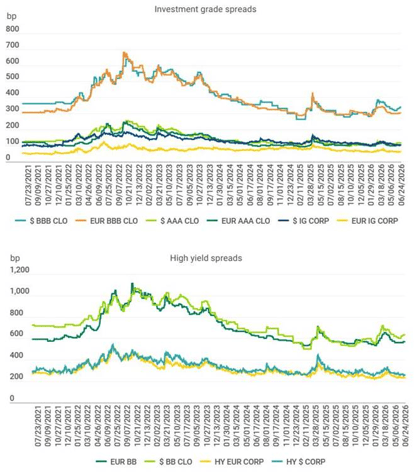
CLOs typically offer higher yields than comparably rated corporate bonds. While this CLO premium varies over time (see Chart 1), AAA-rated CLO bonds have historically offered yields very similar to those of BBB-rated corporate bonds, while BB-rated CLO bonds have typically offered more than 300 basis points of additional yield relative to high-yield (HY) corporate bonds.
Chart 1: CLOs have historically offered a premium over corporate bonds
Past performance is not a reliable indicator of current or future performance. Included for illustrative purposes only. It is not possible to invest directly in an index, and indices are not actively managed. Source: Citi, ICE Indices, Bloomberg, 30 April 2026.
One of the drivers of this yield premium is the asset class's specialisation, rather than lower underlying credit quality. Given the considerable expertise and resources required to analyse CLO structures and carry out due diligence on the underlying corporate loans, this can present an opportunity for active asset managers to capture the CLO premium and pursue higher returns.
2. Protection against floating rates
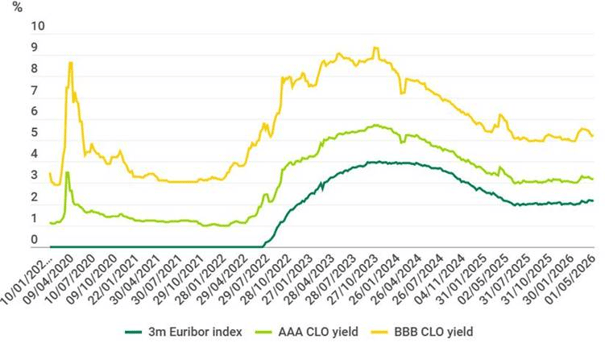
Most CLO bonds are issued at floating rates, so coupons adjust with interest rates. This means CLOs carry minimal duration risk, which can help hedge a portfolio against inflation or shifting market expectations around central bank policy.
Importantly, CLOs also incorporate interest-rate "floors" to prevent their yield from disappearing if reference rates fall significantly. As a result, CLO investors can benefit from rising rates while retaining some protection against downside moves.
As shown in Chart 2, the floating-rate structure of CLO bonds allows yields to rise naturally when reference interest rates increase.
Chart 2: CLO yields adjust with reference interest rates
Past performance is not a reliable indicator of current or future performance. Included for illustrative purposes only. Source: Citi, Bloomberg, 29 May 2026.
3. Diversification
Historically, CLOs have shown low correlation with more conventional bond markets, such as investment-grade (IG) corporate bonds and US Treasuries, making the asset class an effective diversifier for broader fixed-income portfolios.
CLO loan portfolios themselves are granular and generally well diversified by industry, geography and sector, which helps mitigate underlying credit risk. A typical US CLO portfolio contains between 300 and 400 loans, for example, while a typical European CLO portfolio contains between 150 and 200. Standard market concentration limits also cap maximum exposure to a single borrower at 2.50% in Europe and 2.00% in the US, limiting the impact of any single loan's performance on the overall portfolio and helping to reduce idiosyncratic credit risk.
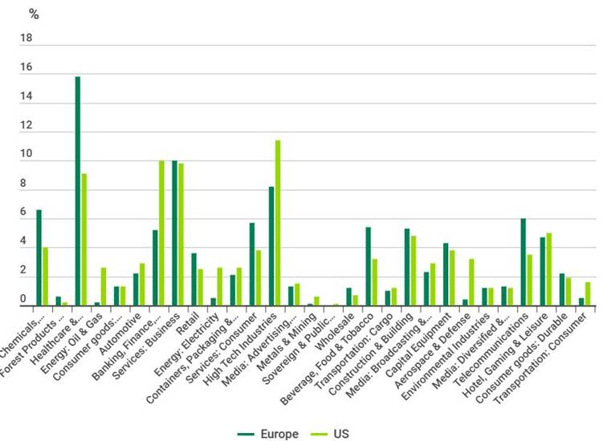
A global approach to CLOs can enhance this diversification benefit, given the significant differences in subordination levels, regulation, CLO management styles and sector exposures (see Chart 3) between the US and European markets.
Chart 3: US vs European CLO sector exposure
Source: IHS Markit, Intex, Moody's, Deutsche Bank, 30 May 2025.
4. Loss mitigation for bondholders
CLOs feature certain structural characteristics designed to protect investors' coupon and principal payments against the risk of losses on the underlying assets.
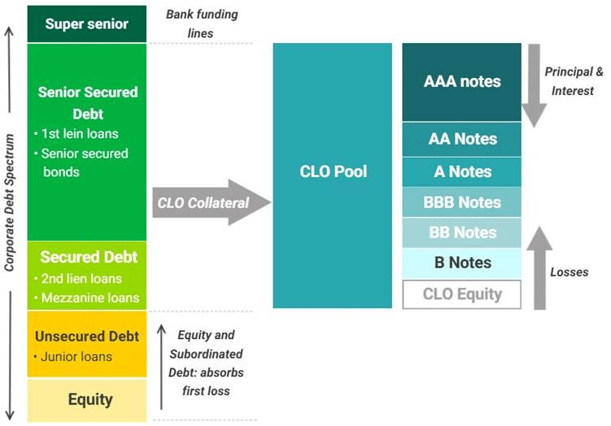
The first of these is subordination. If loans in the CLO pool pay interest and principal as scheduled, this allows interest and principal on the bonds to be paid in order of seniority, from the AAA tranche at the top down to the equity tranche at the bottom — often referred to as a "waterfall" structure. However, if the performance of the loan pool deteriorates enough to affect these cash flows, senior bondholders benefit from subordination, as the lower-ranked tranches — starting with equity and working upward — absorb losses first (see Chart 4).
Chart 4: Senior bondholders benefit from subordination
Source: TwentyFour, June 2026. Used for illustrative purposes to show a typical CLO and not based on any specific security.
This subordination, also known in the market as "credit protection", can act as a buffer against losses. For example, on average, the BB tranche of a European CLO has subordination of around 9.5%; for BB bondholders to suffer their first euro of principal loss, the loan pool's default rate would need to reach approximately 30% (assuming a 70% recovery rate). For AAA securities, this credit protection rises to around 40%, meaning the loan pool's default rate would need to exceed 90% (again assuming a 70% recovery rate) before a typical AAA tranche suffered its first principal loss.
Additional risk mitigation for bondholders comes in the form of credit enhancement, referring to the techniques CLO managers use to improve the creditworthiness of CLO debt tranches. These include over-collateralisation (which ensures the principal value of the underlying loans exceeds that of the CLO's debt) and cash reserve funds, whereby a predetermined proportion of cash flows is retained to cover any shortfall in coupon payments that might arise from unexpected losses in the portfolio.
To further mitigate underlying credit risk, CLO managers take on binding commitments regarding how they will build and manage the asset pool. Limits are set on exposure to lower-rated loans or specific sectors, for example, while collateral quality tests set minimum levels for indicators such as over-collateralisation and interest coverage ratios. Importantly, these commitments can vary, making it essential to scrutinise each deal's terms and each CLO manager's overall approach.
5. A track record of low default rates
CLO credit performance has proven resilient over the long term. Globally, not a single AAA-rated CLO has defaulted in the past 25 years, according to ratings agency S&P — a period spanning both the global financial crisis and the COVID-19 pandemic. Further down the capital structure, CLOs have historically recorded lower default and loss rates than comparably rated investment-grade (IG) and high-yield (HY) corporate bonds (see Chart 5).
Chart 5: CLO default rates vs corporate bonds
Source: S&P default study, 2023. Past performance is not a reliable indicator of current or future performance. Included for illustrative purposes only and based on available data.
This track record is due, in part, to a CLO's senior secured loan structure. These loans still carry default risk, but their senior position in the corporate creditor hierarchy means that, in the event of default, they tend to generate higher recovery rates than "vanilla" corporate bonds. CLOs' historical credit performance is also supported by other loss-mitigation features, such as the over-collateralisation tests described above, which ensure CLO cash flows are directed to senior tranches if the value of the loan pool falls below a predetermined level.
Why TwentyFour?
The potential advantages of investing in CLOs are clear, but we believe capturing them successfully while managing market risks requires specialist active management. At TwentyFour, CLOs are a core part of our ABS business, and the $3.7 billion we had invested in the asset class across all our strategies as of May 2026 represents around 15% of the firm's total portfolios.
In London, we have a ten-person ABS and CLO investment team that combines deep securitisation expertise with thorough analysis of underlying asset risk. This gives us a clear view of CLO issuer management teams, their risk management approaches, culture and market positioning.
The TwentyFour team is highly selective and uses a relative-value approach, seeking attractive risk-adjusted opportunities across the capital structure in both the US and Europe. We also maintain long-standing relationships with leading CLO managers, which can be important for accessing new deals in a market driven by primary issuance. We believe this combination puts TwentyFour in a strong position to capture opportunities in the market.
1. Bank of America, June 2026.
2. Default, Transition, and Recovery: 2025 Annual Global Leveraged Loan CLO Default and Rating Transition Study (S&P).
Important information
The views expressed represent TwentyFour's assessment as at 25 June 2026; they may change and other members of the Vontobel Group may not share them. This analysis is based on publicly available information as of the date indicated above and is for informational purposes only; it should not be interpreted as investment advice or a personal recommendation. References to securities are for illustrative purposes only and should not be considered a recommendation to buy, hold or sell any of the securities mentioned in this document.
Any projections, forecasts or estimates contained in this document are based on various estimates and assumptions. Market expectations and forward-looking statements are opinions, are not guaranteed and are subject to change. There is no guarantee that estimates or assumptions regarding future financial performance of countries, markets and/or investments will prove accurate, and actual results may differ substantially. The inclusion of projections or forecasts should not be interpreted as an indication that TwentyFour or the Vontobel Group consider such projections or forecasts to be reliable indicators of future events, and they should not be relied upon as such. We reserve the right to make changes and corrections to the information and opinions expressed in this document at any time and without prior notice.
Past performance is not a guarantee of future results. Investing involves risk, including possible loss of capital, and diversification does not protect against the risk of loss. Neither the value of the investment nor the income derived from it is guaranteed, and investors may get back less than they originally invested.