Fixed Income Investing: where to find opportunities?

14 NOV, 2024



Once all the major central banks around the world have started on the path of lowering interest rates the answer is, is there still value in fixed income?
The analysis and selection of securities in the fixed income markets becomes more valuable as Central Banks move into an interest rate cutting cycle. In addition, the macroeconomic turbulence that may shake markets in the coming months (the impact of Donald Trump's policies on inflation, geopolitical tensions and their effect on commodity prices, etc.) underscores the importance of active management in fixed income markets.
When the Stars Align: Opportunities in Fixed Income

Flavio Carpenzano, Fixed Income Manager at Capital Group
The Federal Reserve has followed in the footsteps of the European Central Bank (ECB) and the Bank of England, beginning to cut interest rates. Therefore, the question is not whether the Federal Reserve will cut rates in this cycle, but rather by how many basis points. As the easing cycle commences, fixed income markets could offer attractive investment opportunities thanks to high starting yields and the potential for capital gains that rate cuts typically generate.
The Power of Yield
Yields remain attractive across the fixed income market; however, we are beginning to see a decline in spot rates. Spot rates are still comparable to those of investment-grade (IG) credit, as both are around 5%. However, looking ahead one year, the forward market is currently pricing a spot rate of 3.4%, compared to 5.1% for IG credit. In other words, fixed income markets now offer investors the opportunity to secure income over a longer term.
Despite positive year-to-date results, bond yields remain comparable to those seen at the start of 2023. While nominal yields have stayed largely unchanged, inflation has significantly fallen over the past 18 months, leading real yields to rise to healthy positive levels. For example, the real yield on Investment Grade (IG) credit currently stands around 2%. This is significant because, for most of the period following the global financial crisis, real rates were very low or even negative. Consequently, the current environment offers credit investors the opportunity to achieve positive long-term returns.
Yield levels are important not only for the income they provide but also because the initial yield of a bond is highly correlated with its future total return.
Balancing Risk through Duration
In addition to the high yields still available in this asset class, fixed income returns can also benefit from the capital gains that typically accompany rate cuts. The macroeconomic context has shifted from a focus on inflation concerns to a possible slowdown in growth. This means that duration shifts from being a potential drag on portfolio returns to a potentially positive factor.
A Positive Macroeconomic Environment
A multi-sector approach has the potential to capture any tailwinds from duration and offers investors the opportunity to benefit from the attractive yields still available across all fixed income sectors. The broad investment universe accessible with this approach helps diversify available income opportunities and provides the investment team with the ability to adjust positioning across segments as market conditions change.
When analysing the shift in the macroeconomic environment, a soft-landing scenario remains, in our view, the most likely outcome: inflation is falling towards target, and growth, while moderate, remains resilient, allowing rates to come down. This is the optimal outcome for fixed income. The only scenario that could pose a challenge for returns is a reacceleration of inflation. In our view, economic data from the summer suggests that the likelihood of inflation reaccelerating has decreased, while the probability of slow growth and lower inflation has increased.
Good Times Return for Bonds as the Fed Embarks on a Rate-Cutting Path

Vikram Aggarwal, Fixed Income Manager for the Jupiter Global Sovereign Opportunities Fund, Jupiter AM
Investing in global government debt has been a real challenge for investors, as the fixed income landscape has undergone significant changes in recent years, presenting both unprecedented opportunities and increased risks. Now that the Federal Reserve is in a rate-cutting cycle, this asset class has re-emerged as a potentially attractive investment opportunity for active investors.
Understanding Global Government Debt
Global government debt consists of debt securities issued by governments worldwide. These bonds represent a loan from an investor to a government, with a promise to repay the principal along with periodic interest payments. Generally, they are considered among the safest investments, as governments are less likely to default on their debts compared to companies. However, the level of risk and potential return varies widely from one country to another. For instance, developed markets like the U.S., the UK, and Europe offer lower yields but also lower default riskcompared to emerging countries like Mexico, Argentina, and Brazil. We believe there is room for a more active, unconstrained government debt strategy in an environment where correlations are no longer constant or negatively aligned with other asset classes.
Good Times Return for Bonds
The fixed income investment landscape has changed dramatically in recent years, offering investors unique opportunities and challenges. As the Federal Reserve has embarked on a path of interest rate cuts, the appeal of global government debt has resurfaced. This asset class, often overlooked in favour of equities, offers a combination of income generation, diversification, and potential capital appreciation.
Government bonds have struggled recently, as the era of ultra-low interest rates led investors to seek returns elsewhere. Over the past few years, with rising interest rates and tightening monetary policy, we have entered a new environment for this asset class, characterised by high volatility and a dispersion of yields among public issuers worldwide. This is a situation we expect to continue, which could make global government debt a good alternative for active investors seeking to outperform the index. We believe there will be more desynchronised economic cycles, as countries are at different points in the growth and inflation matrix, and central banks are taking varied actions. For example, Brazil’s central bank cut rates much earlier than developed markets and has recently raised them again. This means there are more opportunities to achieve specific returns by capturing each country’s “alpha” and enabling active managers to outperform the market.
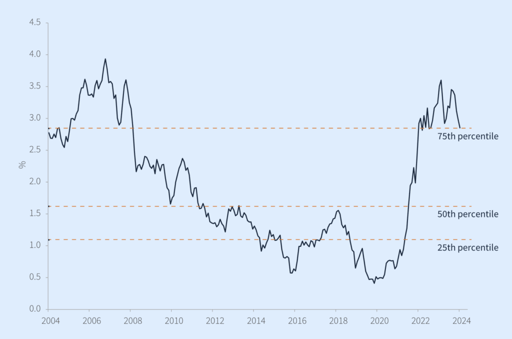
Following a decade of ultra-low interest rates, government debt yields have returned to relatively attractive levels. For example, the chart below shows how yields (according to the Bloomberg Government Bond Index) have returned to the upper quartile after a significant decline over the past 10 years. Of course, it’s important to remember that quoted yields are not a guarantee of return levels but do highlight how the asset class has regained favour with investors.
The Importance of Global Diversification in Government Debt
Global government debt can play a crucial role in diversifying a multi-asset portfolio. Historically, it has shown negative correlations with equities, meaning they tend to move in opposite directions so that when equities rise, bonds fall, and vice versa. However, in recent years, this correlation has weakened and even turned positive, as seen in 2022when bonds and stocks moved in tandem. This discouraged many investors who understandably questioned the role of government debt in diversifying their portfolios. As a result, to achieve true diversification, we have had to look to government debt, sovereign credit, and emerging market currencies to structure a portfolio that serves as a traditional hedge against riskier asset classes.
We believe that emerging market government debt is an attractive area for finding interesting investment opportunities in individual countries, benefiting a diversified portfolio. Another point worth noting is that emerging markets are increasing their weight in global government debt indices. For example, over the past 10 years, emerging markets have grown from representing 4% of the global government debt index to now accounting for 15%. Looking ahead, over the next 10 years, this weight is expected to increase as countries like South Korea join the global government debt indices.
Therefore, the current market conditions, characterised by falling interest rates and increased volatility, could make it a timely moment for investors to consider global government debt. By carefully considering the benefits of active management and the diversification advantages of global government debt, investors can position themselves for long-term success.