Generating alpha through contrarian positions in four energy credits
16 OCT, 2025

By Leon Wei from Jupiter AM

By Adam Darling from Jupiter AM



April was the cruellest month for oil prices this year. During that month, crude prices fell to their lowest level in more than four years after President Donald Trump unveiled his “America first” tariff policy.
The steep reciprocal tariffs induced fears of a sharp slowdown in global growth, casting a shadow over crude demand. Oil prices recovered slightly in the latter part of April after Trump paused the higher tariffs for 90 days. However, prices revisited the April lows in May following an OPEC+ agreement to ramp up output.
Energy credits were hit the hardest by the steep fall in oil prices in April and May, trading as if a severe recession was a certainty, even as credits in other sectors rebounded on a market view that “Taco” Trump would back down from his more extreme pronouncements to avoid recession and market crash. This divergence didn’t make sense to us and helped to inform us that the energy sector was cheap on a relative basis.
Brent Crude
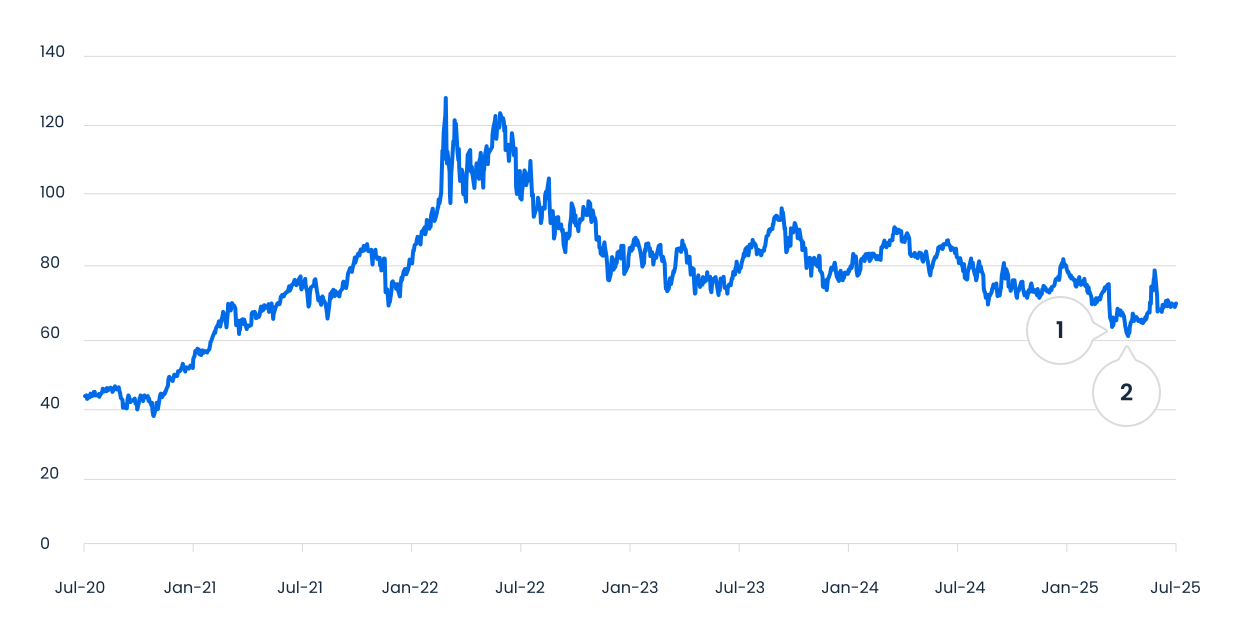
We also believed that crude prices wouldn’t remain severely depressed for a prolonged period, because a long-drawn slump would have made it uneconomical for marginal producers to sustain output, ultimately leading to a recovery in oil prices. This inherent tension between supply and demand is why commodity markets tend to balance themselves out in the medium to long term – with a strong reversion to the mean price tendency that markets tend to overlook at pessimistic and optimistic extremes. These factors encouraged us to take a contrarian and more positive view on our energy exposure.
As with any contrarian view, timing the market turn is difficult, and therefore we ensured the energy names we selected had a solid credit profile, with the resilience to withstand a long period of low oil prices. Some of the names to which we have exposure in the oil exploration and production space include Karoon Energy, Saturn Oil & Gas, Azule Energy, and Talos Energy. All these bonds have rallied strongly from their April lows.
Karoon Energy is an Australian-listed company with key producing assets in offshore Brazil and the US Gulf of Mexico. We have exposure to Karoon, given the company’s relatively low leverage, decent equity cushion, adequate liquidity, and expected positive Free Cash Flow (FCF) generation. We believe these positives help to offset the company’s moderate scale, relatively mature asset in Brazil, and near-term risks relating to shareholder returns and M&A.
The company has a clear fiscal policy of keeping net leverage below 1.5x. The company has a relatively low breakeven oil price of high $50s Brent. Given these factors, we hold Karoon’s 2nd lien notes due in 2029.
Saturn Oil & Gas is a Canadian-listed company with onshore assets in Canada (Alberta/Saskatchewan). We own Saturn Oil’s bonds due in 2029, as we consider it a decent credit, supported by reasonable leverage and expected positive FCF generation. The secured nature of the bond and the sizeable mandatory amortisation also provide additional comfort from a credit perspective. Even assuming $60 WTI, we would still expect the company to be able to generate sufficient FCF to make the mandatory amortisation payment and de-lever going forward.
Azule Energy is 50/50 owned by BP/Eni with main assets in Angola. Azule has a solid credit profile supported by its decent scale and relatively low leverage. The company’s ownership by oil majors BP and Eni is a key credit positive. In addition, despite the assets being located in Angola, there are several important mitigants (e.g. all revenues are received and held offshore in USD with limited capital control/conversion risks) for the company’s emerging market risks. Therefore, we own the company’s bonds due in 2030.
Talos Energy is a US-listed company with offshore assets focused on the Gulf of Mexico. Whilst the Gulf of Mexico is exposed to regulatory risks, the company’s credit profile is supported by reasonable leverage, adequate scale and expected positive FCF generation at the current commodity forward curve. The company, founded in 2012, has survived through both the 2016 as well as the 2020 energy downturn, and has managed to increase its production by more than three times over the past decade even while keeping net leverage in check.
Market sentiment towards energy has improved materially from the lows after “Liberation Day”. By combining robust top-down macro risk assessment with bottom-up credit analysis, we gained confidence to take a contrarian position in a moment of market stress. As mentioned, our selection process is predicated on thorough credit analysis and research, paying close attention to our portfolio companies’ liquidity, leverage and free cash flow generation. We also take into account the relative value of the bonds that we hold in comparison to peers. Keeping in view the Jupiter Global High Yield Bond fund’s philosophy of staying "Active, pragmatic and risk-aware”, we aim to deliver alpha by identifying those bonds that we think offer the opportunity for the most compelling risk-adjusted returns relative to the market.