Gold’s Geopolitical Renaissance: Structural Tailwinds and Strategic Allocation Insights

28 APR, 2025
By Guy Wagner


The price of gold is determined by the interaction between supply and demand for the metal. It is therefore worth briefly reviewing the sources of demand and supply, which are:
On the demand side
- Industrial demand: the yellow metal is used in electronics, aeronautics, medicine, etc. Gold is highly conductive and corrosion-resistant, making it particularly valuable for certain industrial applications.
- Financial (or investment) demand: here, gold is sought for diversification purposes, for its safe-haven qualities and its (often) negative correlation with other asset classes. This generally involves purchases of paper gold (gold-linked financial instruments, primarily ETFs). However, these purchases can also be supplemented by private purchases of bullion or coins during periods of great financial or geopolitical uncertainty.
- Demand from central banks: their purchases are generally motivated by the desire to diversify their foreign exchange reserves.
- Jewellery: countries like India and China are the main consumers here, for cultural and traditional reasons.
Industrial demand is the least significant (generally between 5% and 10%) and generally varies little over time. After falling sharply during the pandemic, demand from the jewellery industry has recovered, but remains well below pre-pandemic levels. It is obviously quite price-sensitive.
On the supply side
- Mining: the main source of supply. ESG constraints and the decision to prioritise the return of capital to their shareholders have meant that gold companies have invested little in exploration in recent years, and there have been no major discoveries of new deposits for some time. As a result, the supply of gold from mining operations is unlikely to rise much in the coming years.
- Recycling: jewellery, electronic waste, dentistry. All the more attractive when gold prices are high.
- Central bank sales.
- Sales by investors.
Since gold is indestructible, it's worth bearing in mind that today's demand is tomorrow's potential supply. Under normal circumstances, the price of gold is essentially determined by investment demand and the actions of central banks.
Gold price trends
Since the beginning of this century, gold has offered an annualized return of around 10% in euro and dollar terms. The evolution of its price can be divided into 3 periods:
- 12 consecutive years of rising prices between 2001 and 2012.
- A decline of some 40% between the end of 2012 and the end of 2015.
- A tripling of the price since then.
Gold price
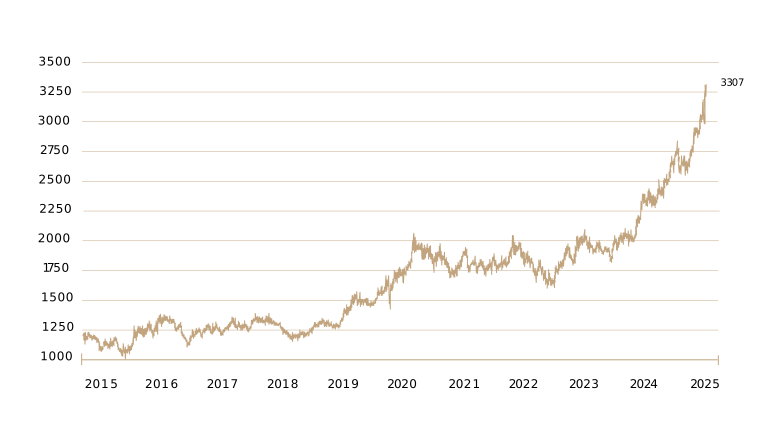
More recently, after a slight decline in 2021/2022, the yellow metal has embarked on an impressive upward trend, rising by 13% in 2023, 27% in 2024 and 19% in the first quarter of the current year. The rise in the gold price in 2023 and 2024 may come as a surprise, given that it took place against a backdrop of a firm dollar and rising real interest rates. In the past, gold prices were generally negatively correlated with the greenback and, above all, with real interest rates, which makes sense given that the yellow metal pays no interest. In reality, however, the rise in real rates did have the expected impact on financial demand, with massive capital outflows recorded by gold ETCs (exchange-traded gold funds) between April 2022 and June 2024. Under normal circumstances, these outflows would have led to a sharp fall in the metal's price. However, they were more than offset by purchases by central banks, particularly eastern central banks. Purchases by the latter have risen sharply since 2022. The decision by Western governments to freeze Russia's foreign exchange reserves was a detonator in this respect. It has reinforced the desire of many countries to reduce their dependence on the dollar and US government bonds, and to hold a growing proportion of their foreign exchange reserves in a neutral asset with no counterparty risk. Official purchases by these countries could also be motivated by the possible reintroduction of gold into the global monetary architecture, under the impetus of China, which aims to establish an alternative to the dollar-based Bretton Woods inspired financial system. Gold is thus increasingly moving eastwards. In fact, history shows that the yellow metal has always tended to move towards countries where the capital stock and savings are growing.
While the rise in recent years thus has more to do with geopolitical than financial considerations, investment demand did return from the middle of last year, as evidenced by the capital inflows recorded by ETCs since then. This return of financial demand can be explained by the loosening of monetary policy by US and European central banks. Finally, in 2025, the uncertainties surrounding tariffs and US trade policy were compounded by Donald Trump's attacks on the Federal Reserve and its Chairman, which are interpreted as a desire to put an end to the independence of the US central bank.
What's next?
Gold's rise since the start of the year has been spectacular. Based on many indicators, gold is now overbought and a correction is obviously possible and could even be considered healthy. Such a correction could be triggered by a slowdown or temporary halt in central bank buying, by a lull in geopolitical or trade tensions, or simply by profit-taking. Central bank purchases are generally not very price-sensitive, but the speed with which the price has recently risen could nonetheless prompt them to slow down or temporarily halt their purchases. In the past, demand for gold has also often shown seasonal effects, with a slowdown from May onwards and a notable upturn in the autumn. A possible correction in the gold price would represent a buying opportunity. The long-term outlook for the yellow metal remains favourable:
- Firstly, for the reasons set out above, the supply of gold will not be able to rise much in the coming years. At the same time, the supply of paper currencies will only increase.
- Geopolitical developments, marked by the fragmentation of the global economy into two or more blocs and the loss of confidence in the dollar, increasingly seen as a geopolitical weapon used by the USA, will continue to argue in favour of gold. Eastern central banks' purchases are part of a strategy to recycle their trade surpluses through channels other than US government bonds, which have lost their lustre as safe, neutral assets.
- As mentioned above, financial demand returned in the second half of 2024. This demand could prove all the more important as any renewed rise in inflation would put central banks in the unpleasant position of having to choose between fighting inflation or limiting debt servicing costs (interest payments on existing debt). As gold is a hedge against inflation in the monetary sphere rather than in the real economy, any return by central banks to much less restrictive monetary policies, or even to some kind of quantitative easing, would be likely to boost the price of the yellow metal. History has shown that periods of particularly high public indebtedness are always accompanied by negative real rates (interest rates adjusted for inflation). Recourse to inflation makes it possible to reduce the real cost of debt, provided that such higher inflation does not lead to an equivalent rise in interest rates.
- Among the functions generally attributed to a currency - unit of account, means of payment and store of value - gold essentially fulfils that of a store of value. For example, since the beginning of this century, inflation in the USA has averaged 2.6% per year (based on the consumer price index. Many observers believe that this index grossly underestimates the true increase in the cost of living). As a result, the dollar has lost some 50% of its purchasing power since 2000. Over the same period, the yellow metal has appreciated by 10% a year against the dollar. In other words, the greenback, like the euro, has lost 90% of its value against gold. Gold, on the other hand, has not only protected, but increased the purchasing power of investors.
- There have been periods, of varying length, when gold's quality as a store of value has not been sought after, and the yellow metal has been regarded as a relic of the past. These are generally periods when monetary authorities are concerned with maintaining the purchasing power of their currency, and fiscal authorities are exercising budgetary rigor. During such periods, Warren Buffett's famous remark about gold is clearly valid: "Gold gets dug out of the ground in Africa, or someplace. Then we melt it down, dig another hole, bury it again, and pay people to stand around guarding it. It has no utility. Anyone watching from Mars would be scratching their head." Between 1980 and 2000, the price of gold depreciated by over 50% against the dollar. The reason for this decline was the Federal Reserve's decision, under Paul Volcker, to undertake unprecedented monetary tightening to combat inflation. It should be noted that this period was also marked by limited budget deficits in the main industrialized countries, with the USA even recording a budget surplus under the presidency of Bill Clinton, and by the important role played by the Bundesbank in Europe. Times have clearly changed. In 2024, both the Federal Reserve and the European Central Bank relaxed their monetary policies, while the inflation rate remained above the target they themselves had set. The goal of price stability clearly no longer seems to be a priority.
In conclusion, the conditions for a continuation of the upward trend in gold appear to be in place. We often hear the remark that, after the sharp rise of recent years, the price of gold is too high and it's too late to buy. In the case of gold, however, such considerations make no sense. Too high compared to what? It's true that the price of the yellow metal is at an all-time high, but if we compare its evolution since 1980 with that of economic or financial variables such as industrialized countries' GDP, money supply, public debt, house prices and stock markets, gold lags far behind. In real terms, gold's progress is also far less spectacular: adjusted for inflation, the $850 gold reached in January 1980 during a period of high inflation and geopolitical tensions would correspond to around $3,000 today, a level the yellow metal has only recently reached.
An investment in gold should always be seen as insurance, not as a short-term investment. In the current context, another quote from Warren Buffett seems highly relevant: "Gold is a way of going long on fear, and it has a pretty good track record in that respect. But you really have to hope people become more afraid in a year or two than they are now. And if they become more afraid you make money, if they become less afraid you lose money, but the gold itself does not produce anything."
Gold companies
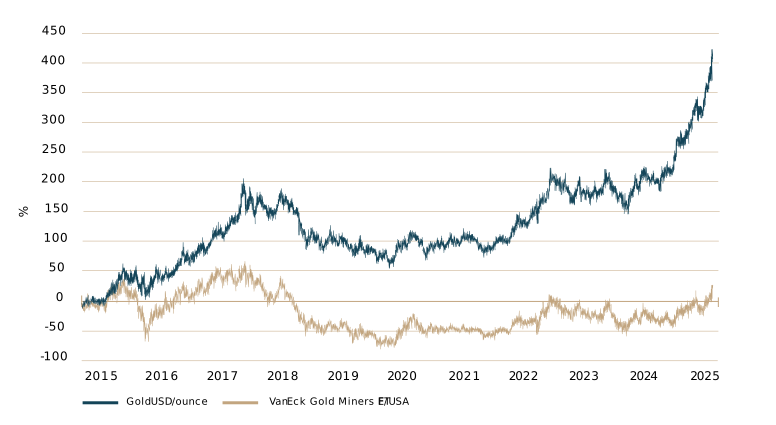
Insofar as they often amplify gold's movements, gold companies offer leverage for investors confident in the yellow metal's medium- to long-term prospects. Nevertheless, as a group, these companies have tremendously underperformed the metal in recent years. The gold mining index is some 25% below its September 2011 level, while the gold price is now more than 70% above its level at that time. Apple's market capitalization alone represents more than three times the sector's total market capitalisation.
Gold and gold miners index
There are a number of factors to consider before making an investment:
- The sector is characterized by high volatility. Moreover, there are periods when gold companies are more correlated to the stock market than to gold.
- Gold producers' business model is based on finite resources: once the gold has been mined and smelted, it's gone, and new gold has to be found.
- The positive effect of a rising gold price on gold companies' profit margins may be offset by a rise in their operating costs, starting with higher energy costs.
- In the past, gold companies have not always been disciplined in their allocation of capital. They tended to act pro-cyclically, increasing exploration expenditure or making acquisitions at high prices when gold prices were high. When the price subsequently fell, they found it extremely difficult to make these expenditures and acquisitions profitable.
- In the current cycle, however, gold companies have so far generally shown great discipline. Despite rising gold prices, they have remained reluctant to increase capital expenditure, preferring to pay down debt, increase dividends or buy back shares. As a result, the sector today offers a rarely seen combination of solid balance sheets, strong cash flow generation, capital allocation discipline and attractive valuations.
Selectivity remains key when investing in gold companies. Royalty companies offer a far superior business model to conventional producers. In simple terms, this model consists of obtaining a percentage of the gold or revenues from a mining operation in exchange for initial financing. Royalty companies thus have the advantage of not being exposed to the operational risks associated with conventional producers, and are notably unaffected by any increase in the latter's exploration costs. As a result, they generate a significantly higher return on capital employed. They also offer greater diversification, as they hold royalties on a large number of projects, reducing their exposure to geopolitical risk.
A second interesting segment is made up of medium-sized producers with their reserves in geopolitically stable countries. These producers could become an interesting target for the large producers, that are often in need of growth.