Investing with a quality bias: why fundamentals may reclaim their place in your equity portfolio

30 DEC, 2025



By Devan Kaloo, Global Head of Equities, Aberdeen Investments
Is quality-biased investing ready to make a comeback? As markets shift and fundamentals regain prominence, we explore why resilience and predictability may soon be back at the forefront of equity strategies.
Since the recovery began after the pandemic, the quality investment style has fallen out of favor in equity markets. Investors have gravitated toward value stocks and the cyclical recovery, drawn by expectations of a rebound in economic growth.
This shift has posed challenges for active managers whose philosophy centers on investing in high-quality companies. However, as market conditions evolve, there are compelling reasons to believe that quality could come back into fashion.
Understanding quality as an investment style
Quality investing focuses on companies with strong fundamentals: resilient earnings, solid balance sheets, and prudent management. These companies are often better equipped to weather economic downturns and deliver sustainable returns over time.
Historically, quality strategies have offered investors less exposure to tail risk – the possibility of rare but extreme events that can cause significant losses – a greater margin of safety, and less volatile earnings streams.
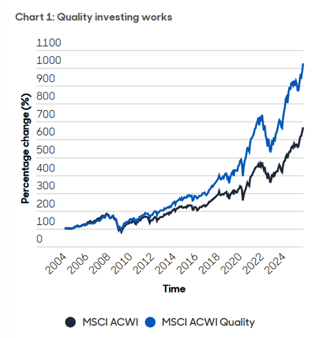
Over the long term, quality strategies have outperformed the broader market, providing a more predictable experience for investors (see Chart 1).
Notably, quality represents the largest segment of the global equity market, accounting for approximately 42% of the US$2.9 trillion universe of active cross-border and UK equities (1).
Recent headwinds: the dominance of growth and value
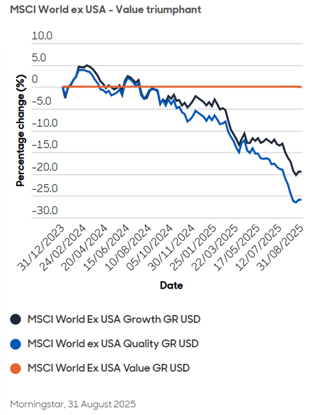
In recent years, quality as an investment style has faced significant headwinds. This environment has been particularly challenging for quality-focused portfolios investing outside the United States, where value has predominated. By contrast, when U.S. assets are included, growth has generally outperformed (see Chart 2).
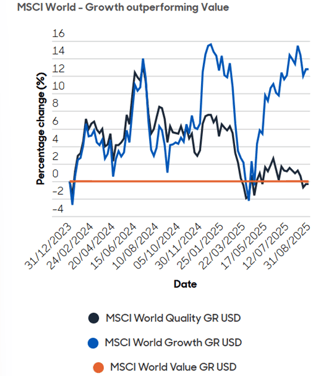
In the United States, growth stocks – led by a group of technology giants – helped propel U.S. equity markets to successive record highs, as investors enthusiastically embraced the narrative around the transformative benefits of artificial intelligence. These U.S. companies now dominate both the domestic market and global equity indices.
Elsewhere, value stocks, often perceived as inexpensive, have outperformed, driven by hopes of a cyclical recovery. This has certainly been the case over the past six months. While this narrative has some merit, markets may be getting ahead of themselves.
The challenges are both structural and cyclical. The rise of passive investment funds and exchange-traded funds (ETFs) has transformed investor behavior; fee compression and the disruptive force of technology have reshaped the competitive landscape.
These dynamics have created obstacles for quality-focused strategies, but they also serve as catalysts for innovation and adaptation.
Why quality could be poised for a resurgence
That said, there are early signs that the tide may be turning. We see three factors suggesting that a rotation from value to quality could be on the horizon:
- Economic headwinds and growth concerns. Global economies face multiple challenges, from slowing U.S. growth to the impact of tariffs and geopolitical uncertainty. As these risks become more tangible, investors are likely to become more selective, favoring companies with predictable earnings and strong fundamentals. This environment should create a more favorable backdrop for quality to outperform.
- Interest rates. Expectations of rate cuts are another potential source of support. As rates fall, the relative attractiveness of stable, high-quality companies increases. Historically, periods of declining rates have seen a rotation from value to quality. Market consensus now points to rate cuts this year and in 2026, which is generally supportive for both equities and quality.
- Broader technology leadership. While much of the recent market rally has been concentrated in a handful of U.S. technology giants, there are signs that technological optimism is broadening. Chinese technology stocks now have as much upside potential as their U.S. counterparts, and the benefits of investment in artificial intelligence and data centers are spreading across global supply chains. This broadening of market leadership could benefit quality-focused portfolios, especially those with a global reach.
Fundamentals back in focus
As the market outlook becomes more nuanced, with significant valuation divergences amid a slowdown in economic growth, corporate fundamentals are likely to move back into the spotlight. This environment should favor stock pickers and those focused on quality.
In a world where change is the only constant, the enduring virtues of quality – resilience, predictability, and sustainable growth – are likely to regain their appeal.
Investor confidence is improving, with rising risk appetite, particularly toward emerging markets (EM). Allocations to emerging market equities are at their highest level since early 2025, and there is renewed interest in regional equity strategies (excluding the U.S.), as well as in smaller companies.
However, while markets are currently pricing in a benign outlook for 2026, caution is warranted. Significant political and geopolitical risks remain, and we are entering uncharted territory in which many of the old rules no longer apply.
Conclusions
In an environment defined by uncertainty and change, quality offers a disciplined, fundamentals-based approach. As investors seek to balance risk and return, quality will once again prove to be the style that endures.