Israel-Iran Conflict: Impact on Financial Markets


The recent outbreak of tensions between Israel and Iran has brought geopolitics back to the forefront of market concerns. The exchange of attacks and threats has rekindled fears of a regional escalation with unpredictable consequences, which has triggered an immediate reaction in financial assets. While Brent oil surpasses 90 dollars per barrel and investors seek refuge in gold and Treasury bonds, the main stock indices are falling due to the increase in geopolitical risk.
In this article, industry experts analyze how markets are digesting this new focus of uncertainty and what implications it may have for global investors.
Samy Chaar, Chief Economist and CIO Switzerland, Bank Lombard Odier

We maintain our current position in the portfolio for the time being. So far, this still seems more like a controlled confrontation, although market turbulence is being reflected as expected in commodity prices, especially oil. But, at least for now, there are no signs of an irreversible escalation.
That said, even without an escalation of the conflict, persistent uncertainty and structurally higher energy costs have the potential to slow economic growth and raise inflation. The Federal Reserve usually ignores oil price shocks, as it considers them transitory supply-side events. We believe that the focus of monetary policy will continue to be centered on core inflation, which better reflects underlying demand dynamics.
George Brown, senior economist at Schroders

The oil prices skyrocketed as an initial response to the attack with missiles from Israel to Iran and the equity markets fell. Will the energy price increase persist and could it have inflationary effects?
Similar incidents in recent years have consisted of a limited exchange of missiles. Generally, Iran's response has been enough to demonstrate its internal strength without escalating tensions further.
Several Middle Eastern nations (including those that have already condemned the attacks, such as the United Arab Emirates and Saudi Arabia) have previously intervened to calm situations like this. Specifically, given its role in the oil market and in the regional economy in general, Saudi Arabia exerts considerable influence.
Israel has stated that the operation will continue for "as many days" as necessary to eliminate the Iranian threat. But hostilities could quickly calm down if Middle Eastern countries intervene and, to some extent, the United States.
What does this mean for oil?
For now, the oil production facilities of Iran and the region have not been affected at all.
The likelihood of Iran intervening in the Strait of Hormuz, the catastrophic scenario often considered for oil markets, seems very remote. Such action would impact the flows of other Middle Eastern nations trying to mediate the situation, while inflicting little damage on Israel.
Israel could exert pressure by attacking Iranian oil infrastructures and disrupting Iranian oil supply (which represents 3.5% of the global supply). However, Israel's stated goal has been to prevent the Iranian nuclear program, and therefore all attacks so far have targeted Iranian nuclear and military facilities. This leads us to think that the disruption of oil production could be limited.
Other market dynamics continue to suggest that an oil surplus will continue to accumulate in the global market in the coming months.
Outlook for inflation
Although oil prices are sensitive to these types of conflicts, as in previous similar events, the initial price increase moderated in the hours following the escalation. If Brent crude were to settle at 75 dollars per barrel, it would imply that G7 energy inflation would be slightly above 5% over the next year.
Would this lead to broader inflationary pressure? Probably not. Our research suggests that each 10% increase in oil prices only adds 0.1% to core inflation.
Elisa Belgacem, Senior Credit Strategist at Generali AM (part of Generali Investments)

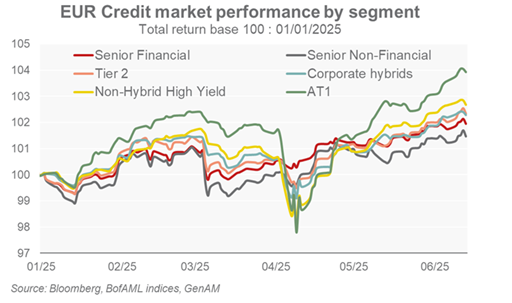
It is unlikely that the recent Israeli attack on Iran will have a significant immediate impact on credit markets, given the strength of the technical indicators over the summer. With a limited forecast of new issues and demand that remains strong, the environment should continue to be favorable. However, the negative impact on confidence weighs on cyclical values, except those related to oil, which will benefit from the rise in crude prices. Among the defensives, we favor utilities, which are also positively exposed to the dynamics of energy prices. Hybrid companies should also show resistance, due to their high concentration in the energy and utilities sectors.
Banks, on the other hand, appear more vulnerable, both because they tend to perform worse when spreads widen and because they currently seem expensive in relation to their cyclical exposure. Airlines could also be pressured by their sensitivity to rising oil prices. It is important to note that we believe the risk of recession remains low, as the U.S. would likely intervene to prevent a greater escalation. Therefore, we maintain our long positions in investment grade and slightly long in high yield in the global allocation.
Max Stainton, Senior Global Macroeconomics Strategist at Fidelity

The escalation of the conflict between Israel and Iran has intensified tension in the Middle East. Israel seems determined to neutralize Iran's nuclear capabilities, while the possibility of a regime change adds significant risks.
Although damage to energy infrastructure has been reported in both Iran and Israel, the impact on global supply remains limited. There have been no attacks on key production facilities or attempts to block the Strait of Hormuz, a critical point for global oil and gas trade. The market, although it has incorporated a geopolitical risk premium, seems to consider that extreme risks remain unlikely, at least for now.
From a macroeconomic perspective, the main channel of transmission of this crisis is energy. The increase in the price of crude oil (which exceeded 13.5% in the early hours of the attacks, although it has moderated to around 7% at the time of writing these lines) reflects growing concern. This rebound could generate a new stagflationary impulse in the U.S., further complicating the task of the Federal Reserve, which is already facing pressures from other supply disruptions. The situation is complex and is unlikely to be resolved quickly.
From an asset allocation perspective, we maintain a balanced view of risk, although we continue to closely monitor developments.
Raphael Olszyna-Marzys, International Economist at J. Safra Sarasin

The exchange of missile strikes between Iran and Israel triggered an increase in oil prices of around 6%. Markets initially reacted with a wave of risk aversion, but rebounded on Monday as investors judged it unlikely that the escalation would deal a significant blow to the global economy. However, risk aversion returned after Donald Trump made aggressive statements at the G7 summit.
What is the main channel of contagion and what are the risks?
The most direct economic impact would stem from oil prices. Historically, the price of oil needs to double in order to trigger a recession in advanced economies.
Could tensions in the Middle East push prices to such high levels?
Markets appear doubtful, and that scepticism seems well-founded—not because the conflict couldn’t escalate, but because a sharp and prolonged increase in oil prices would require several contributing factors to align.
Let’s first consider the current situation. The oil market is not particularly tight. In recent months, attention has focused on the possibility of an oversupply. Prices are rising from low levels: Brent crude hit a four-year low in May and, despite the recent upturn, remains about 12% below where it was a year ago. At these levels, oil prices continue to exert a disinflationary force.
A sustained rise to around $125 per barrel would require a significant impact on the Gulf’s export capacity. The exclusion of Iran alone would likely not suffice: its production accounts for 12% of OPEC and 8% of OPEC+. However, other Gulf producers have spare capacity and would likely act quickly to recapture market share. That said, we cannot rule out the possibility that oil producers might opt to keep output steady to benefit from higher prices and increased revenues.
For prices to rise sharply, Iran would need to strike regional oil infrastructure or attempt to close the Strait of Hormuz, through which about a quarter of the world’s seaborne crude passes. In our view, this is unlikely. In recent years, Iran and Saudi Arabia have largely normalised relations; Riyadh has condemned the Israeli attacks. While Iran might attempt to disrupt tanker traffic in the Strait, any such move would likely prompt a military response from the United States. Even China, one of Iran’s key allies, has an interest in avoiding such a disruption and may well have made this clear to Tehran. Even in the event of a temporary blockage, Saudi Arabia could reroute some exports through its Red Sea ports.
Nonetheless, persistent uncertainty and/or an escalation in hostilities could keep the risk premium on oil prices elevated. The Israeli government appears determined to inflict lasting damage on Iran’s nuclear programme, likely through strikes on the fortified Fordow facility—a move that may not be feasible without American support. If Iran were to feel increasingly cornered, it might attempt to damage oil infrastructure to gain leverage in future negotiations with the United States.