Japan and the automation segment

10 FEB, 2023



Enhancing the resilience of supply chains has become a top priority for governments as they look to secure their economic lifelines amid a rise in geopolitical uncertainty. In Japan, the passage of the Economic Security Promotion Act gives the government more oversight of companies that rely on foreign suppliers for critical input and services. Anne Vandenabeele, economist at Capital Group believes this could be a milestone that kicks off a significant restructuring of supply chains in the coming years.
“The key for investors is to identify companies that do not depend on a single market for most of their growth or resources,” says equity portfolio manager at Capital Group, Harry Gunji.
Innovation is crucial to untangling the kinks in supply chains. Long known for its strength in automation, Japan’s technology could grow in importance as companies turn to industrial robots to mitigate costs.
It may be difficult for export-dependent Japan to avoid a recession in the event of a significant global economic slowdown, but its world-class companies in industries including semiconductors, precision manufacturing and automation may benefit from major trends such as digital and green transitions. Attractive stock market valuations and robust corporate earnings compared to the US and Europe also cast Japan in a positive light.
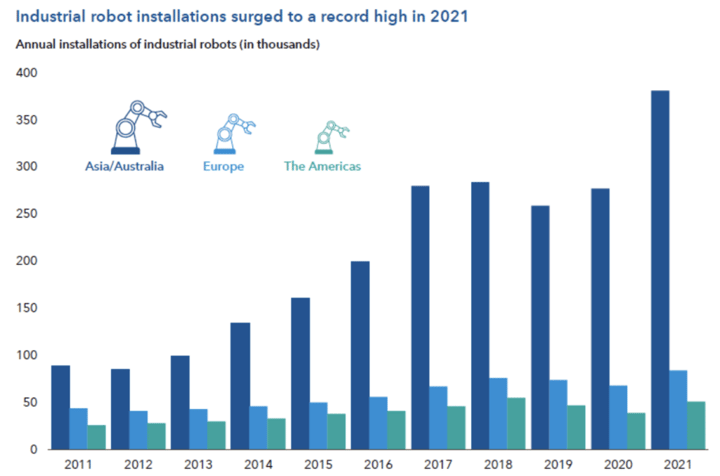
Five countries accounted for 78% of global robot installations in 2021: China (52%), Japan (9%), US (7%), South Korea (6%) and Germany (5%). Totals may not reconcile due to rounding. Sources: World Robotics 2022, International Federation of Robotics