The Japan opportunity: potential for attractive long-term returns

21 APR, 2023
By Carl Vine



We believe Japanese equities represent a compelling long-term investment opportunity. In our view, they offer the potential for attractive returns over the coming years. While there are some short-term tactical considerations that might keep some investors on the sidelines, these should be considered in the context of the overall opportunity set for the asset class.
The Japan opportunity – long-term strategic case
Over the next five to ten years, we think Japanese equities could plausibly generate an annual percentage compound total return in the mid-teens (Figure 1). The main driver of potential returns is likely to be earnings, which we believe could grow at an annual compound rate of 8%, a level corporate Japan has indeed delivered over the past decade.
Figure 1: The Japan Opportunity: drivers of potential returns from Japanese Equities
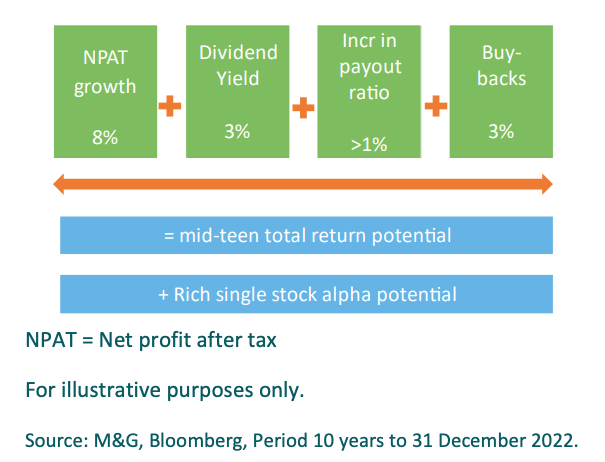
Dividends could also add to the potential return. The stock market’s starting dividend yield is a little under 3% currently. Dividends have also been growing faster than earnings over the past decade. This has been possible because the payout ratio has been increasing, albeit from a very low level, and company balance sheets are strong. An increase in the payout ratio could increase dividend growth by more than 1% pa, in our view.
And finally, when you include the contribution of share buybacks (the stock market has been buying back around 3% of itself every year), we think it is easy to see how you could plausibly get a mid-teen total return.
This is before any change in valuation ie or multiple expansion. It is worth noting that the starting point for valuations in Japan is low – low versus the rest of the world and low versus Japan’s own history. And if an adjustment is made for excess cash and assets, the multiple is even lower. So, if valuations were to expand, in addition to the factors above, we could potentially end up with a very attractive return over a multi-year period.
Another factor to consider is that despite being the third largest economy in the world, the Japanese equity market is poorly covered by the investment community, in our view. The lack of coverage makes the market inefficient and creates a rich source of opportunities for stockpickers like ourselves. For selective, active investors, the prospective equity returns could be even higher.
Continuing change in Japan
The dividend yield of the Japanese equity market is observable, and the ability of companies to increase their payout ratios and buyback shares is evidenced by their strong balance sheets and clear trends. Therefore, the big question about the potential return from Japanese equities centres around how companies are going to grow earnings by 8% compound. This might not be such a leap of faith as it appears.
Abenomics
A decade ago former Prime Minister Shinzo Abe launched his “three arrows” programme of economic and corporate reform known as “Abenomics”. As part of these policies, companies were encouraged to go forth and make profits.
Abenomics created a tremendous buzz and, over the next couple of years, foreign investors went on a quarter-of-a-trillion yen buying spree on Japanese equities. They then spent the next eight years selling their shares, disappointed with the apparent lack of progress on corporate reform.
Foreign investors should be kicking themselves. What happened over the past 10 years is that the market recorded a compound annual growth rate (CAGR) in earnings of around 12 to 13% (in local currency terms). This is very respectable compared to other markets. Even the mighty S&P 500 Index, did not achieve this level of earnings growth (Figure 2).
Figure 2: Delivering the results
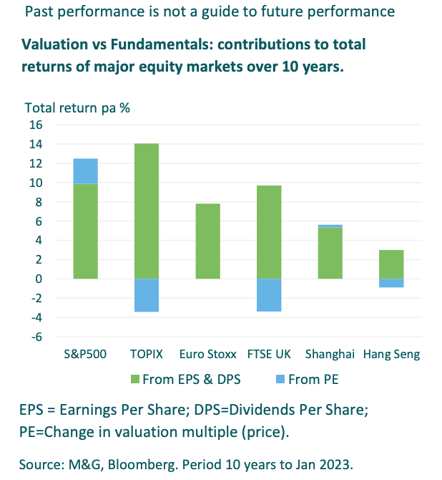
In light of this track record, we would argue that forecasting attractive earnings growth and returns for the next 10 years should not be the same leap of faith it was 10 years ago.
Corporate improvement
Japan has delivered, in our opinion. What is impressive, is that this has been achieved against a backdrop of challenging domestic economic conditions – low GDP growth and little or no inflation.
There has been a coordinated, state-sponsored campaign to drive corporate improvement (Figure 3). In some ways it is a bit like Singapore 20 years ago. It has been a massive institutional project, to upgrade the legal framework in which companies operate.
Figure 3. Campaign to drive corporate improvement
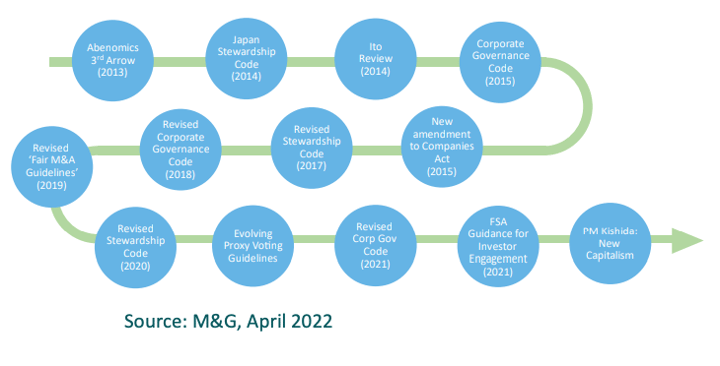
Whilst there was a perception Abenomics was taking too long for some investors, the pace of change was not unreasonable, in our view. It takes a long time to go from post-ar industrial policy to the mantra of “go forth and make money”.
A good example of a business that was an early adopter of change is the incumbent telecommunications company NTT. NTT has seen only a modest increase in revenues over the past 10 years. However, over that period investors have enjoyed an internal rate of return (IRR) of 19% in yen terms. This was not due to multiple expansions – it still trades on a similar multiple to the one it did at the start of the period (11x). It was down to increased profit margins, share buybacks, and dividend growth.
To labor our point, double-digit earnings growth across the market was achieved without the complete institutional framework in place. In our view, the framework is now fit for purpose. This is why we believe there is still a lot more earnings growth to come. There is an abundance of low-hanging fruit to be picked, in our opinion – cross-shareholdings to be sold; too much cash on balance sheets; headquarters buildings that can be sold and leased back; and scope for productivity/margin improvement. (Margins are low in Japan and productivity is poor because the corporate sector is massively fragmented.)