One keystroke away

4 AUG, 2026



Picture the most boring building in Brussels. Not the Commission, not the Parliament, none of the places the cameras point. A clearing house. Euroclear, a piece of financial plumbing most people with money have never heard of and quietly depend on every day. It settles trades. It holds securities. It is about as glamorous as a substation.
And for the whole of last winter, that substation was the most fought-over address in Europe. Sitting inside it: around 193 billion euros of the Russian central bank’s money, frozen since 2022. On the table: whether the European Union could use it, or lend against it, to keep Ukraine solvent through a war now grinding into its fourth winter. The leaders argued into the small hours of a December night, drew back from seizing the assets outright, borrowed the money on the markets instead, and then reserved the right to reach for the Russian billions later. They locked the assets down under an emergency treaty article so no future government could quietly hand them back.
I’m not here to tell you whether that was right. There’s a serious case on each side, and the people making both are not fools. A country invaded its neighbour, and using the aggressor’s frozen money to fund the defence has a rough justice to it. On the other hand, Belgium’s own prime minister spent weeks warning that treating euro-denominated assets as politically seizable might crack the one thing a financial centre sells, which is the promise that what you park there stays yours. Both things are true at once. That’s what makes it hard.
But step back from the rights and wrongs, because underneath the legal argument sits a plainer fact, and the plainer fact is the one that matters for anyone with wealth to look after.
Owning and reaching are not the same thing
For most of modern finance, we’ve treated two ideas as one. Owning an asset, and being able to reach it. They felt identical. Your money was in the account, the account was yours, end of story. The gap between the two was so small it wasn’t worth naming.
The Russian precedent named it. An asset can be legally yours and practically gone. The title never changes hands. The Russian central bank still owns those billions on paper, and will keep owning them, right up until the day someone decides it doesn’t. What changed is access, and access turned out to be the thing that was actually load-bearing all along.
Here’s the detail that should stay with you. Freezing those reserves took no army and no vault. It took an instruction sent through the same infrastructure that holds the assets. The wealth and the off-switch lived in the same building. That is the quiet vulnerability of anything you hold as an entry in someone else’s system. It is wonderfully efficient, right up to the moment it isn’t yours to reach.
The most conservative money on earth already moved
Now the part that turns a geopolitical story into a personal one.
While the politicians argued, the world’s central banks, the least dramatic investors alive, had already voted. Not with speeches. With their reserves. Since 2022 they have bought gold at a pace not seen since the 1960s, more than a thousand tonnes a year, year after year, roughly double the rate of the decade before.
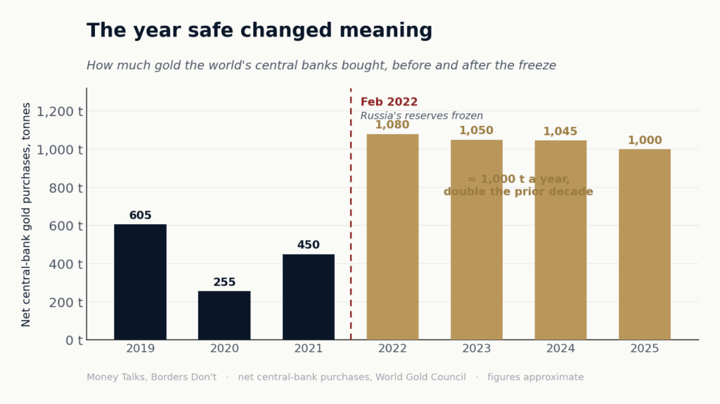
The scale of it only really lands with one statistic. For the first time since 1996, central banks now hold more of their reserves in gold than in US Treasuries. Treasuries, the asset the entire system was built to treat as the definition of safe. And gold ran to an all-time high in late January of this year, its first record that actually clears the old 1980 peak once you adjust for inflation, before settling back the way these things do.
Ask a reserve manager why, and the answers stop sounding like finance and start sounding like something older. Gold has no counterparty. It sits in no one else’s system. It cannot be frozen through the banking network, cannot be switched off from another capital, cannot be devalued by a decision made somewhere you don’t vote. Taking it requires physical seizure, a truck and a border crossing, not a memo. In a year when a memo was exactly the weapon on the table in Brussels, that stopped being a philosophical nicety and became the whole point.
These are not gold bugs chasing a rally. Gold pays nothing, stores awkwardly, and fell more than twenty percent from its January high. These are the most risk-averse institutions in existence, quietly rewriting their own definition of a safe asset in real time. When that crowd moves, it’s worth watching what they’re afraid of, because they are rarely afraid of nothing.
Put a number on it
Take a family with forty million euros, built the way most are, one relationship at a time. Nobody planned the shape of it. It just grew.
Eighteen million sits in a managed portfolio at one bank. Nine million more, deposits and a couple of structured notes, at a second. Six million at a third. Four million inside a life policy. Two million in a house, owned outright but in a single country. One million in gold, in a vault.
Now sort it by the question nobody usually asks: who could reach it without your say-so. Thirty-seven of the forty million, ninety-two percent, exists as an entry in someone else’s ledger, reachable in principle by an instruction sent through a system you don’t control. Three million, the house and the gold, you hold outright. And the largest single custodian, that first bank, holds eighteen million by itself. One instruction to one institution touches forty-five percent of everything you have.
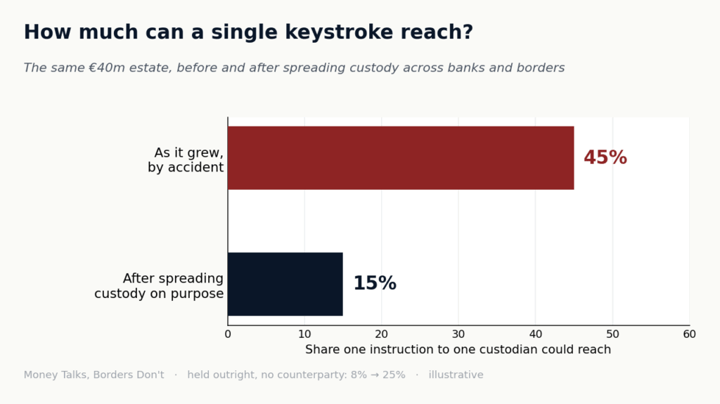
Spread it on purpose and the picture changes without anyone earning an extra cent. Take the concentration out of the one bank, add a second jurisdiction and a third, let a real slice sit in things that answer to no counterparty. Same forty million. Now the largest single point of reach is fifteen percent, not forty-five, and the part you hold outright has gone from eight percent to a quarter. Nothing was hidden. Nothing left the daylight. The estate simply stopped having one door that opens all of it.
What it means one floor down
You do not run a national reserve. But the logic doesn’t need a central bank to hold. It scales straight down to a family, and it changes one thing: the questions you ask about where your wealth sits.
We’ve spent past issues on the cost of things. Too many banks, and you fix it by giving each a role. Currency bleeding out of every transaction, and you fix it by managing it once. This is the same instinct pushed one level deeper, past cost and return, to access. Not how much your holdings earn. Whether you can reach them, in full, on a bad day.
In practice this is not about paranoia, and it is certainly not about hiding from anyone. It’s the ordinary prudence the central banks just modelled for you. Don’t hold your entire life inside a single institution, or a single country’s legal reach, so that one instruction can reach all of it. Spread custody the way you’d spread the portfolio. Keep some part of your wealth in forms that don’t depend on a counterparty staying solvent and a system staying friendly. Know, actually know, which of your assets are entries in someone else’s ledger and which are things you hold. Most people have never drawn that line. It’s worth an afternoon.
None of this is a forecast that anything bad is coming for you. It almost certainly isn’t. It’s the recognition that safety quietly stopped meaning how much and started meaning whether you can reach it, and that the smartest, dullest money in the world figured this out first and acted while everyone else read the headlines.
The building in Brussels didn’t change anyone’s ownership. It changed everyone’s understanding of what ownership is worth without access. That lesson cost the central banks nothing to learn. They’d already bought the insurance. The only real question this leaves on your desk is a small, uncomfortable one. How much of what you own could be moved beyond your reach by someone who never has to leave their chair.
*For analysis, not advice. This is about lawful diversification of custody and jurisdiction, nothing else. Every situation should be assessed with your own advisors.*
---
Sources & notes
The Euroclear episode draws on reporting of the European Council of 18 to 19 December 2025, at which EU leaders agreed a roughly €90 billion loan for Ukraine for 2026 to 2027, financed by EU borrowing rather than direct seizure of the frozen assets, while reserving the right to use them and invoking an emergency treaty basis to keep them immobilised. Roughly €193 billion of Russian central-bank assets are held at Euroclear in Belgium; Belgium’s prime minister publicly warned of the precedent and credibility risk, and Russia’s central bank sued Euroclear (NPR, Centre for European Reform, European Parliament briefing, Max Planck Institute).
On gold and reserves: central banks have bought more than 1,000 tonnes a year since 2022, roughly double the prior decade’s pace (World Gold Council, via 2026 survey coverage). Gold reached an all-time high of about $5,590 an ounce on 28 January 2026, its first inflation-adjusted record, before pulling back through mid-year. For the first time since 1996, gold now exceeds US Treasuries as a share of central-bank reserves (Morgan Stanley Research). In the 2026 World Gold Council survey, a large majority of reserve managers expected the dollar’s reserve share to fall over five years, with emerging-market institutions citing geopolitical-risk hedging as a leading reason. Annual purchase figures in the chart are approximate.
References: NPR, Centre for European Reform, European Parliament, Max Planck Institute for Comparative Public Law, World Gold Council, Morgan Stanley Research, and contemporaneous market coverage.