One podium, two chairmen

24 AUG, 2026
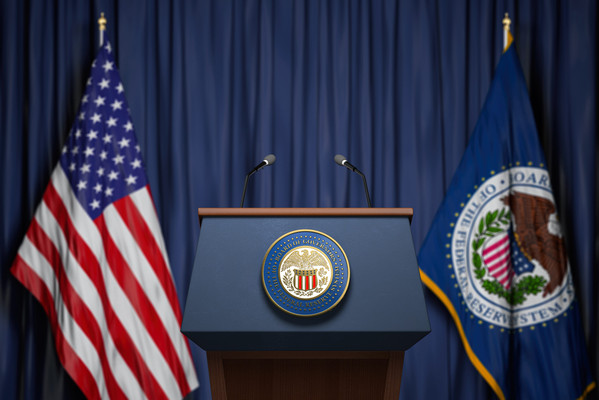


This Friday, in a mountain lodge in Wyoming, a little village will host the most expensive speech of the year.
Jackson Hole, the annual gathering of the world’s central bankers, runs from the 27th to the 29th. Every August the same ritual: a hundred and twenty policymakers from seventy countries, and one keynote that can move more money in twenty minutes than most governments move in a year. It was here that Bernanke announced the second round of money printing in 2010, and here that Draghi’s “whatever it takes” era took shape.
This year’s edition has a plot twist. The keynote belongs to Kevin Warsh, the new chairman of the Federal Reserve, in the job barely three months after the closest confirmation vote in the institution’s history, 54 to 45. It’s his first Jackson Hole at the podium.
And sitting in the audience, with a vote on the committee, will be Jerome Powell. The previous chaairmn didn’t leave. He stepped down from the chair and stayed on the board, where his term runs to 2028.
An opinion on either man is not needed to see why the room matters. Inflation is running at 3.1%, core at 3.3%, 1.5% above the target the Fed has promised for years. The new chairman has commissioned fifteen outside experts to rewrite the Fed’s entire framework by year-end, talks about shrinking a 6.6 trillion dollar balance sheet aggressively, and may use Friday to announce that the era of flexible inflation targeting is over.
The speech everyone watches moves the price of money that matters least to you. The price that matters most has been moving for five years, quietly, and no speech controls it.
Two prices of money
Every family with wealth is exposed to two interest rates.
The short rate is the one central banks actually set. It reprices your Lombard loan, your cash, your floating debt. It moves when chairmen speak. It’s the one on every front page this week.
The long rate is the one the market sets: the yield on twenty- and thirty-year government bonds. It anchors mortgages, discounts every property valuation, and marks every bond portfolio on earth. Central banks influence it, but they don’t command it. And it has been telling its own story.
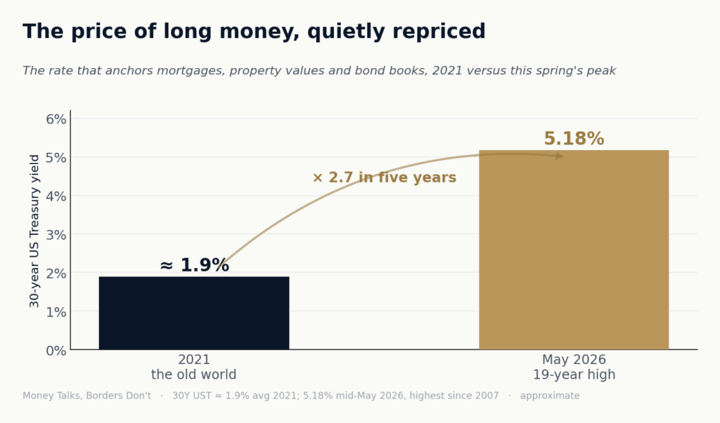
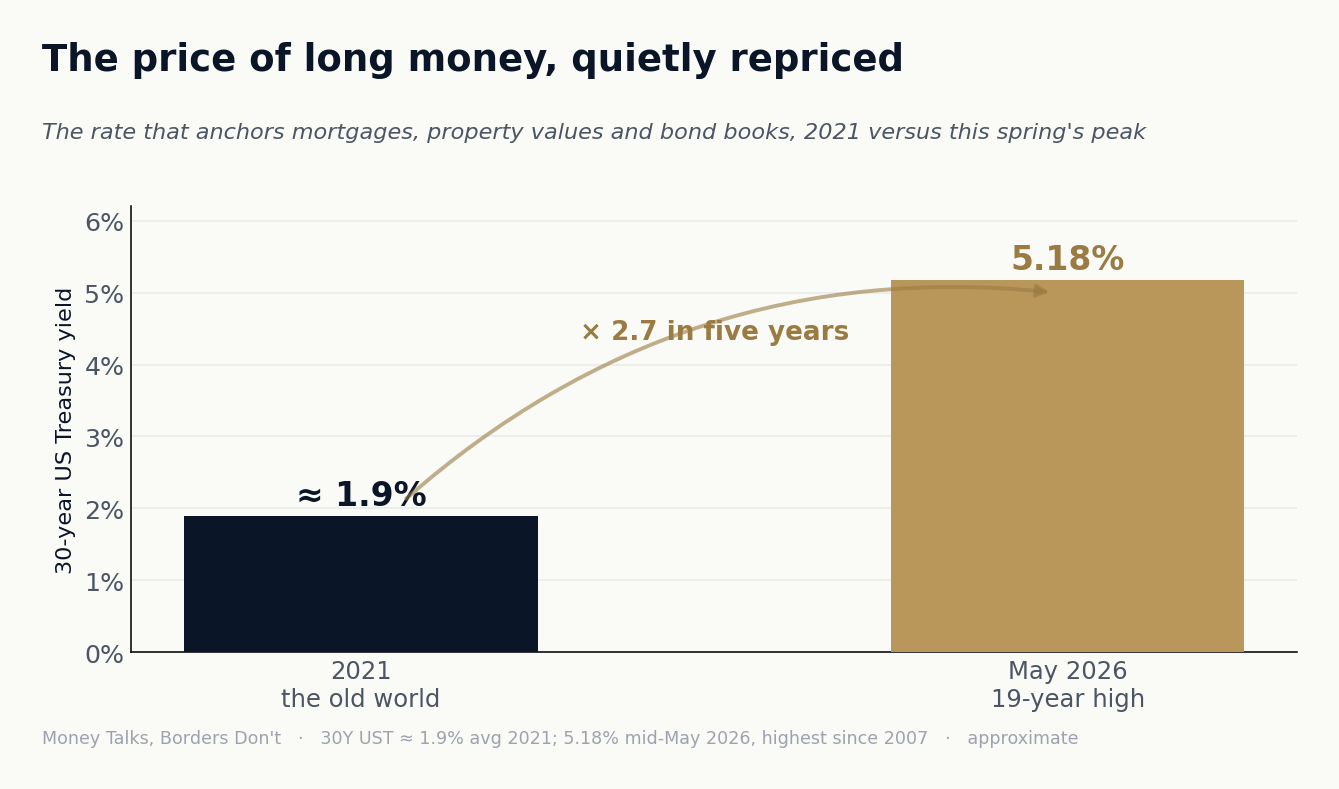
In 2021 the thirty-year US Treasury paid around 1.9%. This May it touched 5.18%, the highest in nineteen years. Not in a crisis, not in a crash. Quietly, across five years, the price of long money nearly tripled, and the American long rate is the anchor every other one in the world is priced off, from a mortgage in Milan to a gilt in London.
Why did it move? Partly inflation. But increasingly, something older: what economists call the term premium, and what I’d call the uncertainty charge. It’s the extra return investors demand for lending far into a future they trust less: governments borrowing like there’s no tomorrow, inflation that won’t quite die, a technology revolution nobody can price, and, yes, questions about central banks themselves. That charge was roughly zero for a decade. It’s back.
Here’s the uncomfortable part: no speech lowers the uncertainty charge. A chairman can cut the short rate on a Friday morning. The long rate answers to whether the world believes the next thirty years will be orderly. That belief is exactly what’s being repriced.
What one point actually does
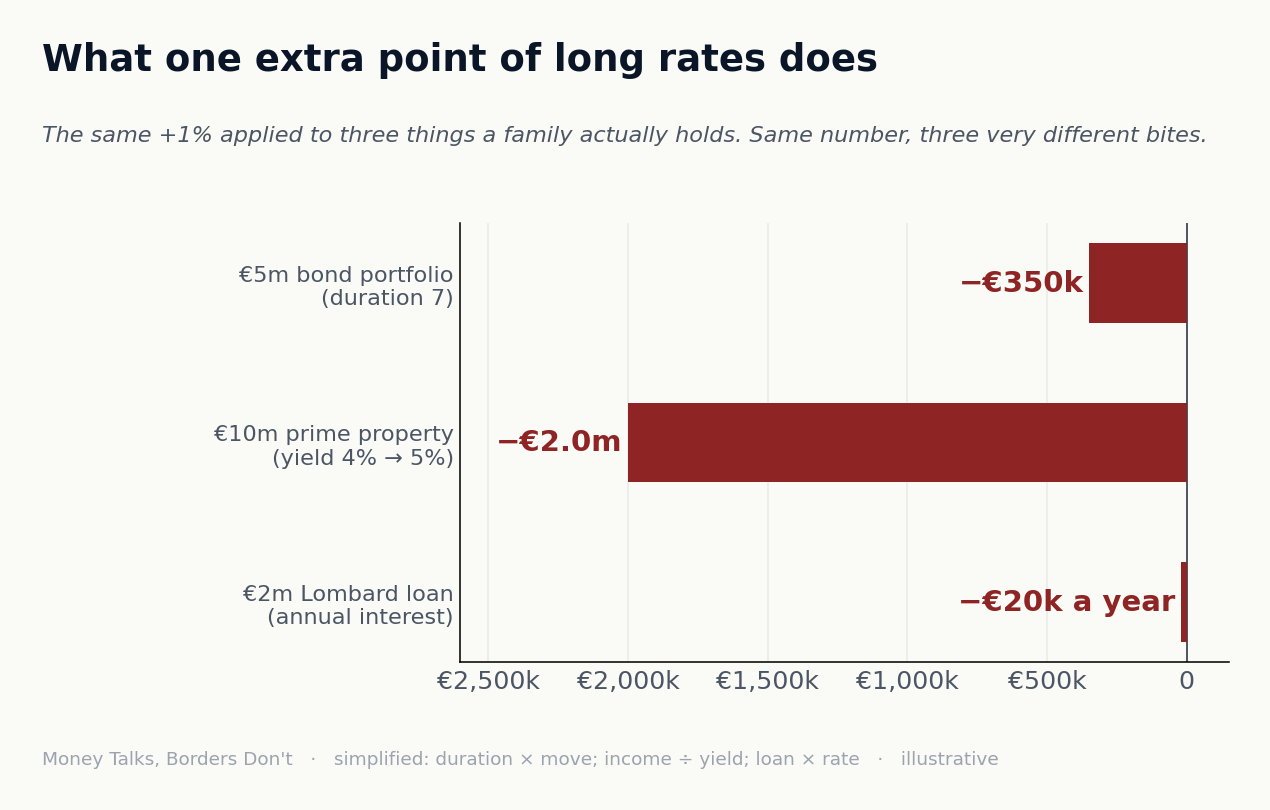
Abstract, until you run it through a balance sheet. Take one extra percentage point on long rates, which is roughly what the last eighteen months delivered, and apply it to three things a family actually holds.
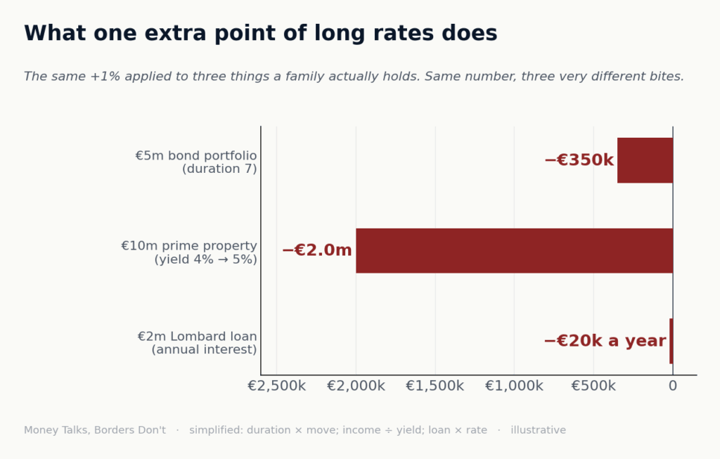
A five million euro bond portfolio with a duration of seven loses about 350 thousand, on paper, immediately. Not because anyone defaulted. Because the same coupons are worth less when the world pays 5% for patience.
A ten million euro prime property is the quiet one. Property is valued off its yield, and yields follow long rates with a lag. If the market’s required yield drifts from 4% to 5%, the same rental income prices the building at eight million, not ten. Two million, gone without a single bad tenant. Nobody sends you a statement for this one, which is why it’s the loss people discover years later, at sale.
A two million euro Lombard loan costs about twenty thousand more per year. The smallest number of the three, and the only one people actually watch, because it arrives as an invoice.
That’s the asymmetry worth tattooing somewhere: the visible cost of rates is the small one. The invisible ones, the bond mark and the property multiple, are ten to a hundred times larger, and they answer to the long rate, the one being set by trust, not by speeches.
What to do with the week
Three thoughts, none of them a forecast.
Know your duration, everywhere. Not just in the bond portfolio, where it’s printed, but in the property book, where it isn’t. A family holding long bonds and prime real estate and a fixed mortgage is one big bet on long rates, assembled by accident. Nothing wrong with the bet. Everything wrong with not knowing you’ve made it.
Treat the visible rate calmly and the invisible one seriously. If Friday’s speech moves your Lombard cost by a quarter point, that’s dinner money on the sums that matter. If the world’s uncertainty charge keeps repricing, that’s the property multiple and the bond book. Watch the thirty-year, not the soundbite.
And remember the lesson of the room itself. The most powerful monetary institution on earth now has its former chairman voting on its current chairman’s policy, a framework under review, and a target it hasn’t hit in five years. Whatever your politics, that is not a picture of certainty. And certainty, as the last five years of the long bond have shown, is no longer free. It’s the one price that went up for everyone, in every country, at the same time.
A village of ten thousand sets the tone this week. The price of the next thirty years gets set by whether anyone believes it.
*For analysis, not advice. The worked examples are simplified: durations, yields and pass-throughs vary by market and asset. Every situation should be assessed with your own advisors.*
---
Sources & notes
Jackson Hole 2026 runs 27–29 August at Jackson Lake Lodge, themed “Financial Innovation: Implications for Payments and Policy”, with roughly 120 participants from over 70 countries (Federal Reserve Bank of Kansas City; Finance Calendar). Kevin Warsh was sworn in as Fed Chair on 22 May 2026 after a 54–45 Senate confirmation, reported as the narrowest for a Fed Chair in history; Jerome Powell remains on the Board as a governor, with a term to 2028, and votes at the FOMC; Warsh’s keynote is scheduled for Friday 28 August (contemporaneous coverage). July CPI printed around 3.1% headline and 3.3% core; Warsh has commissioned a fifteen-expert review of the Fed’s framework by end-2026, with a possible move away from average inflation targeting, alongside a “monetary barbell” of pragmatic short-rate management and aggressive balance-sheet reduction from $6.6 trillion (Riviera Wealth Management preview; CNBC, 29 July 2026). The 30-year Treasury yield touched 5.18% in mid-May 2026, its highest since 2007, and long-end yields remain sensitive to real yields and fiscal concerns; the term premium as a rising “uncertainty” component of long rates is discussed in current strategist commentary (Argent Financial; Empower, August 2026).
The one-point examples use standard simplifications: a duration-seven bond portfolio marks down roughly seven percent per point; a property yielding 4% repriced to a 5% required yield loses a fifth of its value with unchanged income; a floating Lombard loan reprices one-for-one. Real pass-throughs are slower and messier, which is stated rather than hidden.
References: Federal Reserve Bank of Kansas City, CNBC, Empower, Argent Financial Group, Riviera Wealth Management, Finance Calendar, and contemporaneous market coverage.