The potential benefits and risks facing global equity investors

16 OCT, 2024
By



- Global valuations remain favourable for markets outside the US.
- Potential for market drivers to multiply, creating opportunities for active investors.
- Japanese companies remain well positioned to reward shareholders.
- US elections: potential increase in volatility, but fundamentals take precedence.
- Increased scrutiny around AI monetisation
Author: Simon Webber, Head of Global Equity at Schroders.
Increasing market breadth and volatility in a resilient economic environment should create opportunities for active fund managers.
We continue to believe that a soft landing for the US economy is the most likely scenario and expect equity markets to be supported over the medium term by modest corporate earnings growth. In Europe, inflation has remained on a clear downward path as the Eurozone and the UK have emerged from shallow recessions.
This has allowed the European Central Bank and the Bank of England to begin cutting interest rates. Economies such as the UK and Spain have a high percentage of variable rate mortgages and a lowering of interest rates will provide some immediate support to the consumer. We are also seeing stronger real wage growth in Europe and the UK, which combined with excess savings should further support consumer growth.
The August market correction saw equities depreciate reflecting a more uncertain outlook for the US economy, but stocks have quickly recovered losses, supported by good corporate earnings growth and the prospect of more favourable monetary conditions. Equity markets were vulnerable to a correction after nine months of great strength, but company fundamentals are decent and higher volatility creates repositioning opportunities when dislocations occur.
Global valuations remain favourable for markets outside the US
By most commonly used metrics, the UK remains one of the most attractive markets in the world relative to its long-term track record. In global equity markets, valuations remain favourable for non-US markets, in particular the UK, Japan and emerging markets (EM) (see table below).
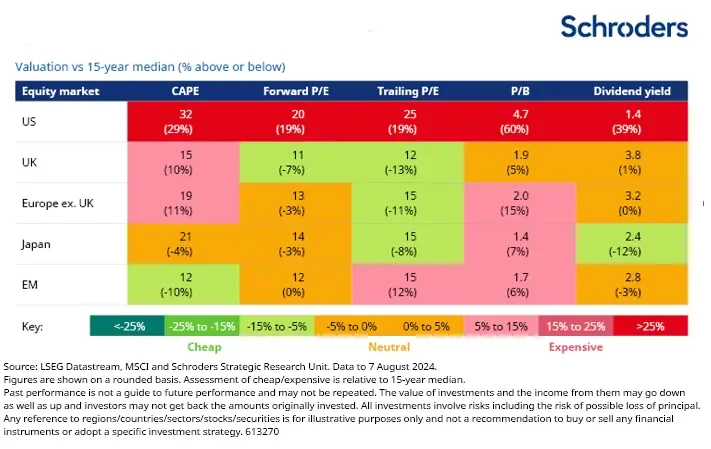
However, valuations in the US market look less elevated when looking beyond the mega-cap growth stocks of the ‘big techs’, which are driving the overall S&P 500 P/E multiple higher. By contrast, the rest of the market has faced a still difficult operating environment, which has held back revenue and net income growth for much of this time.
Potential for market drivers to multiply, creating opportunities for active investors
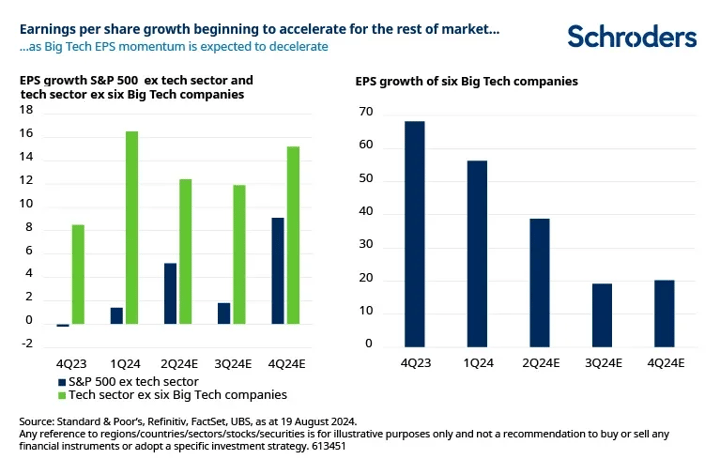
Market breadth has remained extremely low over the past year as the vast majority of market gains have been accounted for by a small group of stocks. The tightness of markets to date has been the consequence of top-down factors - AI - and bottom-up fundamentals, represented by divergent revenue and earnings growth.
Market consensus now expects this gap to close somewhat, with expectations of an acceleration in earnings growth for the market as a whole, and a significant slowdown for large technology companies (see chart below). Large cap US technology companies have shown very strong earnings growth over the past 18 months, driven by renewed cost discipline and sustained revenue growth.
However, the benefits of that cost discipline are expected to diminish in the coming quarters, bringing earnings growth closer to that of the rest of the market. Overall, these companies remain underpinned by large businesses and strong fundamentals, but are vulnerable to falling asymmetry in revenue and earnings relative to the rest of the market.
There is also a case for a widening of equity market returns at the regional level. European economies will be more sensitive to interest rate cuts than the US economy, and in Japan real wages have turned positive after many months of contraction. Europe and the UK, for example, returned to positive GDP growth earlier this year after a period of weaker growth and a more protracted slowdown in profits.
These regions should benefit further from interest rate cuts. European consumers, in particular, are more exposed to variable rate mortgages (compared to the US) and companies are more dependent on bank loans. In contrast, the US has moved from controlling inflation to avoiding a recession. While a recession in the US is not our baseline scenario, there is the possibility of a recovery in some regions.
Japanese companies remain well positioned to reward shareholders.
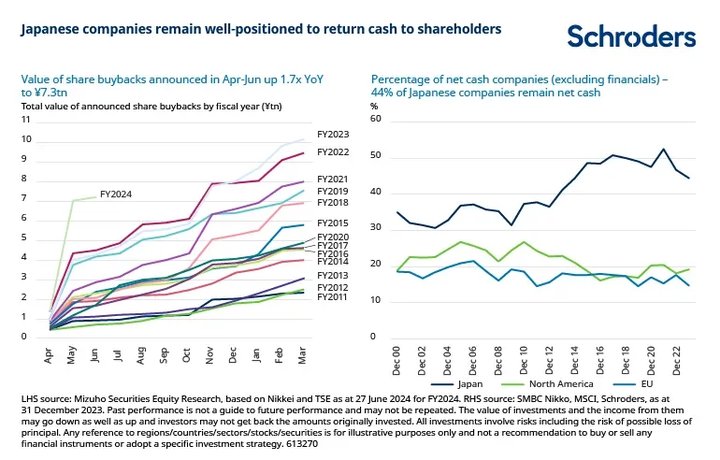
We continue to see an undervalued trend of improving earnings that should continue to support Japanese equities. Three decades of deflation have led companies and individuals to hoard cash.
We are now seeing ongoing reforms, led by the Tokyo Stock Exchange and various government institutions, aimed at improving governance and capital efficiency. These reforms are being introduced along with incentives such as the NISA tax-free investment scheme for individuals. These initiatives should help put excess cash to work and increase the exceptionally low investment rates in equities compared to other developed markets.
As a result, we are seeing a greater focus on shareholder returns, as well as increased investment and capital spending. This renewed focus on productivity and profitability is supported by a more normal inflationary backdrop that is leading the Bank of Japan to move away from yield curve control at a time when most central banks are leaning towards easing.
We believe this should provide further support for the currency, which has eroded foreign investor returns for most of the last decade. As a consequence, we should see a greater number of attractive opportunities in domestically focused companies.
US elections: potential increase in volatility, but fundamentals take precedence
The political calendar has been particularly busy in 2024. More than 40 countries, representing three quarters of the global investable universe, have held or plan to hold national elections. The US election in November remains one of the most eagerly awaited, with an outcome that has the potential to significantly affect geopolitical relations.
Overall, the policies and policy differences of the Democratic and Republican candidates remain thin in key areas, while greater clarity could perhaps serve to increase short-term volatility rather than reduce it. That said, where differences are evident - trade tariffs, energy policy, banking deregulation, drug prices - we believe the implications are clear. In either scenario, we expect to see trade policies that move US relations away from rivals and prioritise advancing US leadership in high-tech industries.
History has shown that positioning portfolios around who you think will win an election is almost always a losing strategy, and it is always important to diversify risk. Of course, this is not to say that we ignore potential political risks, but we believe it is more important to remain focused on the outlook for the economy, the direction of interest rates, earnings growth forecasts and the relative attractiveness of valuations.
In our portfolios we prefer to hold companies that control their own destiny. To this end, we have tried to minimise as much as possible our exposure to some of the more sensitive areas that are in the crosshairs of political risk.
Increased scrutiny around AI monetisation
The euphoria around generative AI has been one of the main drivers of stock price growth in the markets over the past year. Investors have flocked to some of the clear beneficiaries in the semiconductor and data centre segments.
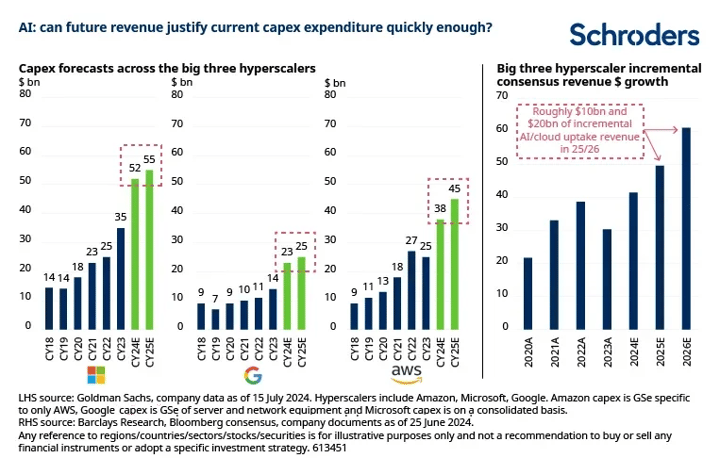
However, revenues from AI are approaching a level that is estimated to be 10 times less than the amount of capital expenditure currently being invested. As a result, there are doubts as to whether there will be sufficient future revenues in the near term to justify the current level of infrastructure build-out. These uncertainties contributed to large technology stocks bearing the brunt of the US equity market decline during the August correction. The ability of these technology companies to monetise their spending on artificial intelligence will continue to be an important issue.
We are fully aware that generative AI is still in its infancy and that the development of this technology holds enormous potential to transform business and productivity. However, it now faces increased scrutiny around the level of energy consumption, supply constraints and the pace of revenue growth. There are also questions about whether we are witnessing an overbuild that will require a consolidation phase for AI infrastructure-related stocks.