The cheque Monaco can’t touch

28 AUG, 2026



The US Open is under way with the biggest purse in the history of tennis: 108 million dollars, up twenty percent in a single year, up forty-four in two. The champions will lift 5.5 million each. Losing in the first round now pays 140 thousand, which is more than most professionals earn in a season.
And as always someone will mention the famous fact: half that locker room lives in Monte Carlo. The world number one, the former champions, the rising stars.
Everyone assumes they know why. Low taxes on the winnings.
It’s wrong, and the way it’s wrong is the most useful thing I can tell you this week.
The trophy is taxed at the net
Here’s what almost nobody outside the profession knows: a Monaco residence does absolutely nothing for that 5.5 million dollar cheque.
Prize money is taxed where it’s won. The champion’s payout on Arthur Ashe is American income, and the United States withholds on it before the player’s plane leaves JFK, federal plus New York’s share, wherever that player calls home. The same happens in Paris in June, in London in July, in Melbourne in January. Every tournament, every country, takes its bite from its own cheque. Tax people call it source taxation.
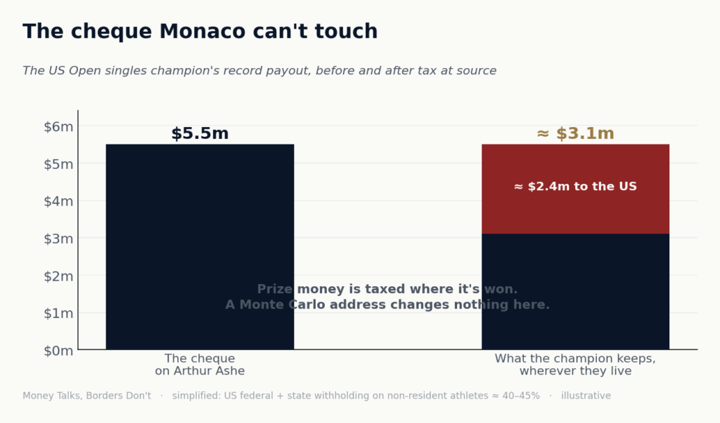
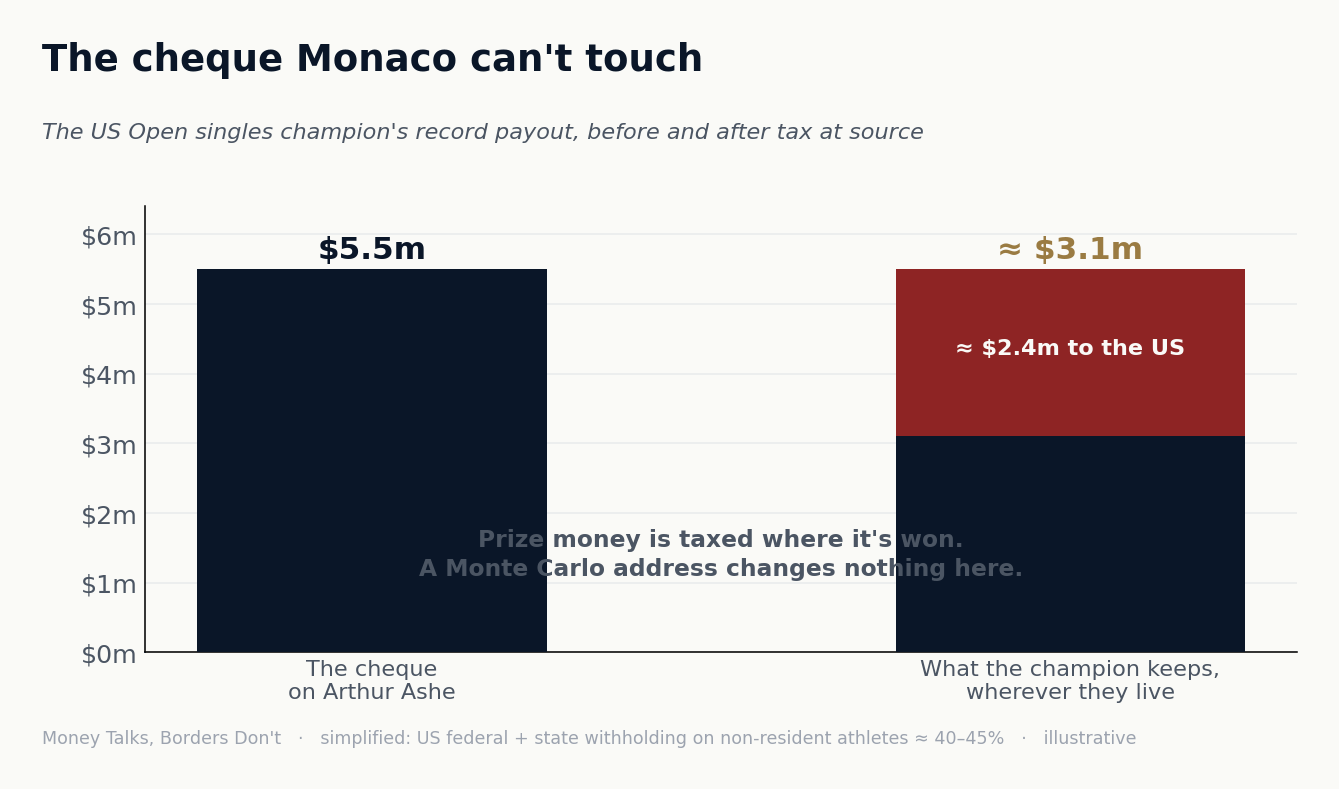
Run the arithmetic on this year’s record cheque, simplified but honest: of 5.5 million, something like 3.1 arrives, and roughly 2.4 stays in America. For the player living in Monte Carlo, exactly the same. For the player living in Stockholm, exactly the same. The most famous tax address in sport is completely irrelevant to the most famous cheque in tennis.
So why do they all live there?
Because the trophy is the small part
Look at where a star’s money actually sits, and the answer writes itself.
For a top-ten player, prize money is the visible minority of income. The majority is everything around it: the racquet deal, the watch on the wrist during the trophy photo, the appearance fees, the sponsorships, and, increasingly with age, the investment income on everything already earned.
And here is the trend hiding inside this week’s record purse: the champion’s slice keeps shrinking. Ten years ago the singles winner took 18.3 percent of all singles prize money at this tournament. This year, 12.9. The pot grows, the top prize grows, but the game’s real economics moved off the court long ago.
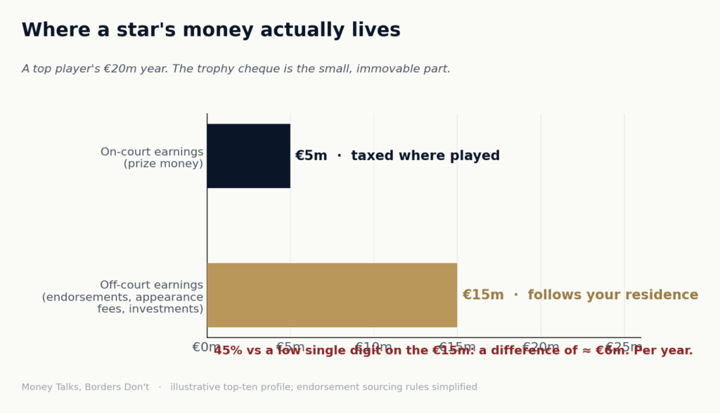
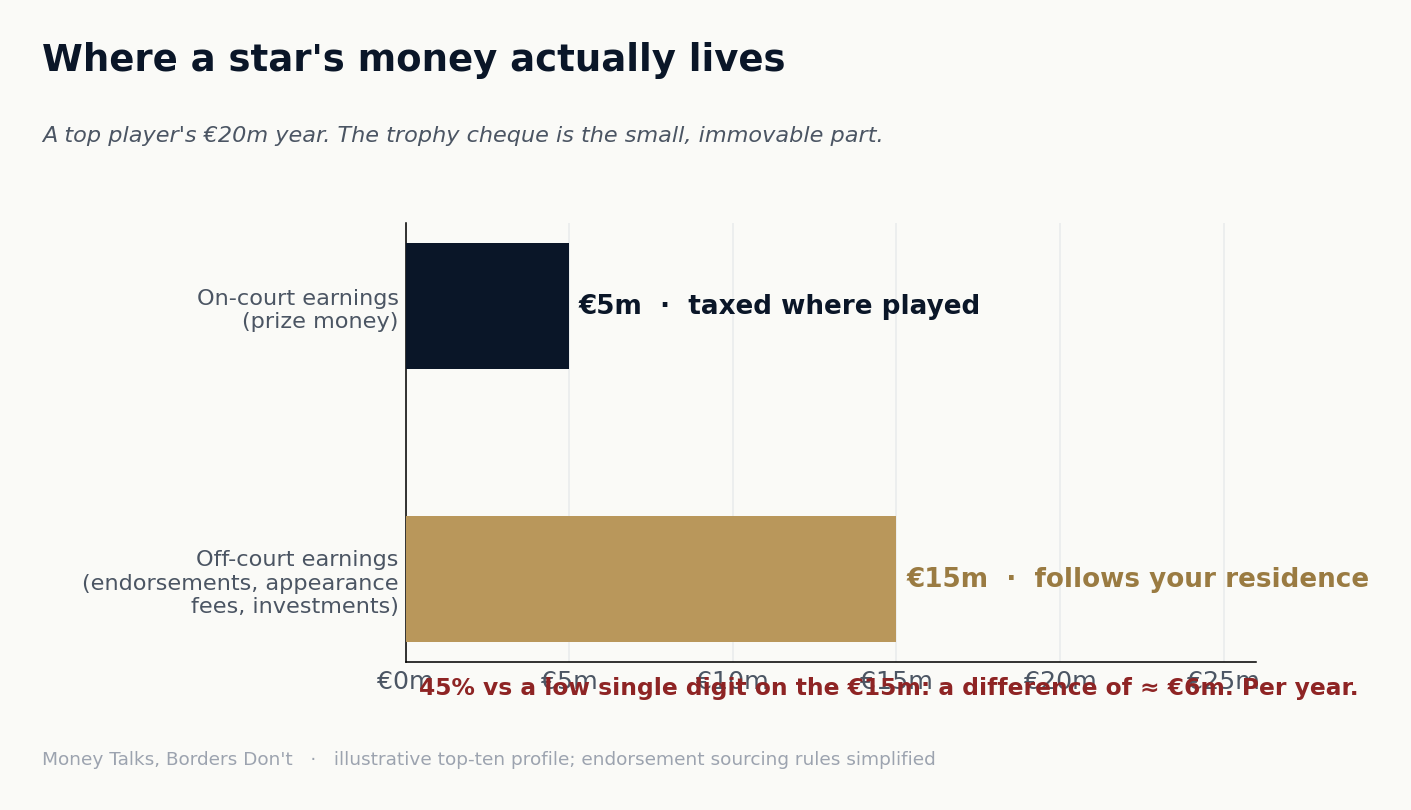
Now apply the tax logic. The on-court money is nailed to wherever it was won. The off-court money, endorsements, image rights, appearance fees, investment returns, follows the player: their residence, their structuring, their choices. Sketch a twenty-million-euro year for a star, five on court and fifteen off it, and put forty-five percent against a low single digit on that fifteen. The difference is around six million euros. Per year. That’s what the Monte Carlo address is actually for, and the trophy cheque was never part of it.
The real lesson isn’t about tennis
Here’s why this belongs in a wealth newsletter and not a sports page.
Athletes are the purest case of something that’s true for everyone with serious earning power: income has a geography, and only some of it can move.
A tennis career compresses a lifetime of earnings into roughly a decade, and it starts at twenty. So players, or the good people around them, are forced to answer the residence question at an age when the rest of us are choosing a university. They classify their income early: this part is nailed down, that part follows me, and they position themselves for the part that follows. Not at fifty-five. At twenty-two. Because their peak decade arrives first and doesn’t come back.
Now the uncomfortable mirror. Entrepreneurs and executives have peak decades too. The years around a company sale. The vesting window. The carried-interest years. And unlike a tennis cheque, the biggest single payment most business owners will ever receive, the gain on selling their company, is generally taxed the athlete’s other way: it follows residence, not source. Which means it’s plannable, and plannable years in advance.
Yet most people do it backwards. The athlete plans at twenty-two for a peak at twenty-six. The entrepreneur starts thinking about it eighteen months before the exit, when half the good options have expired, because residence decisions need time to be real, as regular readers of this newsletter know by now. Real presence, real substance, real years. The move made early is planning. The move made the year before the sale is a red flag with a removal van.
One afternoon, two columns
So here’s this week’s exercise, borrowed from the locker room.
Take your own income and your family’s, and sort it the way a player’s adviser would. Column one: nailed to a place. Salary where you work. Rent where the building stands. Business profits where the substance sits. Prize money, if you happen to have any. Column two: follows you. Investment income, most capital gains, royalties and image rights, the eventual sale of what you’ve built.
Most people have never drawn the line, and it changes how you see everything. Column one is what it is; optimise the small things and pay it. Column two is where residence, timing and structure actually work, and it’s usually the bigger column, exactly as it is for the players.
Then ask the athlete’s question: when is my peak decade, and am I positioned for it before it starts, or am I planning to improvise during it?
The players figured this out because they had no choice; a short career is a brutal teacher. The rest of us get longer careers and use the extra time to postpone the question.
The trophy is taxed at the net. The career is taxed where you planned it. Half of tennis lives in Monte Carlo because somebody explained the difference to them at twenty-two.
For analysis, not advice. Tax treatment of athletes and of endorsement income varies by country, treaty and facts, and the figures here are deliberately simplified orders of magnitude. Every situation should be assessed with your own advisors.
Sources & notes
On the tournament: the USTA announced a record $108 million in total player compensation for the 2026 US Open, up 20% from 2025’s $90 million and about 44% from 2024, with $5.5 million to each singles champion, $2.8 million to runners-up, $140,000 to first-round losers, and increases weighted toward early rounds and qualifying; the singles champions’ share of singles payouts has fallen from 18.3% to 12.9% over the past decade, and the rise follows a public revenue-sharing dispute in which top players wrote to the four majors in March (Sportico; Bleacher Report; Tennis Majors; Yahoo Sports, August 2026).
On the tax mechanics: prize money earned by non-resident athletes is generally taxed at source in the country (and, in the US, often the state) where the event takes place, with withholding applied to the payment; the roughly 40–45% combined bite on a New York champion’s cheque is a simplified illustration, and the “jock tax” is the informal name for the state-level version. Endorsement and image-rights income follows different, residence- and structuring-sensitive rules, with a portion attributable to duty days in some countries; the on/off-court split and the €6m illustration are stylised for a top-ten profile. Monaco levies no personal income tax on residents (French nationals excepted by treaty).
The two-column exercise reflects the standard distinction between source-taxed and residence-taxed income, simplified for readability.
References: Sportico, Bleacher Report, Tennis Majors, Yahoo Sports, Man of Many, and contemporaneous tournament coverage.