The ETFs Powering the AI Supply Chain

27 APR, 2026
By VanEck


Marketing Communication
What Actually Powers AI?
AI may feel purely digital, but it relies on physical infrastructure—hardware, electricity, and raw materials. Training a model like GPT-4 reportedly consumed around 50 gigawatt-hours of energy—enough to power a major city for days. And that’s just the training phase. Inference, serving AI to millions of users, requires continuous, large-scale energy use.
All that computation flows through three critical layers:
- Semiconductors that. perform computations
- Energy to run data centers 24/7
- Strategic metals embedded in hardware.
If any layer faces constraints—chip shortages, power limitations, or restricted access to minerals—it impacts the entire AI ecosystem. Instead of focusing only on software companies, investors can target the infrastructure underpinning AI.
How the AI Supply Chain Works
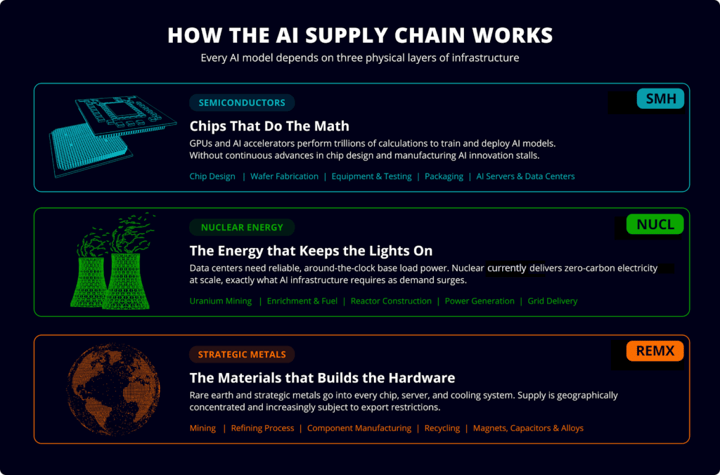
AI runs on physical infrastructure. Before a model can answer a question or generate an image, semiconductors process data, power plants keep servers running, and raw materials are mined, refined, and built into hardware. Each layer depends on the one below it.
Source: VanEck. These are not recommendations to buy or to sell any security.
Why Semiconductors Are Critical to AI?
Without advanced chips, none of these works. GPUs and custom accelerators handle the computations required to train models and run AI applications. The entire AI wave can be interpreted as, at its core, a semiconductor demand story.
The industry is highly concentrated, with only a few companies producing cutting-edge chips, creating strong demand and pricing power.
VanEck Semiconductor UCITS ETF (SMH) provides exposure to leading U.S.-listed chip companies across design, manufacturing, and equipment. Key risks to consider are liquidity, concentration, geopolitical, and market volatility risks.
Why AI Needs Reliable Energy
AI data centers require constant, uninterrupted power. While renewable energy sources help, their intermittency creates challenges.
Nuclear energy is gaining attention as a reliable, zero-carbon solution, with companies like Microsoft, Amazon, and Meta investing alongside supportive government policies.
VanEck Uranium and Nuclear Technologies UCITS ETF (NUCL) covers the full nuclear value chain—uranium mining, reactor construction, and electricity generation—supporting the growing energy demands of AI infrastructure. Key risks include liquidity, concentration, regulatory, and market volatility risks.
What Materials Are Important to AI?
AI infrastructure depends on specialized metals:
- Neodymium and dysprosium for magnets in cooling systems and drives
- Copper for electrical connectivity
- Tantalum for stable power delivery in chips
- Gallium and germanium for semiconductors and fiber optics.
VanEck Rare Earth and Strategic Metals UCITS ETF (REMX) provides exposure to companies deriving at least 50% of revenue from rare earths and strategic metals—essential to AI hardware, from semiconductors to data centers. Risks to consider are liquidity, concentration, commodity price volatility, and geopolitical risks.
Discover the AI Build-Out with VanEck
The biggest AI winners over the next decade may not be software companies, but the firms enabling its infrastructure—those producing chips, generating power, and supplying essential materials.
VanEck’s AI supply chain ETFs let investors gain targeted exposure to the physical infrastructure that every AI company depends on.
IMPORTANT INFORMATION
This is marketing communication.
For investors in Switzerland: VanEck Switzerland AG, with registered office in Genferstrasse 21, 8002 Zurich, Switzerland, has been appointed as distributor of VanEck´s products in Switzerland by the Management Company VanEck Asset Management B.V. (“ManCo”). The representative in Switzerland is Zeidler Regulatory Services (Switzerland) AG, Stadthausstrasse 14, CH-8400 Winterthur, Switzerland. Swiss paying agent: Helvetische Bank AG, Seefeldstrasse 215, CH-8008 Zürich. For investors in the UK: This is a marketing communication targeted to FCA regulated financial intermediaries. Retail clients should not rely on any of the information provided and should seek assistance from a financial intermediary for all investment guidance and advice. VanEck Securities UK Limited (FRN: 1002854) is an Appointed Representative of Sturgeon Ventures LLP (FRN: 452811), which is authorised and regulated by the Financial Conduct Authority (FCA) in the UK, to distribute VanEck´s products to FCA regulated firms such as financial intermediaries and Wealth Managers.
This information originates from VanEck (Europe) GmbH, which is authorized as an EEA investment firm under the Markets in Financial Instruments Directive (“MiFiD”). VanEck (Europe) GmbH has its registered address at Kreuznacher Str. 30, 60486 Frankfurt, Germany, and has been appointed as distributor of VanEck products in Europe by the ManCo, which is incorporated under Dutch law and registered with the Dutch Authority for the Financial Markets (AFM). This material is only intended for general and preliminary information and does not constitute an investment, legal or tax advice. VanEck (Europe) GmbH and its associated and affiliated companies (together “VanEck”) assume no liability with regards to any investment, divestment or retention decision on the basis of this information. All relevant documentation must be first consulted. The views and opinions expressed are those of the author(s) but not necessarily those of VanEck. Opinions are current as of the publication date and are subject to change with market conditions. Information provided by third party sources is believed to be reliable and has not been independently verified for accuracy or completeness and cannot be guaranteed. Please refer to the Prospectus – in English language - and the KID/KIID - in local language - before making any final investment decisions and for full information on risks. These documents can be obtained free of charge at www.vaneck.com, from the ManCo or from the appointed facility agent.
VanEck Semiconductor UCITS ETF ("ETF") is a sub-fund of VanEck UCITS ETFs plc, a UCITS umbrella investment company, registered with the Central Bank of Ireland, passively managed and tracking an equity index. The product described herein aligns to Article 8 Regulation (EU) 2019/2088 on sustainability-related disclosures in the financial services sector. Information on sustainability-related aspects pursuant to that regulation can be found on www.vaneck.com. Investors must consider all the fund's characteristics or objectives as detailed in the prospectus, in the sustainability-related disclosures or related documents before making an investment decision.
VanEck Uranium and Nuclear Technologies UCITS ETF ("ETF") is a sub-fund of VanEck UCITS ETFs plc, a UCITS umbrella investment company, registered with the Central Bank, passively managed and tracking an equity index.
VanEck Rare Earth and Strategic Metals UCITS ETF ("ETF") is a sub-fund of VanEck UCITS ETFs plc, a UCITS umbrella investment company, registered with the Central Bank of Ireland and tracking an equity index.
The value of the ETF may fluctuate significantly as a result of the investment strategy. The ETF´s holdings are disclosed on each dealing day on www.vaneck.com under the ETF´s Holdings section and as per PCF under the Documents section and published via one or more market data suppliers. The indicative net asset value (iNAV) of the ETF is available on Bloomberg. For details on the regulated markets where the ETF is listed, please refer to the Trading Information section on the ETF page at www.vaneck.com. Investors must buy and sell units of the UCITS on the secondary market via an intermediary (e.g. a broker) and cannot usually be sold directly back to the UCITS. Brokerage fees may incur. The buying price may exceed, or the selling price may be lower than the current net asset value. Investing in the ETF should be interpreted as acquiring shares of the ETF and not the underlying assets. Tax treatment depends on the personal circumstances of each investor and may vary over time. The ManCo may terminate the marketing of the ETF in one or more jurisdictions. The summary of the investor rights is available in English at: summary-of-investor-rights.pdf. Investing is subject to risk, including the possible loss of principal. For any unfamiliar technical terms, please refer to ETF Glossary | VanEck. No part of this material may be reproduced in any form, or referred to in any other publication, without express written permission of VanEck.
© VanEck (Europe) GmbH ©VanEck Switzerland AG © VanEck Securities UK Limited
───────────────────────────
¹ Global Electricity Initiative. Data Centers and AI Energy Consumption: The Surge in Electricity Demand. 2026.
² The Washington Post. AI firms turn to nuclear power amid soaring energy demand. 2025.
³ International Energy Agency (IEA). Global Critical Minerals Outlook 2025. Paris: IEA, 2025