The plan nobody knows

20 AUG, 2026



Bernard Arnault did something last month he had never done in his life. He posted on social media.
Not to launch a maison, not to toast a result. Europe’s richest man joined X to amplify a three-page letter to the leadership of Le Monde, after the paper ran a six-part series on his empire, ending with the piece that clearly stung: the succession battle reportedly warming up among his five children, the alliances said to be forming between the branches, and shareholders getting nervous about the absence of any plan they’ve actually been shown.
Set aside whether the reporting is fair. He says it isn’t, and he may be right. What’s interesting is the shape of the story, because it’s the same shape as every other succession fight in this summer’s headlines.
In Hong Kong, the heiress to the Wahaha beverage fortune just lost an appeal, leaving 1.8 billion dollars frozen in an HSBC account while she fights half-siblings whose existence became public only after her father died. In Singapore, the family of a 99-year-old drinks patriarch is in the Supreme Court over a structure that was designed, expressly, to prevent a family conflict. In Melbourne, four children of a two-billion-dollar estate are heading to trial over two wills, one signed, one not.
Different countries, different fortunes, different lawyers. One pattern.
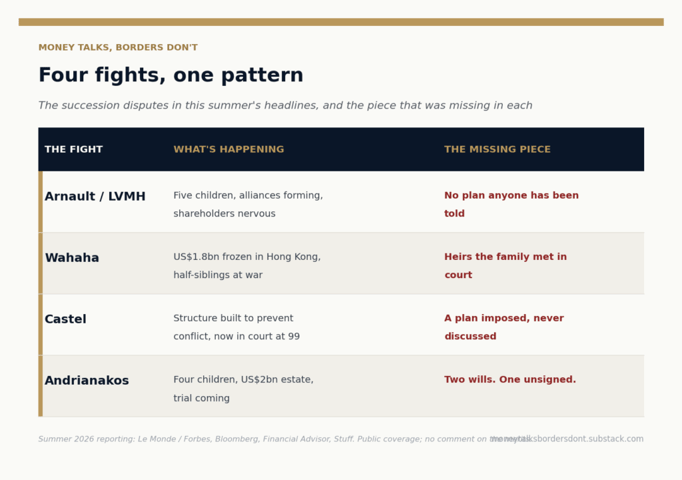
None of these fights is really about a document. Every one of them is about what happened around the document. A plan nobody was told. Heirs nobody had met. A structure imposed and never discussed. An intention drafted and never signed.
The paperwork didn’t fail. The silence did.
The most common estate plan in the world
Here’s the thing I’ve learned sitting on the professional side of these files: the most common estate plan among wealthy families isn’t a trust, a holding or a will.
It’s a secret.
The patriarch has a plan. It may even be excellent: properly drafted, tax-efficient, structurally sound. And it lives in a drawer, or in the head of a notary, or in a folder the family knows exists but has never seen. The people it governs will discover its contents at the exact moment they are grieving, reorganising their lives, and, for the first time ever, negotiating with each other without a referee.
Ask why, and the answers are always human. Talking about it feels like inviting death to dinner. Or the plan treats the children differently and nobody wants that conversation. Or there’s a fear, rarely said out loud, that once the heirs know, something changes: motivation, respect, the balance of a Sunday lunch.
All understandable. All expensive. Because a plan nobody knows isn’t a plan. It’s a surprise with a notary’s stamp on it. And surprises are precisely what courts are full of.
Look back at the table. The Wahaha fight isn’t about drafting, it’s about discovering your co-heirs in a courtroom. The Castel fight isn’t about the structure’s quality, it’s about a structure handed down like a verdict. The survey work in this field says the same thing in duller language: the trust and estate profession’s own association lists imposed, undiscussed structures and differing views on what inheritance is for among the leading causes of conflict. The old top-down way, decide everything and tell no one, is the single most reliable generator of litigation yet devised.
Put a number on it
Because “family conflict” sounds like an emotional cost, and it is, but it invoices like a financial one.
Take an estate of twenty million. Three heirs, an ambiguous plan, positions that harden. Four years of proceedings, which for a contested cross-border estate is not pessimistic, it’s median.
The lawyers come first. Multiple firms, several jurisdictions, experts, valuations. Six percent of the estate over the life of the fight is a defensible, even gentle, assumption. One point two million.
Then the freeze, which is the cost nobody prices. While the fight runs, the core of the estate is blocked: accounts preserved by court order, property that can’t be sold, a company nobody can properly govern. The Wahaha case has 1.8 billion sitting frozen right now. On our twenty million, say twelve million immobilised for four years, earning nothing instead of an ordinary portfolio return. Call it one point nine million in returns that never happened.
Then the endgame. Settlements need cash, and estates are rarely liquid, so something gets sold, and sold under deadline. A property, a stake, a collection. Forced sellers pay a discount that patient sellers don’t. Another million.
Twenty million becomes fifteen point nine. Roughly a fifth of the estate, gone, not to tax, not to bad investments, but to the fight itself. And the number is the recoverable part. The Sunday lunches don’t come back on any schedule.
Now price the alternative. Getting the documents genuinely right, aligned across every country involved, costs serious but bounded money, a few tens of thousands. The part that prevents the fight, though, costs almost nothing, which is exactly why it’s skipped: it’s the conversation. Telling the family what the plan is, and why, while the person who made it is alive, in the room, able to answer the question “why does my sister get the house” with something better than silence.
The plan explained by its author is a decision. The same plan discovered in a drawer is an accusation.
The August window
Which brings me to the calendar, because there’s a reason this piece runs in mid-August.
Cross-border families live scattered. Milan, London, Geneva, Monaco, New York. The one moment the whole system is physically in one place, around one table, for more than a weekend, is exactly now. The villa, the boat, the mountain house. August is the only board meeting most families ever hold.
I’m not suggesting you ruin lunch with a PowerPoint on your own mortality. The bar is far lower and the effect is far larger. One conversation, this month, in whatever form fits your family. Here is the plan. Here is why it’s built this way. Here is who to call first. Ask me anything, and ask it now, while I can still answer.
Twenty minutes. It will feel awkward for five of them. It is, per minute, the highest-return planning act available to a wealthy family, and it’s the one that no notary, no bank and no structure can perform on your behalf.
One more thing for the cross-border readers, which is most of you. Every extra country in a family multiplies the venues where a fight can be filed. The Melbourne case turns on a will changed in Greece. The Wahaha fight runs through Hong Kong for a Hangzhou fortune. Ambiguity doesn’t just create disputes, it lets the dispute go shopping for its favourite courtroom. The more borders you live across, the more the clarity has to do the work that geography used to.
The uncomfortable summary
The richest man in Europe is on social media this summer, at 77, arguing with a newspaper about who gets what. Whatever else that is, it’s proof of one thing: no amount of money, structuring talent or legal firepower substitutes for the plan being known.
We keep circling one instinct in this newsletter. Banks with roles. Currency managed once. Structures that are real, not just correct. Custody you can actually reach. This month’s version is the simplest and the hardest: a plan that exists only in a drawer protects the drawer.
The estate always transfers. That part is guaranteed. The only question is whether the plan transfers with it, and that transfer doesn’t happen at the notary.
It happens at the table. You’re sitting at it this month.
For analysis, not advice. The cases mentioned are drawn from public reporting; no comment is made on their merits. The worked example is illustrative and simplified. Every situation should be assessed with your own advisors.
Sources & notes
On the Arnault story: Le Monde published a six-part series in late July 2026 on the LVMH empire, closing with the reported succession tensions among his five children and shareholder unease at the absence of a communicated plan; Arnault responded with a three-page letter amplified in his first-ever social media post, rejecting the portrayal (Forbes, 27 July 2026). On Wahaha: Hong Kong’s Court of Appeal upheld orders freezing a US$1.8 billion HSBC account at the centre of Kelly Zong’s dispute with half-siblings, whose existence became public after founder Zong Qinghou’s death (Bloomberg via VnExpress, 23 July 2026). On Castel: the daughter and a nephew of the 99-year-old patriarch moved against his chosen CEO, in a dispute now before Singapore’s Supreme Court, over a succession process designed to prevent exactly this (Financial Advisor / Bloomberg, June 2026). On Andrianakos: the four children of the late Melbourne billionaire are heading to trial over an estimated A$2 billion estate and two wills, one revised in Greece and never signed (Stuff / Australian press, 2026). On causes of conflict: the Society of Trust and Estate Practitioners’ survey work identifies blended families, cross-border complexity, imposed top-down structures and differing views on the purpose of inheritance as leading drivers; “imposing structures on next generations can lead to immediate conflict and a sense of distrust” (STEP, via Financial Advisor, June 2026).
The worked example is illustrative. The assumptions, six percent aggregate legal and expert costs over four years, sixty percent of the estate immobilised at a four percent foregone return, and a five percent forced-sale discount on assets sold to fund a settlement, are practitioner orders of magnitude for a contested cross-border estate, stated so they can be challenged. Durations and costs vary enormously with jurisdiction and temperament.
References: Forbes (27 July 2026), Bloomberg via VnExpress (23 July 2026), Financial Advisor magazine (June 2026), Stuff (April 2026), STEP survey coverage, and contemporaneous reporting.