The Succession Gap: What Portuguese Families Are Getting Wrong

11 MAY, 2026
By Paulo Soares from ISGAM – Asset Management



Portuguese families are often highly disciplined in building wealth, but far less prepared to transfer it.
Across Europe, one of the largest intergenerational wealth transfers in history is already underway. According to recent UBS research, 76% of investors worry about a smooth transfer of assets to the next generation. Yet 41% have no wealth transfer or estate plan, and 42% do not have an updated will. Those two realities should not coexist. But they do. And in Portugal, the gap may be wider than many families realise.
Portuguese wealth was often built through decades of work, entrepreneurship, and patience. Business owners who built companies over thirty or forty years. Families who accumulated real estate across generations. What tends to receive far less attention is what happens after the accumulation phase ends.
Part of the issue is structural. Wealth in Portugal remains heavily concentrated in illiquid assets: operating businesses, agricultural land, family real estate held across generations. These cannot simply be divided and transferred without consequence. Who keeps operational control? Who receives liquidity? How is family cohesion preserved when the underlying asset cannot realistically be split? Most families underestimate how difficult these questions become once they are urgent.
Another part is cultural. In Portuguese family culture, wealth is a deeply private subject. Discussing inheritance can feel uncomfortable, almost as if planning succession means anticipating loss. So, the conversation gets postponed. Usually until circumstances force it.
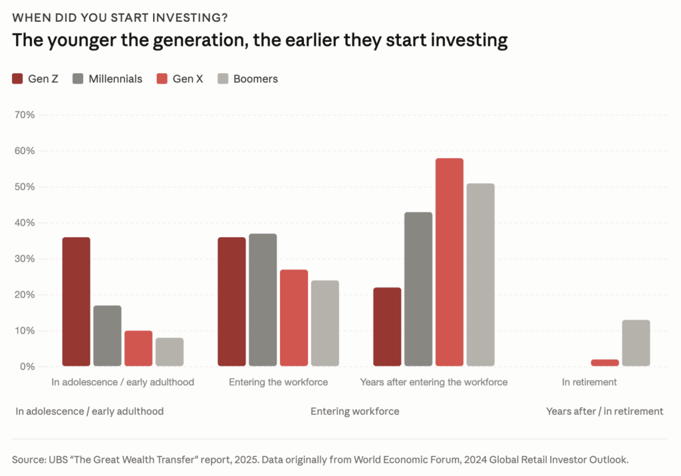
What makes this more pressing is that the next generation's relationship with money has changed. As the chart above illustrates, younger investors are entering financial markets significantly earlier than their parents did. They are more informed, more engaged, and often already forming views on how family assets should be managed. Succession planning that ignores this reality tends to produce conflict rather than continuity.
The difficult part of succession is rarely legal or fiscal. Those problems are usually solvable. The harder part is transferring the logic behind the decisions. Why the structure exists. Why certain risks were avoided. Why preserving wealth and growing it are not always the same exercise.
Families who navigate succession well rarely do so because they found the right structure at the last minute. More often, they succeed because the conversation started early enough for the transition to happen gradually rather than abruptly.
The Great Wealth Transfer is not a future event to prepare for. It is already happening, inside real families and portfolios, often without the frameworks to manage it well.