Thematic equity: Not all thematic investments are the same

27 AUG, 2025



By: Steve Freedman, Head of Research and Sustainability, Marc-Olivier Buffle, Head of Thematic Client Portfolio Management, and Hans-Peter Portner, Head of Thematic Equities, all at Pictet AM.
Thematic equities were once niche investments, but over the past five years they have become increasingly mainstream among investors. Asset managers rushed to launch thematic strategies in response to the surge in demand after Covid-19. Since late 2019, assets in thematic equities have grown from $270 billion to $560 billion, while the number of funds has more than doubled to 2,800. However, many of these hastily created funds struggled to meet expectations, and as returns deteriorated, net outflows reached $50 billion over the following three and a half years.
It is important to recognise that not all thematic equity investments are the same.
In the long run, they can provide superior risk-adjusted returns. By focusing on specific areas of the economy, they enhance the potential for excess return relative to risk, making them valuable additions to any equity portfolio across full market cycles. With the right philosophy and process, they combine quality and growth that are not easily accessible through conventional global equity portfolios.
But success requires identifying sectors undergoing transformational change and selecting specialist companies in rapid expansion that can sustain high levels of profit growth. This demands a deep understanding of complex economic and non-economic phenomena, supported by a scale of resources unavailable to many asset managers.
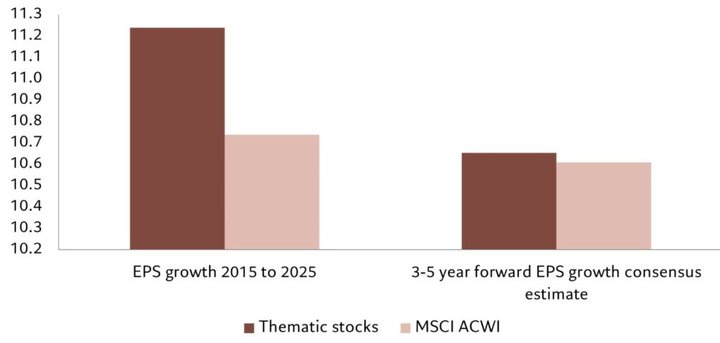
Recent analysis shows that companies within Pictet Asset Management’s thematic universe (400 firms included in the Global Megatrend Selection strategy) achieved annual sales and investment growth of 13% and 10% respectively over the past ten years, compared to 11% and 8% from around 2,500 firms in the MSCI All Country World Index (ACWI). Furthermore, the Holt score—an indicator of the ability to increase free cash flow—has consistently been higher for thematic companies, which also delivered stronger earnings per share growth over the last 15 years, a trend not fully reflected in long-term analyst forecasts.
Another advantage is that these thematic companies score well on factors associated with high-quality, well-managed businesses. The HOLT analysis suggests that over the past five years, the thematic universe has had a greater weighting towards “quality” firms—those with more stable profits exceeding their cost of capital. Their earnings have been more consistent than most companies, and more frequently demonstrated growth rates above their cost of capital. The sectors represented in these thematic portfolios have generated positive operating profit growth every year for the past 20 years, compared with several years of declines in many MSCI ACWI sectors.
A distinctive feature of thematic companies is their specialisation. Unlike complex conglomerates, thematic firms tend to be focused. Empirical research supports this: more specialised firms deliver higher excess return relative to risk once traditional factors are accounted for (Barinov, A. Firm complexity and conglomerates expected returns, 2020).
Even a Bloomberg index of equities resulting from US conglomerate spin-offs showed that these companies significantly outperformed the broader market in the first three years following their spin-off.
Portfolio construction is also critical. It requires a specialist investment team conducting independent analysis within a clearly defined universe, ensuring comprehensive coverage of all equities. This approach builds specialised expertise and a deep understanding of value chains that cross traditional industry boundaries, allowing better assessment of competitive positioning, earnings prospects, and valuations compared with typical global equity teams supported by generalist analysts covering a much larger universe. Data from Morningstar shows that generalist fund managers tend to underperform their benchmarks (MSCI ACWI or S&P 500), while specialised managers perform better against their respective indices. Similarly, ETF evaluations show that Pictet AM’s thematic strategies have outperformed over two, three, and five years to June 2025. Indeed, a thematic equity manager with reasonable skill in stock selection (information ratio of approximately 0.5 against its thematic benchmark) has more than a 55% probability of outperforming a conventional index such as the MSCI ACWI.
As Yogi Berra, Hall of Fame baseball player for the New York Yankees, once said in his paradoxical yet wise manner—his words resonate surprisingly well with investing in thematic equities:
- “If you don’t know where you’re going, you’ll end up somewhere else.” The megatrend framework helps build and maintain secular growth universes.
- “You can observe a lot just by watching.” Dedicated thematic advisory boards and academic partnerships support analysis.
- “Better cut the pizza in four pieces because I’m not hungry enough to eat six.” The ACWI index may include around 2,600 stocks, but it is not necessarily more diversified due to extreme concentration.
- “Nobody goes there anymore; it’s too crowded.” Intense enthusiasm for thematic investing has been followed by indigestion. Some consolidation of providers is creating more discipline and a stronger foundation for growth.
- “When you come to a fork in the road, take it.” Analytical discipline and expert judgement are vital to confirm an investment or adjust course.
- “It’s déjà vu all over again.” Learning from historical patterns helps anticipate booms and busts across cycles.
- “The future ain’t what it used to be.” Understanding economic and social evolution, evaluating trends, and conducting scenario analysis is enhanced through collaboration with experts such as the Copenhagen Institute for Futures Studies.