USA and China announce a temporary reduction of tariffs

12 MAY, 2025
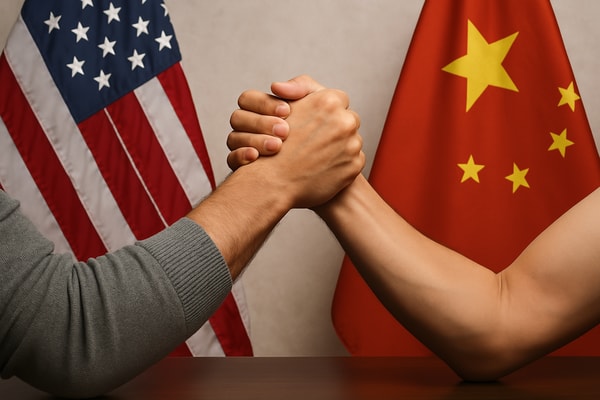


The United States and China announced this Monday an agreement to significantly reduce reciprocal tariffs for an initial period of 90 days. Washington will lower its tariffs on Chinese products from 145% to 30%, while Beijing will do the same with American goods, going from 125% to 10%.
The pact, reached after intense negotiations in Geneva, represents the largest de-escalation in the trade war between both powers since its inception and establishes a mechanism to continue the economic dialogue in search of a lasting solution.
Next, the experts from Fidelity, Vontobel, Columbia Threadneedle Investments and Ostrum AM help us to know more details about this agreement and what aspects investors will have to pay attention to from now on.
Tariff reduction between the US and China

Stuart Rumble, Investment Manager for Asia Pacific at Fidelity International
The United States and China have issued a joint statement announcing a temporary tariff reduction: the US will reduce tariffs on Chinese products from 145% to 30% for a period of 90 days, while China will reduce theirs on American imports from 125% to 10% during the same period. The Asian markets have responded positively, with Chinese and Hong Kong stocks rising with the news.
This short-term respite is an encouraging sign for the markets and should help restore some confidence. However, although the cuts are significant, they are also temporary. But for now, sentiment may matter more than substance for market confidence and internal political support, more than the content of any substantive agreement. So,
What should investors take into account from this announcement?
- Firstly: although the reductions are temporary, they represent a notable change in the overall effective tariff burden. The high tariff regime between the U.S. and China has already caused significant disruption, reducing bilateral trade between the world's two largest economies and increasing the risk of a broader global slowdown. Although neither of the two economies is currently near a breaking point, a significant reduction in overall tariffs helps to mitigate that risk. The U.S. administration is likely to continue supporting demand through extended tax relief and other fiscal measures aimed at supporting household spending. China, having spent years preparing for possible trade tensions by reducing dependence on U.S. exports, also maintains the ability to expand domestic stimulus. These developments, along with lower trade barriers, should be favorable for both equity and credit markets.
- Secondly: even with these tariff cuts, much of the shift in global trade flows has already begun. The decrease in direct trade between the U.S. and China has driven an increase in diversion through Southeast Asia and other third countries. Tariff differences remain relevant and will continue to shape trade flows based on relative competitiveness, infrastructure capacity, and internal policy responses. While these structural changes will take time to materialize as companies adapt their supply chains and logistics, they are important for investors considering their allocations to Asia.
- Lastly: although encouraging, this development should perhaps be seen by investors as a decrease in tensions within a broader and long-term shift in the relationship between the U.S. and China, towards greater self-sufficiency.

Jean-Louis Nakamura, director of Conviction Equities (Vontobel boutique)
The reaction of the markets has already shown that this period of pause and cooling will contribute to prolonging the rebound that began in mid-April. This movement is based mainly on the feeling that the peak of trade uncertainties is behind us. However, the reality is that the markets have reversed the entire correction experienced in the last 10 days of April. At the same time, tariffs are still significantly higher than before. In addition, we do not yet have a clear view of the extent of the damage caused to the global economy (particularly in the United States and China).
In the next two months, several hard data will confirm whether the collapse of some of the most advanced components of recent surveys was exaggerated. We could witness a tug of war between the pre-announcements of more sustainable and global agreements, closer to the initial starting situation, and the hard data suggesting a rapid deterioration of domestic demand in the US and the dynamics of exports in China. If the latter arrive first, the markets should experience another major episode of volatility.

Anthony Willis, Senior Economist at Columbia Threadneedle Investments
We have seen a positive outcome on the trade talks between the United States and China, which took place over this weekend. While there was anticipation about possible advances in tariffs, the substantial reduction agreed in this regard between both countries, even if only for an initial period of 90 days, has been greatly surprising.
The US Treasury Secretary, Scott Bessent, had already acknowledged that the situation was unsustainable, amid concerns that the punitive tariffs applied since the beginning of last month had begun to affect economic data. However, the levels of pragmatism shown and this morning's statement that "neither party wants a disassociation" highlights how intertwined the two global economic superpowers continue to be. The flow of news this morning and last week (the "agreement" with the UK) suggests that tariffs will remain in place, but at a level that allows President Trump to argue that he has taken steps to address the US deficit and encourage the relocation of production factories, but also at a level that does not have a significant impact on the economic trajectory of any country willing to engage with the United States and reach a framework to reduce tariffs.
Given that tariffs have been in place for a limited time, the economic damage should only be superficial. Although there will inevitably continue to be uncertainty, this is a positive step. This morning we are witnessing a strong rebound in risk assets, and we anticipate a further recovery in risk appetite as market participants assess the possibility of new "trade agreements" with other countries in the coming weeks.
The agreement does not resolve the technological competition between the US and China

Philippe Waechter, chief economist at Ostrum AM (affiliate of Natixis IM)
Chinese and Americans have partially buried the hatchet of tariffs. This protocol will be in force for 90 days, time to debate and reduce the risk of escalation.
Good news and all the better if we can avoid a fire that would be detrimental to everyone.
Two observations:
- The 30% is not a harmless rate for the American consumer and for companies. Of course, it is much less than the 145% rate that was monthly and validated a high risk of recession, but it is still high. This will have an impact on inflation and the dynamics of activity, even if it now eliminates the risk of recession.
- This does not solve the issue, for Americans, of China's technological competition. This was the initial struggle of the White House, it is not resolved. For Washington, the challenge is to innovate enough not to suffer this strong competition. But, is this viable in an economy that aspires to isolationism?
The reduction of tariffs represents a pause, but not the end of tensions between both countries.