Why Asia’s dividend income opportunity is too big to ignore

18 MAR, 2026
By Christina Woon from Eastspring Investments



Asia enters 2026 with one of the strongest income profiles globally. The region’s corporates continue to deliver the highest free cash flow yields alongside robust growth in cash flow generation globally, supporting sustainable dividends and healthier balance sheet dynamics.
Asia’s constructive macroeconomic backdrop is underpinned by sustained investment in infrastructure and supply‑chain diversification. The global Artificial Intelligence build-out is also driving growth in the region as it results in an increased demand for Asia’s semiconductors, electronics, power generation equipment, batteries and data centres. These long‑term structural themes are translating into earnings momentum that has not been seen for more than a decade, creating a stronger and more durable foundation for dividends. Meanwhile, Asia equity valuations remain compelling.
Asia has attractive dividend yield and cheaper valuations
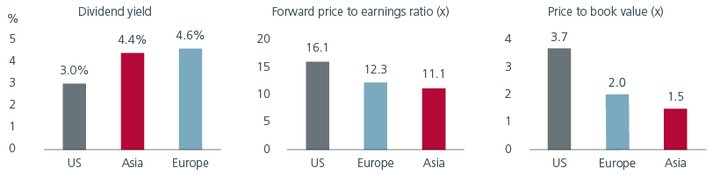
There is also a growing emphasis on shareholder value creation across the region. In 2024, South Korean regulators put in place a Value-Up Programme designed to address the undervaluation of Korean stocks and incentivise better shareholder return policies. Since then, similar programmes have been rolled out in India, China and most recently in Singapore. The actions by Asian companies to drive better shareholder returns have been rewarded by the markets. The greater focus on shareholder returns has also led to lower dividend volatility. All this, coupled with lower starting valuations, has helped to lift Asia’s risk adjusted returns. The 3-year risk adjusted returns from Asian dividend stocks at 1.10 (as of December 2025), are higher than the US’ (0.76) and Europe (1.0).
One unique factor that sets Asian dividends apart is that the Technology sector (22%) makes up a substantial share of the high dividend yield index in Asia, unlike in US and Europe, where the Consumer Staples and Healthcare sectors are more prominent. As such, investors in a high dividend yielding strategy in Asia can potentially also gain some exposure to Asian tech companies and enjoy both dividends and growth.
It is also notable that high dividend yielding stocks in Asia have lower correlations to high dividend yielding stocks globally, as well as to global and Asian bonds. This suggests that adding Asian dividends to a global income portfolio can provide investors with greater portfolio diversification.
The diversity of dividend payout ratios and yields across Asian countries and sectors creates a rich opportunity set, but we believe that an active approach is needed to fully capture its potential while managing downside risks. Deep fundamental research can help to identify emerging income opportunities linked to structural trends or cyclical sector recoveries. It can also help to seek out opportunities potentially missed by passive or screen‑based strategies. This includes companies that do not currently feature on traditional dividend screens but are approaching an inflection point where they may resume dividend payments, as well as companies which have the necessary conditions and capacity to deliver special dividends. Equally important, we believe that rigorous bottom‑up analysis can proactively help to identify risks to dividend sustainability, which may arise from deteriorating fundamentals, industry disruption or regulatory change.
For income focused portfolios, an underweight to Asia risks overlooking some of the most attractive dividend equity opportunities available today. The breadth of income sources across the different sectors and countries in Asia provides both diversification and resilience in a shifting macro landscape. This is especially important when geopolitical tensions, tariff headlines and shifts in central bank policies are starting to shape the markets in 2026. For investors looking to diversify and take advantage Asia’s attractive equity valuations, dividend buffers come in handy in supporting total returns during periods of market volatility.