World Cup Pick: Home Bias

10 JUN, 2026
By Kiko Vallarta from iM Global Partner



The World Cup starts this month, and with the United States being one of the host nations, I feel obligated to pick the home team. But this is not a forecast. I will hold out hope, but the U.S. is unlikely to win. I am picking them anyway. There is something about watching your own country play on home soil that bypasses rational judgement entirely, which, as it turns out, is exactly the point.
And that instinct of backing the home side regardless of what the odds say happens to be a powerful driver behind how investors build portfolios.
We call it home bias, and it is everywhere. The average investor in nearly every country holds far more of their domestic market than its share of global markets would justify. Canadians overweight Canada, Australians overweight Australia, and Europeans overweight Europe equities. Investors are more comfortable owning the names they know and the companies they read about.
The United States is now nearly two-thirds of the MSCI ACWI, a record weight for a single country in the global index.
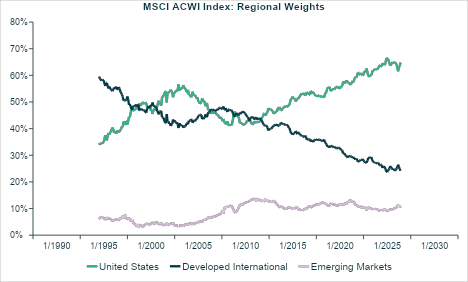
Investing in domestic equities today is not making a modest tilt toward the familiar. It is making a concentrated bet on one country’s stocks at the most expensive relative valuation in a generation. At glance the premium makes sense: the U.S. economy continues to be resilient, dynamic, and is benefiting from the AI tailwind. However, home bias has never carried a bigger price tag.
We have written for months about the value of diversifying away from concentrated U.S. exposure, and the last eighteen months has rewarded that view. International and emerging markets have led U.S. equity markets. The MSCI ACWI ex. U.S. index returned 32.4% in 2025 (ahead of the S&P 500’S of 17.9% gain). Foreign equities are again outpacing U.S. stocks this year with returns of 14.2% p.a. and 11.4% p.a., respectively.
So, I will root for my side but will likely be eliminated before my colleagues’ teams head for the exit. On the field, backing your home team is the entire point. However, in a portfolio, it is the bias most worth scrutinizing, particularly now, when concentration and conviction in U.S. equities are historically high.
The World Cup ends in July but portfolio decisions last a lot longer.