Hugo van Kuffeler from J. Stern & Co. is our Sales Manager of the Month

5 AUG, 2026
By Joanna Piwko from RankiaPro Europe


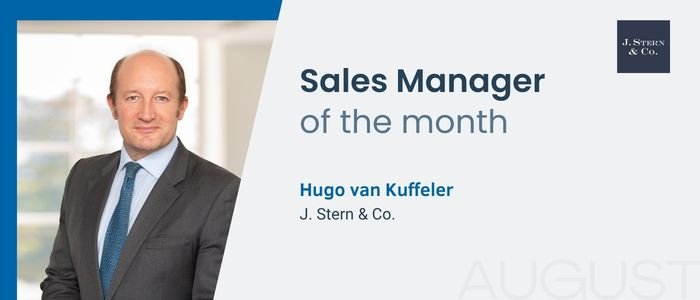
Hugo van Kuffeler is a Client Director at J. Stern & Co., a London-based asset manager with a 200-year heritage built on long-term, quality-driven and ESG-integrated investing.
With over 25 years of experience across asset and wealth management, van Kuffeler has built his career around business development and strategic growth of boutique investment firms. Prior to joining J. Stern & Co. in 2023, he co-founded Tyndall Investment Management and earlier served as Assistant Fund Manager at Jupiter Asset Management. He holds a BA in Philosophy from the University of Southampton.
If I didn’t work in finance, I would…?
Be a Lobsterman. From as early as I can remember, each summer my family would spend a couple of weeks on the Isle of Mull, on the West Coast of Scotland, where there was a lot of mucking around in boats, catching fish and setting lobster pots. We would catch crab as well as lobster and the occasional dogfish, always a challenge, always exciting and in the most stunning scenery. Sitting in a boat on a sea loch on Mull is a magical environment where breathtaking wildlife surprises you every day.
What first drew you to the industry, and what key experiences have shaped your approach to markets and client relationships?
My father was an investment banker, so financial services was always appealing to me as I had paid close attention to my father’s career which looked exciting.
My first job was with Jupiter Asset Management in London, which was run by the mercurial John Duffield. He was one of the greatest Fund Managers of his generation, and he had employed some of the best fund managers which created one of the most incredible environments I have ever worked in. It was 1995, the personalities and culture were so strong there, it was infectious.
This period was a bull market up to the dot-com crash in 2000 and we kept almost all our clients. After the crash, I saw how important it was that we had made a lot of effort with our clients on the way in and held their hand during challenging market conditions.
Looking back on your career, is there a major event in the industry that stands out to you, and how did it influence your professional path?
The dot-com crash was the first market correction of serious magnitude that I experienced. It was the first time that I saw markets drop by 5% per day and 20% per week and that gives you great perspective for the future. At the time you think that everything is going to zero and it’s the end of times! But the reality was (in this instance) that the robust and more traditional businesses looked appealing again to investors and the market slowly recovered with only the best in show from the dot com stable (which are now household names) surviving. This was also my first experience of how important the firm culture is, the narrative is around the firm you work for and the importance of your investment process - you can’t always be selling performance - in this instance performance was terrible! But the consistency of your process and how you come to your investment decisions as well as your firm’s culture is what reassures investors during challenging times.
What widely accepted market belief do you think should be questioned more critically, and for what reasons?
That Active Management has had its day, and Passive investing is the only way to invest. Low-cost passive investing has revolutionised the market and made investing a lot more accessible, however it has magnified market concentration and market inefficiencies - the very things passive investing set out to overcome. This in turn continues to create opportunities for active managers, particularly the traditional stock selector. Passive and Active investment products should sit side by side in any investment portfolio – one should not replace the other.
How do you adjust your strategy when market conditions change abruptly?
Clients need consistent communication – particularly when there are abrupt changes in market conditions. Keeping them informed of what the portfolio is doing and why we remain confident in what we hold, helps build confidence over time. Clients know that they can speak to me or the Fund Manager at very short notice, but consistent communication is essential to making investors feel comfortable. Sudden changes in the market are an intrinsic feature of investing, and this is a time when discipline is tested, and we must clearly communicate our investment philosophy.
As markets are increasingly driven by data, speed, and technological innovation, how has your investment approach evolved over time?
Our investment discipline has not changed since inception in 2012. Technology has certainly enabled us to consume and analyse more data, more quickly but investing in quality businesses that we know intimately and hold for the long term, is entrenched in our DNA. The case for this approach is not theoretical. The J. Stern & Co. World Stars Global Equity strategy has outperformed the MSCI World in 76 per cent of all five-year monthly rolling periods since inception in October 2012, measured across 100 rolling periods, net of fees. Quality is not just a label but is a gating condition that all companies must satisfy before we invest.
Quality companies must have a strong and sustainable competitive position in a good and growing industry: businesses with genuine economic moats, great brands and growth prospects from innovation, market growth and capital allocation.
Quality companies must have management with a demonstrable track record of value creation, leaders who allocate capital wisely, think in decades rather than quarters, operate in good corporate governance frameworks and invest in innovation and growth.
Quality companies must have a balance sheet of great strength, so robust that the company can weather any adversity, whether a pandemic, a banking crisis, an oil shock, a recession or a wave of tariffs, and emerge not merely intact but stronger than its weakened competitors.
Quality companies are more resilient to market shocks and are the companies that are doing the disrupting rather than being disrupted.
How has the role of Sales Manager evolved over the years, and how do you see it developing over the next five years?
The role has changed a great deal over the last 3 decades. Whilst the goal of establishing trusted relationships is a key part of the role, I think that the good salespeople are as informed as the investment team and can carry a meeting with the most senior investors. You need to know your product intimately as well as the universe it sits in, alongside how the different profiles of investors think about the investment strategies in front of them. The Sales Manager is the first impression of the business, so you need to stick in a prospect’s mind for the right reasons!
How do you maintain balance between intense professional demands and personal life?
With difficulty! I have 3 amazing children who I am lucky enough to spend weekends with. I live in the countryside, so enjoy nothing more than being in the woods with a chainsaw and strimmer!
What advice would you offer to young sales professionals looking to establish trust and credibility early in their careers?
Watch and listen to those who have been in the industry for a while. Always remain teachable – life has a habit (just when you think you’ve seen it all) of sending you something to learn from. Always ask questions, stay curious and read about the industry as much as you can. Once you understand the context of what you are selling, the process becomes a lot easier. Make mistakes but only once (!) and always apologise. The reality is that the first decade of your working life is your early career, so grab every opportunity with both hands.