Lorenzo González Menéndez from DNB AM is our Sales Manager of the Month

13 MAY, 2026


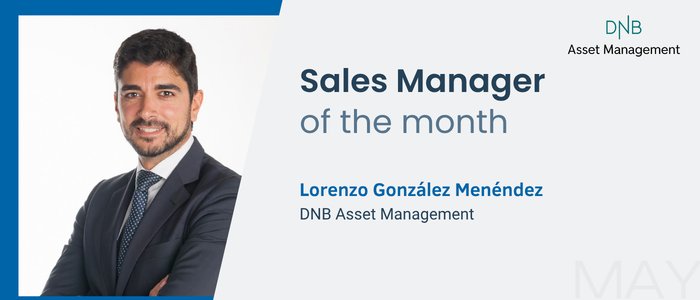
Lorenzo González Menéndez is currently Head of Southern Europe at DNB Asset Management. He joined the firm in December 2024 as Head of Iberia, after spending 10 years at Nordea Asset Management, where he served as Head of Discretionary Business. Prior to that, he held senior portfolio management and product roles for over 15 years at Bankia, Banco Sabadell, Banco Atlántico, the Spanish Confederation of Savings Banks (CECA) and Analistas Financieros Internacionales (AFI). Lorenzo holds a Bachelor’s degree in Business Administration and is a CESGA and CAIA charterholder.
If you were not a Sales Manager, you would be…? Have you ever considered a different career path and what is it about asset management that ultimately won you over?
Early on, I seriously considered becoming a doctor. It wasn’t an easy decision, and I took my time choosing my career path, mainly because I was very drawn to professions where you can help people in a direct and meaningful way.
Towards the end of my university years, I started attending conferences and events related to the financial industry. That exposure helped me realise how attractive this sector is: constantly evolving, highly dynamic and driven by innovation. I was particularly drawn to the fact that continuous education is essential to perform well, and that learning never really stops. The combination of these elements ultimately led me to choose asset management as a career.
How has the industry evolved since you began your career?
The industry has evolved significantly and become much more professional over the years. Competition has increased, products are more sophisticated, and there is a constant need to innovate in order to adapt to changing market conditions.
At the same time, investors are far more informed and demanding. They look for deeper analysis, greater transparency and solutions that are tailored to their needs rather than generic approaches. This evolution has raised standards across the entire industry and continues to push professionals to improve.
In your view, what truly builds lasting trust with clients in this industry?
Lasting trust is built through transparency, consistency, dedication and, above all, genuine passion for what we do. Clients value clear communication, honesty and people who fully assume responsibility for their role.
Taking the time to listen, being available and demonstrating commitment over the long term are key. When clients feel supported throughout their investment journey—rather than simply sold a product—trust develops naturally.
What advice would you give to young professionals entering the sector today? Which personal qualities are essential to succeed?
My main advice would be to develop a real interest and passion for finance. It is a very stimulating and rewarding sector, but it also requires continuous learning and curiosity. Ongoing education is essential.
Beyond technical knowledge, qualities such as discipline, dedication and humility are crucial. Markets constantly evolve, and no one has all the answers. A willingness to learn and improve every day is what truly sets professionals apart.
As Head of Southern Europe, what notable changes have you observed in the region, and what trends should we be paying attention to?
Passive strategies have clearly established themselves as core elements within many portfolios. That said, I do not believe they will replace active management products. Rather, both approaches will continue to coexist and complement each other within well‑constructed portfolios.
At the same time, we are seeing growing interest in thematic strategies that reflect economic, technological and geopolitical changes. These strategies are playing an increasingly important role in diversification, in a region where investor sophistication continues to rise.
How do you navigate short‑term performance expectations while staying focused on long‑term investment strategies when engaging with clients?
Meeting short‑term expectations is always challenging, especially in volatile market environments. To navigate this properly, it is essential to have a strong understanding of how markets evolve and how different financial products behave and adapt to those changes.
Providing clients with timely, accurate and high‑quality information is key. At the same time, reinforcing the benefits of long‑term investing remains fundamental. When portfolios are assessed over longer periods, it becomes easier to separate short‑term noise from solid management, genuine trends and quality outcomes—something clients increasingly recognise.
Looking ahead, what trends do you think will most impact the asset management industry over the next few years?
Many of the key trends are clearly shaped by a constantly changing geopolitical environment, as well as by society’s need to evolve technologically and structurally. Themes such as European defence, energy solutions capable of meeting growing demand—like nuclear energy—as well as critical metals and technology, stand out for their long‑term relevance.
In addition, the healthcare sector will be increasingly important, particularly in areas related to new therapies and medical innovation. These are structural trends rather than short‑term cycles and will remain central from a long‑term investment perspective.
Do you think the impact of AI and technological advancements on your profession is underestimated or overstated?
When used properly, artificial intelligence is a very powerful tool that can bring clear long‑term benefits. It enhances efficiency, analysis and decision‑making across many areas of the investment process.
However, the human element remains essential. Understanding clients, building trust and offering meaningful guidance require personal interaction, experience and judgement—areas where technology can support, but never fully replace, people.
Outside of work, what hobbies or activities help you recharge, and do they influence your professional mindset in any way?
My greatest priority outside of work is my family. Spending time together and travelling whenever possible is what helps me disconnect and recharge.
These moments allow me to keep perspective and maintain balance, which is essential for returning to work with energy, focus and long‑term motivation.