Jaime Mesia from Alken is our Sales Manager of the Month

11 MAR, 2026


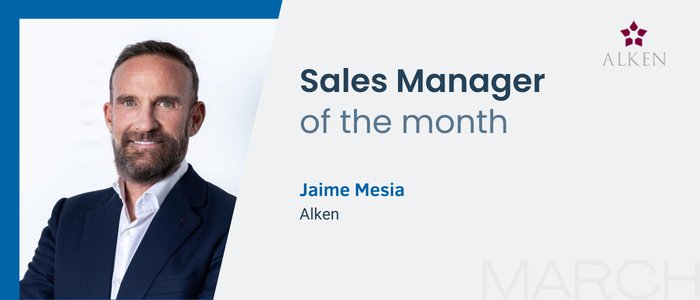
Jaime Mesia joined Alken as Sales Director and Product Specialist in 2011. He is responsible for client relationship management and sales within Spain, Italy, Portugal, Scandinavia, Israel and Americas. He began his career in 1996 as an account manager at Merrill Lynch Private Banking in Madrid. Later, he joined the International Equity Sales Desk at (formerly BBV before merging with Argentaria) BBVA in 1998.
From here, Jaime was offered the same position at Cheuvreux Spain to cover UK and Nordic accounts for the French brokerage firm. He was appointed best Iberian Equity Sales specialist for Nordic accounts by Thomson Extel Survey in 2004. He then joined Gartmore where he worked as Sales Director for Southern European accounts from June 2005 until February 2011, where he joined Alken. Jaime holds an MBA Degree in Finance and Marketing by the University of Miami in Florida. He has 30 years of industry experience.
What first led you into a career in finance, and which key experiences have most influenced how you approach the markets and build relationships with clients today?
Since childhood, I have been drawn to the dynamism and excitement of the financial markets. I became fascinated by how deeply the world is shaped by the economy, and how sensitive our daily lives are to economic forces beyond our immediate control. I admired films portraying executives who thrived, failed, and rose again in the face of adversity. Over time, I came to understand that finance plays a central role in shaping our society. The degree of economic success or failure often reflects broader dimensions of our collective well-being.
My first concrete exposure to investing came during a visit to a branch of SunBank (which no longer exists under that name). A banker introduced me to a mutual fund and explained an equity strategy managed by one of the world’s leading asset managers. I still remember the enthusiasm with which he described the opportunity. His excitement sparked my curiosity and motivated me to look deeper into what stood behind that fund. That moment not only ignited my interest in investing, but also taught me something fundamental: the importance of listening carefully to clients, understanding their needs, and serving them with conviction and genuine passion.
From that point on, my interest in equity markets steadily grew. I began reading investment literature, studying different philosophies deepened my understanding of the multiple paths to successful investing. More importantly, it solidified my desire to be part of this complex and fascinating world — one where discipline, insight, and conviction can shape both financial outcomes and broader economic realities. I have always learned much at every job I have held and have been very lucky to work with talented people who have taught me much.
Alken and the people I have worked with have been pivotal in my career. During the 15 years that I have spent at the firm, we have gone through different cycles, opportunities, issues. Each one of these situations has made me learn many lessons that I shall always carry with me.
Reflecting on your journey, which pivotal career move had the greatest impact on your path, and how did it reshape your professional direction?
After several years working as a broker at multiple institutions, I realized around 2004–2005 that the brokerage industry was entering a new phase. Sales were becoming increasingly commoditized, and client relationships were being reshaped by a set of rules that, in my view, limited the flexibility and discretion of sales professionals. At that point, I felt it was time to pursue a new path—one that would allow me to leverage my experience while offering a fresh perspective on my career. During my research, I discovered the asset management industry. At the time, few people I knew had transitioned from the sell side to the buy side, and in hindsight, it was a risky move—but one I am now very glad I made.
The buy side and sell side demand very different skill sets and approaches to the market. Having experienced both, I have come to believe that anyone seeking a career on the sell side would benefit tremendously from first spending time on the buy side. Doing so provides a deeper understanding of the unique challenges and needs of asset managers, ultimately positioning one to better serve and anticipate the buy-side perspective.
In an environment where markets are increasingly shaped by data, speed, and technological innovation, how has your investment approach adapted or transformed over time?
Over time, I have come to realize that while markets have become faster and more data-driven, the human dimension of investing has not changed nearly as much as the headlines suggest. Information today moves instantly, and clients are often exposed to market commentary before we even speak. As a result, the role of a salesperson has evolved from being a source of information to becoming a source of interpretation, context, and reassurance when needed.
Technology has undoubtedly enhanced transparency. Reporting is more sophisticated, analytics are deeper, communication is immediate, yet in many ways, this abundance of information can create uncertainty rather than clarity. I find that my responsibility as a sales is now less about delivering updates and more about helping clients step back from the daily noise and reconnect with their long-term objectives. In volatile periods especially, the value we bring not just speed but perspective. I try to strengthen my ability to translate the message from the portfolio managers, with a deep understanding of the underlying drivers and the impact onto portfolios to differentiate from others.
In that sense, relationship management today requires not only technical understanding but also emotional intelligence, a deep understanding of the instrument that you are selling and whom you are targeting that message to.
Is there a common market belief today that you think might be wrong or oversimplified? Why?
One belief I find increasingly oversimplified is the assumption that access to more data automatically leads to better investment outcomes. In practice, the sheer volume of information can amplify short-term reactions and reinforce herd behavior rather than independent thinking. Data is powerful, but without discipline and a clear framework, it can just as easily become a distraction. This is where in my opinion fundamental stock picking can make a difference.
I also believe that markets are too often framed in extremes — either driven entirely by macro uncertainty or entirely by technological transformation. Often this leads to short-term investing and even to fund trading. The reality, as always, is more layered. Cycles of optimism and pessimism repeat, even if the catalysts evolve. From a relationship perspective, it is important to remind clients that temporary underperformance does not invalidate a well-constructed process. Conviction must be grounded in philosophy, not in the latest narrative.
Maintaining that balanced perspective is essential, this long-term view and focus on profitability trends, particularly when sentiment shifts rapidly and confidence can be fragile.
What trends are currently shaping conversations with your clients?
Conversations today feel more strategic and more holistic than they did a few years ago. After a prolonged period of extraordinary monetary conditions followed by rapid tightening, many clients are reassessing not just tactical positioning but the broader architecture of their portfolios. The valuation discrepancy across regions and asset classes are bringing forth real opportunities. Today market feels the need to diversify away from US assets into other markets that had been long forgotten. We are seeing interest in European Equities from international investors like we had not seen in decades. And this may become a structural focus as we move into a new world paradigm where the US loses weight.
There is a clear focus on resilience, on risk control, on how portfolios behave under stress, how correlations shift in challenging environments, and how income can be generated sustainably in a higher-rate world. Artificial intelligence is also a recurring theme, not only as an equity opportunity but even more so today as a broader driver of productivity and structural change. Clients are curious, but also cautious, aware that strong narratives must still be evaluated through the lens of valuation.
More than anything, I sense that clients are seeking alignment between performance expectations, regulatory frameworks, liquidity needs, and long-term liabilities. The dialogue has matured from short-term comparisons toward durable solutions. In the end, despite the surge of machines, this continues to be a people’s business where skilled portfolio managers will definitely continue to add value.
How do client expectations recently differ across various European markets?
What continues to fascinate me about working across Europe is the diversity of perspectives shaped by history, regulation, and culture. In the Nordic countries, sustainability considerations are deeply integrated into investment discussions, with a high expectation of transparency and measurable impact. In German-speaking markets, there is often a strong emphasis on capital preservation and risk discipline, reflecting a more conservative financial tradition.
In Southern Europe, relationships tend to be particularly personal and trust-driven, where continuity and accessibility matter just as much as quantitative results. Meanwhile, in markets such as the UK and Switzerland, discussions are often highly analytical, with a strong focus on portfolio construction efficiency and alternative exposures.
Despite these nuances, one common thread across Europe is the expectation of responsiveness and clarity. Clients value speed, but they value thoughtful answers even more.
What advice would you give to young sales professionals seeking to build trust and credibility early in their careers?
I would encourage young professionals to invest deeply in understanding what they represent — not only the strengths of a strategy, but also its limitations. Authentic credibility comes from honesty and from the confidence to acknowledge complexity rather than oversimplify it.
Equally important is consistency. Trust is rarely built in a single meeting; it develops gradually through reliability, preparation, and follow-through. In difficult market environments, transparency becomes even more important. Clients remember how you communicate during periods of stress far more vividly than during periods of strong performance.
Above all, I would remind them that this is a long-term profession. Relationships, like capital, compound over time, and patience is an underestimated competitive advantage.
What qualities do you value most in a successful sales professional? When you disconnect from the markets, what activities or interests help you unwind — and do they in any way shape your perspective on investing?
For me, the most important qualities are intellectual curiosity and empathy. A strong sales professional seeks first to understand — the client’s objectives, constraints, concerns, and even unspoken hesitations — before thinking about positioning solutions. That curiosity builds more meaningful dialogue and ultimately stronger partnerships.
Resilience is equally important because markets inevitably test conviction. The ability to remain composed, constructive, and client-focused through cycles distinguishes those who build enduring careers. And underpinning everything is integrity. Without trust, even the most compelling strategy loses its foundation.
When you disconnect from the markets, what activities or interests help you unwind — and do they in any way shape your perspective on investing?
I find that stepping away from the markets—through sports, time outdoors, reading, spending time with friends and family, or traveling—recharges both mind and perspective. Physical activity reinforces lessons that resonate professionally: progress is incremental, discipline outweighs intensity, and short-term discomfort is often part of long-term improvement. Traveling, in particular, is one of the most enriching experiences in life. It broadens the mind, fosters empathy, and exposes you to new ways of living and understanding the world.
Recently, I earned my Yacht master certification. While owning a boat remains a low priority, achieving this goal was deeply fulfilling. Boating presents a constant challenge: navigating the ocean requires focus, adaptability, and respect for forces beyond one’s control. It is a reminder that, often, the journey itself is more meaningful than the destination.
Reading has also profoundly shaped my perspective. History, in particular, illustrates that while each market cycle may feel unprecedented, human behavior; optimism, fear, overconfidence, caution tends to repeat. In many ways, disconnecting from the daily grind allows me to reconnect more effectively, returning to work with renewed clarity, focus, and insight.