Nadia Bucci from Assenagon AM is our Sales Manager of the Month

28 OCT, 2026
By Joanna Piwko from RankiaPro Europe


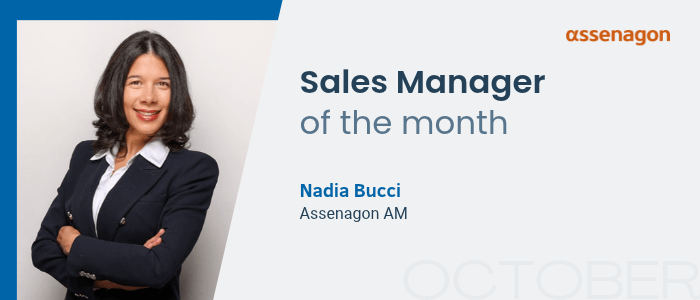
Nadia Bucci is Director, Institutional Sales – Southern Europe at Assenagon Asset Management, which she joined in May 2024. Based in Frankfurt, she helps institutional investors and financial advisors access tailored investment solutions across equities, fixed income and alternatives.
She previously spent almost a decade at Aegon Asset Management, first as Business Development Manager for Spain, Italy and Portugal and, from 2018, as Head of Italy, covering wholesale and institutional clients in Italy and Ticino. Earlier in her career, she held business development roles in London at Osmosis Investment Management and Acropolis Capital.
How did your career in finance begin? If you didn't work in finance, what do you think you'd be doing instead?
My career in finance began with a strong interest in financial markets and the way they influence businesses and the wider economy. I was particularly drawn to the combination of analytical thinking and relationship-building that finance offers.
If I hadn’t gone into finance, I could imagine myself working in the hotel industry, particularly in an international and client-facing role. I have always been attracted to environments where you work with people from different backgrounds, where service and relationships are important, and where no two days are exactly the same. In that sense, there are actually some interesting parallels between hospitality and institutional sales: understanding people, anticipating their needs and building long-term relationships.
Your career has taken you through Milan, London, Madrid, and Frankfurt. Was there a particular market moment or professional turning point along that path that shaped how you work today?
I started my career in Milan, then I moved to London, from London to Madrid and I am now based in Frankfurt. Looking back, I believe each city has contributed something different and added a different piece to my professional development.
However, I would say London was undoubtedly the most significant turning point and the experience that gave me the most. It was an international and competitive environment, and working there really pushed me outside of the comfort zone. I was exposed to different markets, different cultures and different ways of doing business and it made me much more adaptable and independent. Then, moving to Madrid, gave me a much more understanding of the clients. Being physically closer to clients then allowed me to deepen those relationships and develop an even stronger understanding of the local dynamics, which is particularly relevant to what I do today. And currently, being based at the heart of the German financial market while covering Southern European clients allows me to bring different perspectives and cultures, which I find very valuable in my role.
Is there a widely held assumption in institutional sales or fund distribution that you think deserves to be challenged?
I think there is sometimes an assumption that successful institutional sales is primarily about having the right product or being able to make the best pitch. I don’t think that’s the most important part.
The best salespeople understand that distribution is about solving a client’s problem. You need to understand what the investor is trying to achieve, where they have gaps in their portfolio and what matters to them internally. A strong product presented at the wrong time is not necessarily relevant. Equally, a product that genuinely solves a client’s problem can create a very long-term relationship. For me, credibility and relevance are much more important than simply being persuasive.
How has the way you build relationships with institutional clients in Southern Europe changed as data, digital tools, and faster information flows have reshaped the industry?
The amount and speed of information available to clients has changed dramatically. Investors can access data, performance information, research and market commentary almost instantly. That means the salesperson has to add more value than simply providing information.
The relationship has become more consultative. Clients expect you to understand what is happening in markets and to bring them something they may not have seen themselves. At the same time, digital tools have made communication much faster and more efficient. But I don’t think technology has replaced relationships. In institutional sales, particularly in Southern Europe, trust and personal interaction remain extremely important. Technology can help you communicate more efficiently, but it doesn’t replace credibility built over time.
What do you think Northern European asset managers most often get wrong when trying to break into the Southern market?
The biggest mistake is assuming that one European approach will work everywhere.
Southern European markets are sophisticated, but the way relationships are built can be different. There is often a greater emphasis on personal trust, continuity and understanding the local context.
A manager coming from Northern Europe can sometimes focus heavily on the product, the track record and the investment process without spending enough time understanding how the local investor makes decisions. The key is to adapt without losing your identity. You need to bring international expertise, but demonstrate that you understand the local market and are prepared to invest in relationships for the long term.
How do you balance commercial targets with maintaining long-term trust with clients?
I think the two are ultimately connected. You can achieve a short-term commercial objective by pushing something that isn’t right for a client, but that can damage the relationship for years. In institutional sales, your reputation is an asset.
I therefore try to think beyond the immediate transaction. If I believe something is genuinely relevant to a client, I will be proactive. If it isn’t, I would rather say so. That approach may occasionally mean sacrificing a short-term opportunity, but it creates something much more valuable: trust. And over a long career, trust is what drives sustainable commercial success.
How has the institutional sales role changed since you started, and where do you see it heading over the next five years?
When I started in institutional sales, the role was much more focused on relationships, product knowledge, and being the link between clients and the investment teams. Today, the role has become much more strategic: clients expect us not only to provide access to products, but also to bring insights, understand their evolving needs, and help them navigate increasingly complex markets and regulations.
Looking ahead over the next five years, I expect institutional sales to become even more consultative and technology-enabled. AI and data analytics will improve how we identify opportunities and understand client behaviour, while automation will take over many of the more transactional aspects of the role. At the same time, I believe trusted relationships will become even more important. The salespeople who can combine technology and data with strong market expertise and genuine client relationships will be the ones who add the most value.
What would you tell someone early in their career who wants to build a path into institutional sales?
I would suggest to focus on the credibility, before than titles. This is fundamentally a relationship business, so the most important aspect for me would be to understand the clients, the markets where they operate in, and the products they would represent.
Speaking the clients’ language can be a significant advantage, in particular communicating in their native language helps build trust, strengthens relationships, and allows us to understand their needs and concerns more deeply. Over time, I believe the combination of market knowledge, communication skills, language abilities, and trusted relationships becomes the biggest asset.