Poland and India aim to double trade by 2030 as Tusk pitches Poland as India’s gateway to Europe

9 NOV, 2026
By Joanna Piwko from RankiaPro Europe
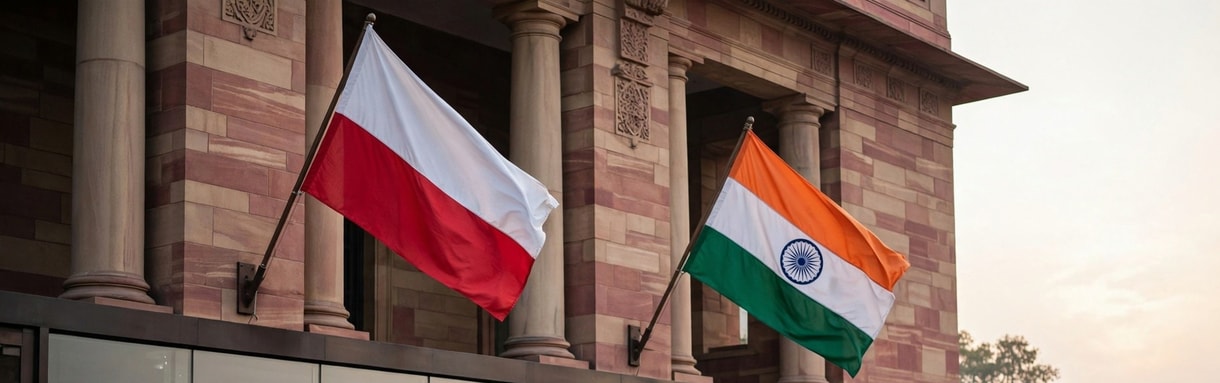


Poland and India have agreed to double bilateral trade by 2030 and make it more balanced, after Polish Prime Minister Donald Tusk met his Indian counterpart Narendra Modi in New Delhi on October 22, 2026. It was the first visit by a Polish prime minister to India in 16 years.
Tusk travelled with Finance Minister Andrzej Domański and executives from nearly 100 Polish companies – the largest business delegation in the history of Polish-Indian relations, according to his office. Modi said the trade goal "will certainly be achieved".
A trade relationship tilted towards India
Trade between the two countries totalled €5.68 billion in 2025, according to figures reported by Polish Radio. Poland exported €1.37 billion of goods to India, mainly machinery, mineral products and metals, while imports from India – led by textiles, machinery and metals – reached €4.31 billion.
| Poland–India trade, 2025 | Value |
|---|---|
| Polish exports to India | €1.37 billion |
| Polish imports from India | €4.31 billion |
| Total bilateral trade | €5.68 billion |
| Polish trade deficit | €2.94 billion |
Domański acknowledged the significant Polish trade deficit and described the current level of trade, just over $6 billion, as "far below our potential".
Poland as India's "gateway to Europe"
Speaking at a Polish-Indian business forum, Tusk said Poland wants to be a European hub for Indian companies, while India can open Asian markets to Polish firms. He pointed to Poland's industrial base, skilled workforce, access to the EU single market and position on major European transport routes.
The pitch is timed around the EU-India free trade agreement, expected to be signed in December. The deal is designed to remove or reduce tariffs on goods worth 96.6% of the value of EU exports to India. Domański called it a "milestone" and said he hoped it would take effect in the first half of 2027.
Tusk also cited Russia's war in Ukraine and fragile supply chains as reasons to diversify partnerships, stressing the need for both countries to reduce reliance on dominant suppliers of critical minerals and strategic technologies.
Defence, space and critical minerals lead the agenda
Modi said the strategic partnership agreed during his 2024 visit to Poland had accelerated cooperation, and he invited Polish companies to co-develop and co-produce in defence, space and energy. The leaders also discussed critical minerals, mining, coal gasification, shipbuilding and cybersecurity.
Other areas named by Tusk include artificial intelligence, digitisation, pharmaceuticals, agriculture and food. Modi announced an India-Poland Startup Bridge and technology hackathons for young people, and several agreements and memoranda of understanding were signed at the business forum, with space a key area.
On the second day of the visit, the delegation – including the Polish Space Agency (POLSA) – was scheduled to travel to Karnataka for a business seminar focused on ICT and aerospace.
Two fast-growing economies
The push comes as both economies outpace their peers. Poland's GDP is forecast to grow 3.5% this year, the second-fastest rate in the EU, and the economy is close to becoming the world's 20th largest. India's growth is forecast at around 7%. For the monetary backdrop in Warsaw, see our coverage of the National Bank of Poland's latest rate decision.
People-to-people links are growing too. Indians are now the third-largest group of foreign workers in Poland, at about 25,500, up almost 5% in a year. Tusk also announced that March 30, the anniversary of diplomatic relations, will be marked each year as Polish-Indian Friendship Day.
For investors, the visit signals that Poland intends to use the EU-India agreement to position itself as a manufacturing and logistics base for Indian companies entering Europe. Whether the trade goal is met will depend largely on how quickly the free trade agreement is ratified and on Polish exporters' ability to narrow the deficit.
The sectors singled out – defence, space, critical minerals and energy – are also those where both governments are most focused on supply chain security, which suggests cooperation is likely to be led by state-backed projects before broader private investment follows.