Biden steps down from Presidential Race: Managers react

23 JUL, 2024
By Jose Luis Palmer from RankiaPro Europe
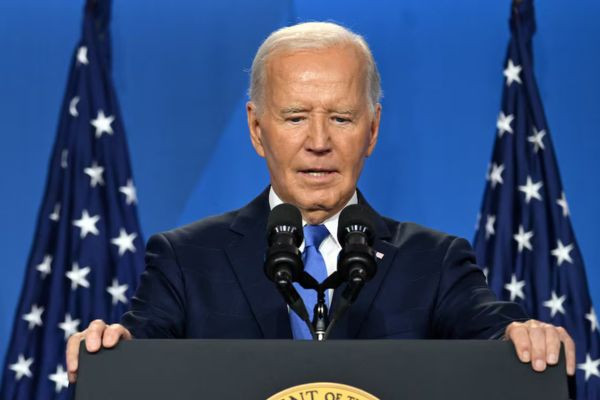


The news of the weekend was undoubtedly US President Joe Biden's decision to give up his bid for re-election in the November elections.
Last Sunday, US President Joe Biden announced in a letter his withdrawal from the election race and his support for Kamala Harris, the current US Vice President, as the Democratic candidate for the US presidency.
This news comes after endless internal pressure on Joe Biden to drop out of the presidential campaign. But, how will the shift in Democratic leadership affect the outcome of the election? How will it affect the markets? As we await confirmation of the Democratic presidential front-runner, in the midst of the election race, managers react to Joe Biden's decision.
Different names, same problems

Gilles Moëc, Chief Economist, AXA Investment Managers
The big news of the weekend was, obviously, Joe Biden's decision to withdraw his re-election bid and endorse Kamala Harris as the Democrats' candidate against Donald Trump. A party convention in August could be decisive. Many commentators have focused on Harris's status as a frontrunner beyond her vice presidential slot because of the ease with which financial contributions to the Biden-Harris ticket could be transferred to Harris's own presidential bid. Republicans, at least on Sunday, were already contesting the legal case for this. However, we note that, according to the New York Times, Biden's campaign apparatus has already switched to working for Kamala Harris (this was at least the gist of a joint message from the president and Biden's campaign manager). With Trump now the clear favourite in the polls, any strong rival to Harris in the Democratic Party might decide to ‘drop out’ of the race this year and concentrate on 2028. At the time of writing on Sunday night, two of the ‘natural alternative candidates’, Josh Shapiro, Governor of Pennsylvania, and Gavin Newsom, Governor of California, chose to explicitly endorse Harris.
With so little time to organise before the convention, we will probably know very quickly whether anyone with a chance of winning will formally throw their hat in the ring. Beyond the name of Biden's replacement, however, the key question for us is how different the economic platform of Trump's rival will be from that of Biden. With limited time to produce a new agenda and, in any case, a decent level of consensus across the Democratic Party on economic issues, we would not expect much change. We note that Kamala Harris herself and most of the ‘natural alternatives’ are closely associated with the Biden administration or the Democratic ‘mainstream’.
On international trade, any Democratic candidate would probably push a fairly strong ‘anti-China’ policy anyway. Biden did not repeal the special tariffs imposed by Trump and with public opinion harbouring negative feelings about China - Pew Center polls suggest that more than 80 per cent of US citizens have a negative view of the country - ‘rolling back’ the Chinese export machine has become uncontroversial in Washington. The key difference with Trump would remain the treatment of imports from other suppliers, which in the event of a Democratic victory in November would spare European exporters a smaller but still painful version of the trade war against Beijing.
Any Democratic candidate would likely maintain Biden's approach to industrial policy, with a continuation of the CHIPS Act and the IRA, with sustained support for the US transition to net zero. On taxation, much of the savings that any Democratic candidate would contemplate would come from allowing some of the tax cuts implemented by Trump in 2017 to expire, at least those that benefit the highest paid people the most. On immigration, any Democratic candidate would likely pledge to reduce inflows, but in any case, the impact on working-age population dynamics would be less than if Donald Trump's ‘tough agenda’ prevails. Of course, the situation remains fluid, but our thesis is that, even with Joe Biden out of the race, it is Donald Trump who would still present the agenda with the most tangible impact on markets, given its inflationary aspects (brutal immigration crackdown, across-the-board increases in customs tariffs, accommodative fiscal policy). In any case, the likelihood of any Democratic Party president also enjoying a majority in Congress is small, which would reduce his ability to steer the economy. The ‘Trump Trade’, which has recently propped up the dollar and put a floor on long-term interest rates despite expectations of rate cuts, is likely to remain ‘active’.
The presidential election continues to look like Trump's thing

Aaron Rock, Head of Nominal Rates at abrdn
Polls suggest there are enough voters who can overlook his polemics, buoyed by messages promising a stronger, more US-centric economy. The devastating events in Pennsylvania may have improved his electability, winning the sympathy of undecided voters.
On the other hand, the Democrats have yet to agree on a candidate who will not only unite their party but also appeal to increasingly wary swing voters, and accusations of slow and out-of-touch leadership have not helped.
It makes sense to us that the market has rushed to reduce premia by flattening the yield curve. In the short term, the prospect of President Trump facing credible competition will ease growing market concerns about the possibility of a landslide GOP victory. A more balanced election race should temper fears of an inflationary second Trump term focused on tariffs and major tax cuts. This has rightly taken some of the stress off the US yield curve, especially at the long end.
It seems that this year's presidential race could return to a more traditional debate, focused on policy rather than fitness for office. We are not convinced. For a start, Trump is likely to be turned on his head again and face his own accusations of being too old for the presidency. In any case, a somewhat less confident Trump could increase the intensity of his campaign, with controversial headlines and inevitable attacks on his character. Add to this the recent softening of inflation and labour market data, implying interest rate cuts before November. One thing seems certain, market volatility will remain high.
Biden's withdrawal could benefit European markets

Michaël Nizard, CIO Multi Asset & Overlay at Edmond de Rothschild
Biden's withdrawal is not a big surprise for markets. That said, the announcement of his withdrawal from the presidential race makes Trump's victory less certain and will further animate this pre-election period. As a sign of the growing anticipation around Biden's exit, it is worth noting that the probability of a Trump victory had already started to decline since 15 July, falling from an all-time high of 66% to 58% last Friday, in favour of Kamala Harris. The probability of a Trump victory could continue to slide following the reshuffling of the Democratic ticket, but is still expected to remain at a high level given the strong momentum of the Trump-Vance campaign.
From the markets' point of view, this rather rare political event - last seen in 1968 when President Johnson stepped down - adds some volatility, precisely when the economic situation shows signs of stagnation, while quarterly earnings announcements also show some signs of weakness, particularly in the consumer sector. On the other hand, this could reduce ‘Trump Trade’ flows related to measures perceived as reflationary, such as the 10% increase in universal tariffs, the 60% tax on Chinese goods, the reduction in the corporate tax rate, measures against immigration flows and regulatory changes. However, it turns out that Trump-related repositioning flows have not yet been massive, and maintaining a high probability for the Republican camp could retain some appeal for the ‘Trump Trade’.
In the short term, in relation to Biden's withdrawal, it would not be surprising to see a slight recovery of European risk assets compared to the US after several weeks of clear underperformance. Indeed, several econometric studies show significant impacts on European growth, around 1%, in case of a resurgence of strong trade tensions related to Trump 2.0. As for the ongoing sector rotation, we believe it may continue, and the recent underperformance of the technology sector will depend more on the upcoming earnings season than on the domestic political situation. As for the dollar, the Republican candidate has been quite supportive of a depreciation of the greenback in the primary interest of US manufacturers. We explain the dollar's fall in July more as a response to the easing of US rates and the imminence of the Fed's first rate cut in September. We therefore believe that the dollar will stabilise pending further data. In the longer term, the widening of US deficits will raise the question of the sustainability of their financing and the valuation of the dollar.
Attention turns to Kamala Harris' running mate

George Brown, Senior US Economist at Schroders
After weeks of speculation, President Biden announced over the weekend that he was withdrawing from this year's presidential race and endorsing Vice President Kamala Harris as the Democratic candidate. Although she has not yet been confirmed as the official nominee, the odds are in her favour and she seems the most likely candidate according to the betting odds.
Attention now turns to the possible running mate of Kamala Harris. The most likely candidates include the governors of the most closely contested states. Meanwhile, the Democrats' chances of retaining the White House have improved slightly, especially as Harris has a blank sheet of paper to change the narrative around the election.
Regarding market reaction, we have seen yield curves steepen in recent weeks as expectations of a Trump victory have risen. This was because a Republican landslide victory would allow Trump a freer hand on fiscal stimulus. In contrast, a Democratic president would face a divided government. It is therefore possible that the recent steepening of yield curves could be reversed if Harris, or another Democratic candidate, narrows the gap in the polls.
Nonetheless, Donald Trump still looks the most likely winner. The recent assassination attempt has given his campaign considerable momentum that could carry him through to the November election.
A second Trump administration would be more inflationary

Michael Strobaek, Global CIO at Lombard Odier
President Joe Biden's decision to withdraw from the race for the White House shakes up the odds for the November elections. It also shifts the focus of the presidential race to Kamala Harris and changes the US electoral dynamic once again.
A second Trump administration would likely be more inflationary, leading to a possible rise in the dollar, a rise in long-term bond yields and a steepening of the US yield curve.
Challenges to the global political order underline the importance of a strategic asset allocation framework that generates the bulk of portfolio returns.
Solid investment guidelines can help navigate volatile markets. An active approach can mitigate the risks of wealth loss and add value to the portfolio.