The impact of Trump “liberation day” tariffs on Emerging Markets Debt

9 APR, 2025



Author: Sorin Pirău and Thomas Haugaard, Portfolio managers of Janus Henderson
Targeting the “worst 60”
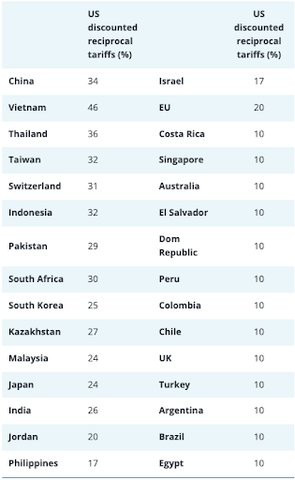
In a significant development on “liberation day”, new tariffs were introduced that surpassed initial expectations. Effective from 5th April, a baseline universal tariff of 10% has been set, with additional targeted “reciprocal” tariffs on the “worst 60” trading partners coming into effect on 9th April. These tariffs, ranging from 10-50%, primarily aim to drive down the US trade deficits with each country. This layered tariff structure has brought the average tariff rate to around 22-23%, as seen in the 1890s.
Figure 1: Reciprocal tariff on top 30 trading partners
An uneven impact across EMs
Such measures underscore the advantages of diversifying investments through the Emerging Market Debt (EMD HC) asset class. Comprised of 69 countries, this asset class offers a broad spectrum of opportunities, mitigating the risks of concentrated impacts from such tariffs. As the diverse country composition allows for smaller individual exposures, it enhances the overall resilience of investment portfolios against market volatility.
In Figure 2 below, other than Costa Rica and Malaysia, no country in the JP Morgan EMBI Global Diversified Index currently exports more than 10% of their GDP to the US, with most exporting much less.
Figure 2: Country export versus US reciprocal tariff
Country exports to US as a percentage of GDP versus US tariff rate
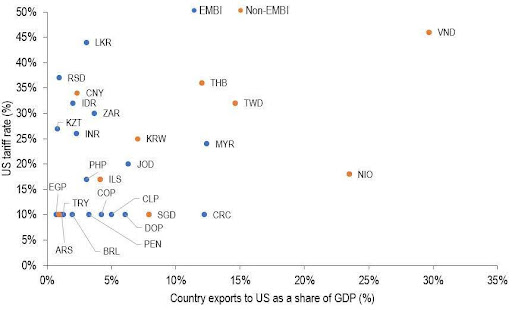
Horizontal axis: Country exports to US (12m rolling sum, US$bn) as a share of national GDP (4Q rolling sum, US$bn); %; Vertical axis: US discounted reciprocal tariff rate announced by President Trump on 2 April; %. Countries are represented by their currency. LKR: Sri Lanka Rupee; RSD: Serbian Dinar; CNY: Chinese Yuan; IDR: Indonesian Rupiah; ZAR: South African Rand; KZT: Kazakhstani Tenge; INR: Indian Rupee; KRW: South Korean Won; MYR: Malaysian Tinggit; VND: Vietnamese Dong; THB: Thai Baht; TWD: New Taiwan Dollar; NIO: Nicaraguan Córdoba; JOD: Jordanian Dinar; PHP: Philippine Peso; ILS: Israeli New Shekel; EGP: Egyptian Pound; TRY: Turkish Lira; COP: Colombian Peso; CLP: Chilean Peso; CRC: Costa Rican Colón; SGD: Singapore Dollar; DOP: Dominican Peso; BRL: Brazilian Real; PEN: Peruvian Nuevo Sol; ARS: Argentine Peso.
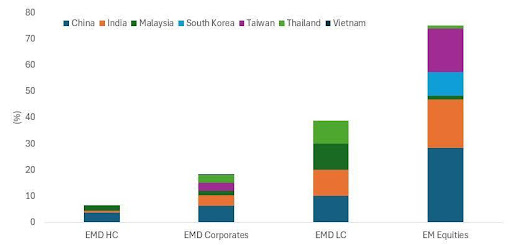
Of the hardest hit EM countries, Vietnam, Thailand, Taiwan, China, and South Korea, play a larger role in the equity and local currency (LC) debt of EMs and frontier markets than in the hard currency benchmark (Figure 3).
Figure 3: Key country exposures in EM and frontier markets debt and equity indices
Exposure of different EM indices to tariffs by country
While the direct tariff impact seems less severe for EMD HC, what is of more concern are secondary effects such as changes in risk sentiment, falling commodity prices, and a Chinese economic slowdown. These factors influence EMD credit spreads, given the primary driver of sovereign spreads is volatility and risk sentiment. Although we have seen some relief with the weakening of the US dollar, spreads could face widening pressure in the near term. However, we expect underlying US Treasury yields to act as a buffer to such sovereign spread moves, as evidenced when the tariffs were announced, helping to mitigate the impact on returns.
Monitoring the evolving economic landscape and adjusting investment strategies as necessary to balance opportunity and risk will be crucial in navigating these changes effectively. As we continue to monitor these developments, the benefit of investing in EMD HC remains where the diversity and country diversification of the asset class provides better resilience than one might expect.