Robeco: the sustainability ranking by country

2 JUL, 2024
By Robeco



AUTHOR: Peter van der Werf, Head of Engagement, Robeco
The Sustainability Ranking by country analyzes the performance of 150 nations, and is updated every six months, based on environmental, social and governance indicators that can have an impact on economic growth and development.
These country scores represent a rich source of data and insights for investors who wish to thoroughly evaluate the risks and opportunities associated with government bonds.
The top 10
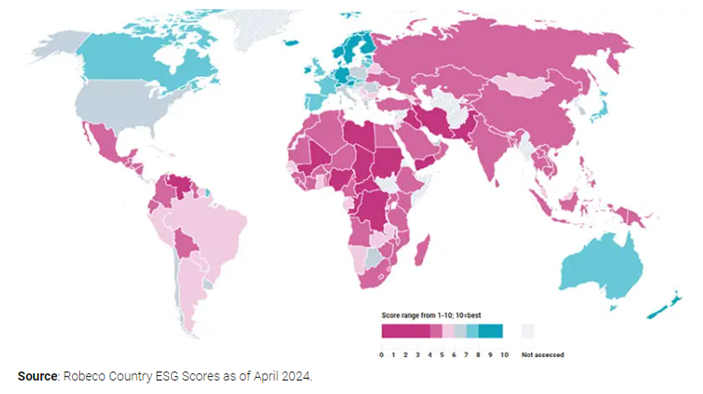
In the latest ranking, Nordic countries continue to compete for a primacy that depends on thousandths of decimal difference. This time the decimals favored Finland (9.04), which maintained the first place, while Norway (9.03) slightly surpassed Sweden (9.029) to conquer the second position.
The scores of the Ocean Health Index have slightly worsened for both Sweden and Finland, lowering their environmental performance compared to Norway, whose score remained stable. On the social front, the trio has seen an increase in income inequality in recent years, while gender equality has progressed.
The increase in renewable energies and the reduction of greenhouse gas emission intensities have been decisive in defining the rest of the top ten. New Zealand has returned to the top after a brief exit at the end of 2023, while Iceland, always in the top ten, unexpectedly dropped out due to a significant drop in climate and energy criteria.
Figure 1 - Global overview of ESG scores
The ranking
Zambia and Mongolia are the countries that have gained the most, with a leap of 15 and 16 positions respectively. Zambia's performance has improved across the board thanks to a greater spread of renewable energies, improved economic equality, and strengthened political stability. Other Sub-Saharan African countries have also improved their scores, including Liberia (+0.24), Uganda (+0.13), Burkina Faso (+0.15), Eswatini (formerly Swaziland; +0.18) and Burundi (+0.11).
On the contrary, Hong Kong (-0.36), Malaysia (-0.22), Mexico (-0.23) and China (-0.19) have dropped several positions. At the bottom of the ranking are Yemen, Libya and Iraq, which continue to score poorly in all ESG evaluations.
The scores of the world's major sovereign debt issuers have remained virtually unchanged. Japan (22nd place) has slightly improved its overall score (+0.02), while the United States (41st place) has slightly decreased (-0.09).
Mexico: rosy prospects, latent risks
Mexico is a classic case of the value of ESG scores in signaling potential risks when everything else appears rosy. Mexico can boast a well-diversified economy with onshore and offshore oil fields, a thriving agricultural sector, and an expanding manufacturing base. In addition, its proximity and good relations with the United States make it a privileged destination for nearshoring initiatives by companies eager to reduce supply chain problems by moving away from China and other emerging Asian countries and closer to final markets. If fully realized, nearshoring could increase Mexico's GDP by almost 3%.[1]
But the country's decade-long ESG score decline should give investors pause. Rampant organized crime, systemic corruption of public bodies, and the ineffectiveness of law enforcement have heavily weighed on social and governance performance. Moreover, the increasing scarcity of water, pollution, deforestation, and exploitation of natural resources are reducing environmental scores and fueling tensions in local communities already afflicted by poverty, unemployment, and limited access to education and healthcare.
Mexico must strengthen internal governance and social cohesion to increase investor confidence and fully exploit long-term nearshoring opportunities.
Portugal and renewable energy
While Mexico seeks to profit from the whole context, Portugal uses wind farms to build a solid economic future. Thanks to prudent fiscal management, the country has reduced public spending, but has managed to prioritize investments in renewable energy. The push for renewable energy has already generated jobs and economic growth, much needed, in the construction, manufacturing, installation, and maintenance of infrastructure, in a vibrant and new generation sector. In perspective, this is helping to build future economic resilience by reducing Portugal's dependence on energy imports and increasing control over energy prices for citizens and industries.
Gender equality enhances economic potential
Treating women and girls fairly is not only morally right, but also economically advantageous. The persistence of gender gaps reflects an environment where human capital is underdeveloped, underemployed, and less productive. It is therefore not surprising that countries with a better gender balance also tend to have higher income and brighter prospects.
Ethiopia and Rwanda are exemplary of the economic power of gender equality strengthening policies. Over the past two decades, substantial increases in gross national income (GNI) per capita have gone hand in hand with substantial improvements in the Gender Inequality Index (GII) scores of both countries.
[1] Deloitte, Nearshoring in Mexico. July 2023.