The great growth–value shuffle: why investors may need to think beyond style labels

8 JUL, 2026
By Rob Hinchliffe from PineBridge



For years, investors have been encouraged to choose a side in one of the market's oldest debates: growth or value. Yet recent market cycles have shown how quickly leadership can shift.
After a decade dominated by growth stocks, rising inflation and higher interest rates in 2022 sparked a rotation into value. Then, the AI-driven rally of 2023 and 2024 helped growth regain the upper hand, while easing inflation and resilient economic growth supported broader equity markets. Beneath the headlines, however, the distinction between growth and value has become increasingly blurred, with many companies moving between the two categories as market conditions evolve.
This constant back-and-forth highlights what we call the "growth and value shuffle" – the reality that many companies do not fit neatly into a single style box. In fact, some of the world's most recognisable businesses have appeared in both growth and value indices at different times, depending on changing market conditions, earnings expectations and index methodologies. Even sectors traditionally associated with value, such as energy, have at times been classified as growth, while leading technology names have appeared in value benchmarks.
For investors, this creates a challenge. If companies are constantly evolving, can a purely style-driven approach consistently identify future winners?
We believe focusing exclusively on style may miss the bigger picture. Rather than viewing growth and value as fixed categories, we see them as characteristics that exist within every company to varying degrees and at different stages of development. The key is understanding where a business is in its lifecycle and how its future prospects compare with current market expectations.
That philosophy sits behind PineBridge's proprietary Lifecycle Categorization Research (LCR) framework. Instead of dividing the market into growth and value camps, the framework categorises companies according to their maturity and cyclicality, helping analysts assess them using valuation approaches tailored to their specific stage of development.
Lifecycle Categories
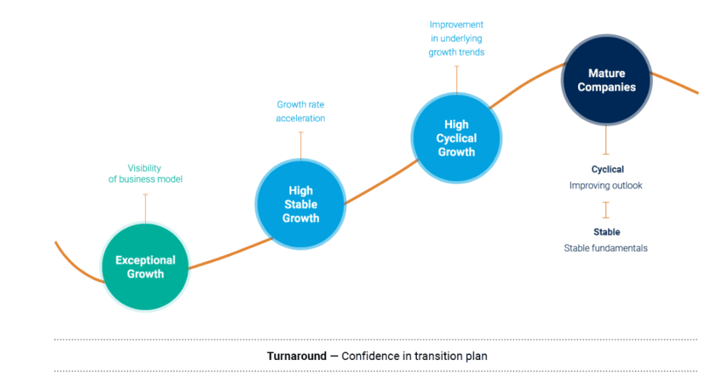
The framework illustrates how companies evolve over time, moving through different phases of growth, stability and cyclicality. By understanding these transitions, investors can potentially identify businesses whose future earnings power is not yet fully reflected in share prices.
This approach also helps avoid the need to make large, top-down calls on whether growth or value will outperform next. Instead, the focus shifts to finding businesses capable of exceeding market expectations regardless of which style happens to be in favour.
In an environment where inflation, interest rates and innovation continue to reshape markets, investors seeking more sustained alpha may benefit from looking beyond style labels and recognising a simple truth: the most compelling opportunities are often found in the space between the two.
To find out more about PineBridge’s Lifecycle Research, visit pinebridge.com
DISCLOSURE
Investing involves risk, including possible loss of principal. This is marketing material. The information presented herein is for illustrative purposes only and should not be considered reflective of any particular security, strategy, or investment product. This material does not constitute investment, financial, legal, tax, or other advice; investment research or a product of any research department; an offer to sell, or the solicitation of an offer to purchase any security or interest in a fund; or a recommendation for any investment product or strategy. PineBridge Investments is not soliciting or recommending any action based on information in this document. You are solely responsible for deciding whether any investment product or strategy is appropriate for you based upon your investment goals, financial situation and tolerance for risk.