Anaïs Gfeller from Lombard Odier Group is our Fund Selector of the Month

22 JUL, 2026
By Joanna Piwko from RankiaPro Europe


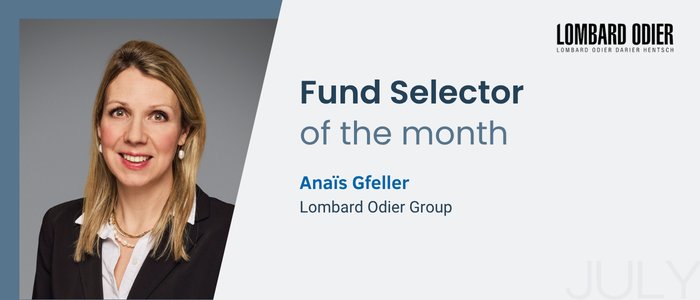
Anaïs Gfeller is Head of Equity Fund Selection at Lombard Odier Group, where she leads equity fund selection after previously serving as Senior Equity Fund Analyst. She brings more than 20 years of investment industry experience, having held senior investment research roles at Allfunds Bank and Lombard Odier across Geneva and London. A CFA Charterholder with a Certificate in ESG Investing, Anais combines deep expertise in equity fund analysis with a strong focus on manager selection and sustainable investing. She holds master's degrees in International Relations from the Geneva Graduate Institute and in Anthropology & Development from the London School of Economics.
If I weren’t working in finance, I would…? Have you ever considered other career paths? What made asset management the one that stood out for you?
…I think I would have loved a career in foreign affairs or diplomacy. I have always been fascinated by international relations, different cultures, and politics. Asset management stood out as it combines intellectual challenge with a truly global perspective. It is an industry that rewards hard work, perseverance, and ambition, while giving you the opportunity to meet incredibly smart people from all over the world and from very diverse backgrounds.
How has the industry changed since you first started?
The industry has become far more institutionalised since I started. In the early days, onsite due diligence was often necessary simply to verify that a firm and its operations were as presented. Today, processes, governance frameworks, and risk management systems are significantly more robust.
We have also seen the gradual decline of the ‘star manager’ model in long-only investing, with greater emphasis on team-based decision-making, co-PM structures, and succession planning to ensure greater stability and continuity.
How do you navigate all the market noise and the constantly changing environment?
From a fund selection perspective, there is no need to react to every piece of market noise. Our investment horizon is typically slightly longer and we are not replacing managers after just a few weeks underperformance.
What matters is whether our managers can distinguish between short-term noise and genuine changes in the investment environment. We expect them to be aware of new trends, structural shifts, and evolving market dynamics, while avoiding the temptation to react to every headline.
At the same time, patience should not become complacency. While we want managers to remain true to their process, we also need to challenge whether their edge remains relevant and whether they are adapting appropriately to changing conditions. The key is finding managers who balance conviction with the ability to evolve when the facts change.
Looking at Europe today, which trends do you think are still being overlooked, and which ones are perhaps getting too much attention?
I think one of the most overlooked trends in Europe is the push towards strategic autonomy, whether in defence, energy, infrastructure, or technology. This is creating investment opportunities that may not yet be fully appreciated by the market. At the same time, I think too much attention is sometimes paid to the narrative that Europe is structurally uninvestable because of its growth challenges. While those challenges are real, Europe remains home to many world-class companies with strong global competitive positions. From a fund selection perspective, the key is identifying managers who can look beyond the headline narrative and focus on where the underlying opportunities are."
What major trends or structural changes do you think will shape global markets over the next 5–10 years?
From a fund selection perspective, I think the next 5–10 years will be characterized by a more dispersed market environment – with higher capital costs, geopolitical uncertainty, and technological disruption, I expect a wider gap between winners and losers.
This should create a more favorable environment for active managers as security selection and fundamental research will remain very important. The challenge for fund selectors will be identifying managers who can consistently exploit these opportunities while maintaining a repeatable investment process.
Historically, we have often valued managers who stay very disciplined within a clearly defined style and avoid style drift. I still believe process consistency is critical. However, in a faster-changing and more disruptive environment, we may need to be somewhat more open to managers who can adapt and evolve within the framework of their process. The objective is not for managers to abandon their philosophy or chase benchmarks, but rather to demonstrate enough flexibility and nimbleness to respond to structural changes and avoid becoming anchored to a market regime that no longer exists.
How much of your fund selection is driven by quantitative metrics versus qualitative judgment and intuition?
Quantitative metrics play a critical role in our fund selection process, particularly at the start of a search. They help us narrow the universe and identify managers who warrant deeper analysis. In many cases, quantitative measures can be a deal breaker.
Once a shortlist has been established, however, the emphasis shifts increasingly towards qualitative assessment. We all know that historical performance is a relatively poor predictor of future returns. What matters more is understanding what drove those results and whether the manager's edge is likely to be sustainable.
Intuition also plays a role, although it is difficult to formally incorporate into a due diligence framework. After meeting hundreds of managers, one develops a sense for qualities such as intellectual honesty, self-awareness, conviction, adaptability and culture. It is not something I would ever rely on in isolation, but I do believe it influences decision-making more than we sometimes acknowledge.
The best outcomes typically come from combining robust data analysis with experienced qualitative assessment and informed intuition.
What advice would you give to young professionals starting out in asset management today?
My advice would be to work hard, get your qualifications, and build strong analytical skills. But I would equally encourage young professionals to invest time in building their network and developing genuine relationships. Over time, your reputation, the people you learn from, and the friendships you build can be just as important as your technical expertise in shaping a successful career in asset management.
What do you like to do outside of work to disconnect and step away from the constant flow of market information?
Sport and particularly swimming is great way to clear my mind. And spending time my – still young – children.