Fabien Villeneuve from Unofi is our Fund Selector of the Month

2 SEPT, 2026
By Joanna Piwko from RankiaPro Europe


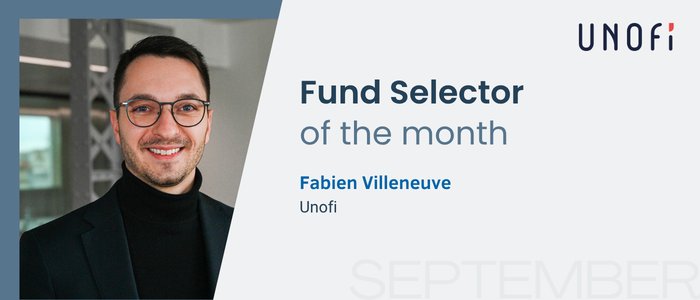
Fabien Villeneuve is a Portfolio Manager specialising in asset allocation and multi-asset fund selection. At Unofi, he manages five funds with approximately €600 million in assets under management, with full decision-making responsibility for allocation, fund selection and portfolio management. He previously spent nearly five years at Eres, managing multi-asset funds and dedicated portfolios. Villeneuve holds a Master’s degree in Asset Management from IAE Caen, as well as a Master’s degree in Asset Management (PRAM) from AFG Formation.
Tell us about your career. If you could revisit the first year of your career, what advice would you give your younger self?
I began my career at Eres Gestion, a leading specialist in employee savings and retirement plans, working within the multi-management team. Joining a fast-growing company was a fantastic opportunity. It allowed me to learn a tremendous amount and quickly take on significant responsibilities.
I then joined UNOFI, which designs financial solutions for the clients of French notaries. Today, I am in charge of asset allocation and fund selection. I manage €600 million in assets under management (AUM) across five funds: four multi-management funds and one equities fund managed directly.
If I could go back to my first year and give some advice to my younger self starting out at Eres, it would be : Learn to be comfortable in the fog, but always keep your compass.
In school, we are taught perfect theoretical models where every problem has a scientific solution. The reality of the markets is entirely different: it is an environment of absolute uncertainty, where geopolitical and macroeconomic variables are constantly shifting. Being comfortable in the fog means stepping outside your comfort zone, refusing to panic when visibility is zero, and knowing how to adapt your tactics.
Was there a mentor, colleague, or investment leader who significantly influenced your approach to asset management? In what way?
Rather than relying on a single mentor, I draw inspiration from major investment leaders to fuel my daily thinking. I am particularly drawn to the contrarian style; knowing when to step away from the consensus when fundamentals require it.
On one hand, I lean on the principles and writings of global figures like Warren Buffett, Howard Marks, Stanley Druckenmiller, and Ray Dalio, particularly for their discipline in risk management, their understanding of major macroeconomic cycles, and their flexibility facing uncertainty. On the other hand, to decipher market psychology and anticipate trend reversals, I closely follow the work of professionals who analyze economic cycles, such as Frédéric Leroux or Julien Nebenzahl.
Combining these different frameworks helps me step back, keep a cool head during herd-like market behavior, and better decode market regimes.
Which market development over the past few years has most changed the way you build portfolios?
The market development that has most significantly changed my approach to portfolio construction in recent years is the structural rise in volatility and the speed of market movements.
Geopolitical and macroeconomic shocks have become more frequent, and markets react to them instantly and often violently. In this environment, building a portfolio that relies exclusively on traditional active mutual funds sometimes shows its limits, particularly due to execution delays (subscriptions/redemptions) that lack the responsiveness required for very short tactical windows.
To adapt, I evolved my process by integrating a much more tactical and liquid management sleeve using Futures and ETFs. They allow me to move much faster when adjusting the overall exposure of the portfolios.
How do you distinguish between a temporary market trend and a lasting structural shift?
This is undoubtedly one of the most difficult exercises in our profession, because the market constantly generates a vast number of temporary trends and false signals. Faced with this daily noise, the key is knowing how to step back to avoid reacting emotionally.
Personally, I force myself to objectively analyze the different data sets available to us. I look at what is truly fueling the movement: is it simply short-term capital flows and market hype, or is the shift backed by deep macroeconomic and regulatory fundamentals?
This approach requires a great deal of humility, as you have to accept that you won't always be proven right immediately.
How much of your fund selection is driven by quantitative metrics versus qualitative judgment and intuition?
It is a 50/50 balance, because numbers and human judgment are inseparable.
The quantitative side is my technical foundation. Data and modern tools are essential to objectively screen the universe, analyze risks, and validate a fund's track record.
The qualitative side comes down to judgment and experience. Financial data only looks at the past and is readily available to everyone today. Data provides the rigor, but qualitative judgment builds the conviction
Which performance indicators or financial metrics do you trust most when evaluating a fund’s potential?
I analyze the fund's performance relative to its peers and the market. I map out how the manager behaves across different market regimes to identify the exact conditions where they excel, as well as the challenging environments where they tend to underperform.
I look closely at risk metrics like Maximum Drawdown and the Sortino ratio. This shows me exactly how the portfolio cushions shocks, handles downside risk, and recovers after a crisis.
I rely heavily on Capture Ratios (Upside / Downside). The goal is to identify asymmetric managers who can capture most of the market gains while significantly softening the losses.
What aspect of your job still excites you after all these years?
It’s pure curiosity. It is incredibly stimulating to experience new chapters every single year; in this line of work, there is always something to learn, fresh developments to grasp, and unexpected twists to analyze. This non-stop renewal is what keeps this job truly exciting every single day.
What skill do you believe future fund selectors will need that previous generations didn't?
Simply knowing how to use AI. It is a major technological shift that absolutely did not exist for previous generations.
Today, AI is radically changing how we collect data, scan markets, and screen funds. Future selectors must master these tools to automate the quantitative heavy lifting, allowing them to focus on where the real added value lies : deep analysis and human judgment
How do you disconnect from markets and recharge after demanding periods?
To be completely honest, I never truly disconnect. It’s a passion-driven industry and the markets never really stop, so cutting the cord entirely is difficult.
However, what works best for me after demanding periods is traveling. Going abroad, exploring new places, and completely changing my environment is my way of clearing my head, gaining fresh perspective, and recharging my batteries so I can come back sharp.