Spyros Agrianitis from Alpha Bank is our Fund Selector of the Month

19 AUG, 2026
By Joanna Piwko from RankiaPro Europe


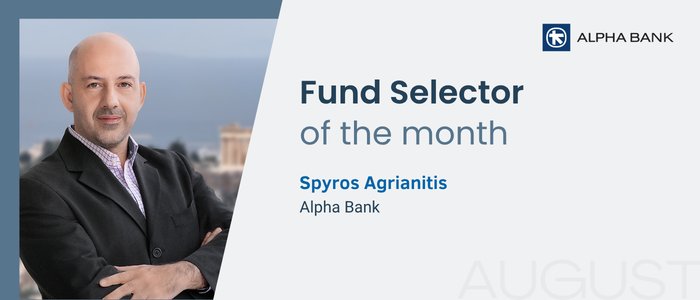
Spyros Agrianitis is the head of Investment Products at Alpha Bank where he started in 2006 and has 25 years of investment experience. Since then he has been developing the growth of third party collaborations and assets. The Funds Advisory and Distribution team is currently managing €6 billlion of AUM and is composed of three members. It is part of the Investment Portfolios Management Division of Alpha Bank. The team is responsible for the 360 advice, support, and distribution infrastructure of funds as well as 3rd Party Relations. Fund selection is only a part of the full funds advice ecosystem process that the team manages. Spyros holds an MBA degree from the University of Huddersfield, UK and several investment accreditations.
Looking back at your career in asset management, how did it start and what were the most important turning points that shaped your investment philosophy?
My early career started as a Group Life Representative at Generali, which gave me the opportunity to access and present to mid-sized and large companies, while also exposing me to top management and diverse corporate cultures. I then moved to Intertrust, which was the largest independent asset manager in Greece at the time, as an Area Manager. The exposure to sales and to different regions of Greece has always been — and still is — a major asset in my career. After all, our fund recommendations ultimately reach the sales networks and, eventually, the clients.
Following this initial phase, the rest of my career has been focused on fund selection, third-party collaborations, and expanding assets under management. These turning points gave me a clearer understanding of the reality of fund selection: it is not just about selecting funds — that could be the role of a Fund of Funds manager. It is about creating, maintaining, and expanding an effective 360-degree ecosystem for the distribution of investment recommendations.
How has your approach to portfolio construction changed over the last decade, especially with rising macro and geopolitical uncertainty?
It has changed significantly. In early 2021, my team and I presented a fund strategy outlook to our distribution networks titled “The World Has Changed.” The core principles of that presentation still hold true today and, in my view, will continue to do so for a long time.
I strongly disagree with the idea of isolated “geopolitical episodes.” Since the start of the war in Ukraine, we have entered a prolonged period of geopolitical tension that is unlikely to settle anytime soon, as superpowers reposition themselves and new geopolitical players emerge. The individual episodes are simply unavoidable events within that broader environment. As a result, investors must incorporate this reality into their strategies and ultimately into their product mix. Diversification, hedges, a focus on quality, and a broader number of products within portfolios — as opposed to the more concentrated pre-2020 approaches — are some of the answers to this new era.
In your view, what are investors most consistently getting wrong in today’s markets?
I would say it is the limited diversification within portfolios. Clients often prefer to see only a few products that they can easily “track,” but this restricts the ability to capitalize on the opportunities and strategies I mentioned earlier. It also exposes investors to risks related to the high concentration currently observed in some indices. Yes, certain indices — particularly equities — have been forgiving, but one cannot rely almost exclusively on a single investment theme. Artificial Intelligence certainly has an important role to play, and not a small one, but not every participant in the space will ultimately prove to be a winner.
How do you balance conviction with flexibility when markets move against your base case?
There is one rule that my team never breaks: “Judge the offering each and every time as if you were building it fresh from scratch today.”
Of course, this does not imply high turnover in our recommendations. We tend to remain committed to our convictions unless something materially changes. Again, the answer lies not in individual product selections alone, but in the combination of strategies, the correct weighting of each product within portfolios, and the necessary diversification. If we believe a strategy is worth holding through a storm, we will fully support it. If, however, we believe it has become irrelevant, we do not hesitate to switch — and we fully support that switch as well.
How do you avoid information overload in an environment where markets react to news almost instantly?
That is one of the biggest challenges. Take the recent war involving Iran, for example. Investors should avoid reacting emotionally to the constant escalation and de-escalation tactics between the parties. Such developments may be useful for traders, but not necessarily for long-term investors. One has to focus clearly on the bigger picture: are the fundamental demands of both sides being met? If not, then the tension continues — even through temporary pauses. This is what we have witnessed so far. A truly “believable” agreement is one that satisfies the fundamental demands of both sides to some extent. Until then, much of the surrounding noise remains just that — noise.
What trends or structural shifts do you think will define the next 5–10 years in global markets?
Artificial Intelligence itself will be a major catalyst for both our industry and the markets overall. We are living through a period of high uncertainty, but also one filled with opportunities. The key question is how effectively we incorporate these new paradigms. Private markets are also reshaping the way we perceive investments and their connection to the real economy. Geopolitics, meanwhile, will continue to shape global markets in profound ways. If one thinks about it carefully, what today is not geopolitical — or at least strongly linked to geopolitics? The rivalry surrounding AI, energy tensions, inflation, trade wars — all are interconnected. Another important factor to consider is the structural shift in investment products and investor access to markets. One interesting example is that ETFs available in the US market already outnumber tradeable stocks. Consolidation within the industry may therefore become a significant trend over the next 5–10 years.
You’re based in Greece. What interesting developments are currently shaping the local market, and what are some common misconceptions investors still have about it?
Greece’s economy continues its remarkable recovery, attracting strong investor interest. The Greek stock market and government bonds have delivered stellar performances, gradually shedding the negative perceptions associated with the past crisis period. The market is now being driven by stronger fundamentals and important institutional upgrades. High-profile transformative projects — such as the €8 billion The Ellinikon smart city development — symbolize this transition, converting the former Athens airport into a major hub for sustainable development, luxury real estate, and foreign investment. At the same time, the banking sector has successfully reduced its legacy non-performing loans and has emerged as a well-capitalized pillar of economic growth. Combined with fiscal discipline, this progress has earned Greece consecutive credit rating upgrades, strengthening its position as an increasingly attractive European investment destination.
What sectors in Greece do you currently see as most attractive from a long-term investment perspective, and why?
Greece’s long-term investment landscape is primarily driven by Renewable Energy, Technology, Logistics, and Luxury Real Estate. With abundant wind and solar resources, the country is rapidly transforming into Southeast Europe’s leading green energy hub, attracting substantial international capital into grid connectivity and energy storage projects. At the same time, rapid public and private sector digitalization has triggered a significant technology boom, with global multinational companies investing heavily in local data centers and cloud infrastructure. Geographically positioned at the crossroads of three continents, Greece is also benefiting from global supply chain realignments and the expansion of modern logistics networks. Finally, the hospitality sector is gradually shifting away from mass seasonal tourism toward premium, year-round eco-luxury developments and large-scale urban regeneration projects. Driven by structural reforms and supported by substantial EU Recovery and Resilience Facility (RRF) funding, these sectors offer institutional investors stable yields, premium capital appreciation potential, and a resilient framework for long-term growth.
What do you like to do outside of work to disconnect and step away from the constant flow of market information?
I have always had a passion for photography, as well as for the sea — especially underwater exploration and freediving. Recently, I combined both passions, and today I shoot almost exclusively underwater. When you are breath-holding underwater, you have no choice but to clear your mind. It creates an immediate shift from tension to peace within the blue environment around you. My greatest teacher, however, has been archery — in more ways than one, with focus being the most obvious. I compete in the Greek championship and, so far, I have won 4 gold, 2 silver, and 3 bronze medals.